-
Tips for a Happy Military Marriage (Military.com)
What if we make marriage a lot harder than it needs to be? What if I told you there are a few tips for a happy marriage you can follow to easily bring intimacy and closeness back to your relationship?
The good news is that most couples do not need an overhaul of their relationship, they just need to be reminded that it’s going to be OK. The military lifestyle throws a lot of curveballs, and it can make anyone feel like the relationship is on shaky ground, even if it isn’t.
It is completely normal for intimacy with your spouse to ebb and flow. It can be days before you get an evening together when your service member is training. Some schedules have you feeling like you are ships passing in the night, literally. Even reintegration after a military separation or deploymentcan leave your military marriage feeling disconnected.
For many couples, anxiety runs high wondering if they will ever feel close again. I know this sounds strange coming from a counselor, but sometimes reconnecting doesn’t have to include massive processing or rehashing the relationship.
Even if your relationship is struggling with bigger issues, here are a few tips for a happy marriage that are not only amazingly simple but effective to “get there” quickly.
Tips for a Happy Marriage: Daily Check-ins
When one or both spouses feel insecure, it is easy to go overboard on communication, especially when you haven’t seen each other for a while. A “check-in” is a simple five- to 10-minute conversation that gives your spouse a highlight reel of how you are doing. It’s perfect for early in the morning to communicate how you slept (which impacts your mood and day) or at the end of the work day. You simply take turns briefly answering these questions:
1.How am I feeling (physically and emotionally)?
2.What is on my mind? (i.e. I slept horribly, I have a million things to do, etc.)
3.How can I best serve you today?
Notice that this is not a time to solve problems, talk about bills, or even process emotional wounds. You would be surprised how often your spouse’s mood has nothing to do with you. Speak briefly in one to two sentences per question and catch up. Give each other the permission to not worry about the relationship by checking in.
Tips for a Happy Marriage: Hold hands
When was the last time you held hands? As ridiculous as it sounds, we can too easily fall out of this habit. Have you ever tried to argue when you are holding hands? It’s pretty difficult to be mad at someone when you are holding hands. Physical touch is a strong communicator that says, “I’m cool with you.” Often, it is better than words.
Usually one spouse values physical intimacy more than the other and gets a bad rap as if all they want is sex. Instead, it actually means they experience deep connection, love and express love through touching first.
Holding hands goes a long way. Reach out to your spouse, take them by the hand, and try your check-in. It is pretty powerful.
Tips for a Happy Marriage: Eye contact
Yep, it is really that simple, folks. Couples who come to me for marriage counseling or who are on retreats tend to sit shoulder to shoulder rather than facing each other. They start to squirm when I ask them to sit knee to knee because it is a more intimate posture.
Technology is also robbing us of intimate moments when our eyes are diverted to something else. Lately, our family is attempting a “Life After 5 p.m.” rule in which all devices are put away at 5 p.m. It is a time to acknowledge each other, look each other in the eyes and be fully present.
Eye contact also opens your hearing in a way that will reduce miscommunication and express that your spouse is the most important person in your world. Want to go even deeper? Stare into each other’s eyes for five minutes without talking. At first, you will giggle, but if you can make it past that, tears will naturally follow. Soul connection doesn’t always involve words; we just want to be truly seen.
The next time you feel like it is all falling apart, try one or all of these things. You will be surprised at how much difference they make. Physical expressions of love, undivided attention and briefly communicating your internal world go a long way.
While some marriages have major issues that trigger conflict (or what I call “minefields”), most if not all can reduce those mountains back to anthills by working on these simple solutions.
Stress a little less by being just a little bit more intentional. It may be just that easy.
-
How to Be Your Own Marriage Superhero (Military.com)
When I pretended o be Wonder Woman as a kid, I focused on her superpowers, trying to mimic flying through the air and dodging bullets. But as an adult, I realized I could not truly be a fan without looking into her whole story.
Fans of any superhero become deeply attached as they follow their favorite’s journey through comic book pages or on film, identifying more with their flaws than their superhuman abilities.
Within the journey are answers to our own weaknesses and insecurities.
When it comes to relationships, superheroes often struggle to balance calling with the equal desire to love and be loved. Like all of us, they deeply desire relationships and have vices that keep them from it. Some of them are even tempted to give up part of who they are to get that love, but in the end learn to balance both.
We can learn a lot from the hero’s journey — maybe even how to become a hero for ourselves. Here’s how
Every Superhero Has a Backstory
As much as you would like to forget about the past, your backstory affects your past, present and future. Comic books re-visit a superhero’s backstory over and over because it impacts how they see the moment and how they see themselves. Would Bruce Wayne have become Batman had his parents not been taken from him? Your story, good and bad, makes you who you are.
Just like any superhero, you must bring purpose out of it in order to find healing in your life. In marriage, your backstory will come up in conflict, values, and your experience of love. Bring purpose out of pain if you must — and then use it to serve others.
The Call to Adventure
Just like Moana is called to the water and Princess Diana of Paradise Island is called to Man’s World, there is always a call to adventure. Many heroes deny the calling, or at least try. For others, something tragic happens to sabotage the call to adventure. Fear, insecurity, even others can convince you that the adventure is too dangerous.
There are many calls to adventure in marriage — the wedding day, reconnecting after a fight, having children, even courageously tearing down the emotional walls that separate you. There will always be a temptation not to answer the call and wait. But you will never truly know the power of marriage, or your own ability, if you deny the call.
Answering the Call
Moana crosses the reef; Diana leaves the island to go to Man’s World. Ironically, this is the favorite part of the journey for the audience and possibly the worst for the hero. The hero must battle the enemy, rescue the victim, and is bloodied and bruised. The audience doesn’t want it to end, but it is not because of the external battle. It is the hero’s inner conflict to which the audience relates.
Marriage is difficult because we must face our own insecurities, backstory, temptations and weaknesses if we will ever have the marriage we desire. This is where we will experience the ugliness of our spouse, life and the world. It also where we see what we are made of and then made into who we are capable of becoming.
Blessing
When the battles seem never-ending, it is hard to believe that blessing is on the other side, but it is. Once the hero has resolved the internal conflict, blessing in the form of completion always happens next.
Not be confused with perfection, there will always be another battle to fight or inner conflict to resolve. Instead, blessing often comes in the form of love from whomever they saved, validation of their identity, or renewed confidence. In marriage, we see it in the release of tension when we have worked through a difficult conflict and find each other again.
True Identity
Every hero is transformed through this process, and so are you. It is a cycle we go through again and again as we grow into who we have been created to be.
Deployments change us, as do life’s surprises. Many of us return to our loved ones different than we left.
For Diana, she is no longer just their princess, she is now Wonder Woman. Superheroes realize through this journey that they no longer fit in one place and must accept who they are.
Marriage can become truly home. Your spouse can be your safe place to return where you can rejoice in victories or have your wounds bandaged — either way, you are home and you.
Where are you in the hero’s journey? Do you need to accept the call to adventure, embrace your backstory, or maybe remember blessing is coming? Where is your spouse in his or her journey? Don’t forget that they are your hero too.
While superheroes struggle to balance their calling with their relationships, they recognize that there is no calling without love. Those who love a hero accept that their hero may be called to serve the world, but they get to serve the hero.
You can watch or listen to more about “The Hero’s Journey” on the Lifegiver Podcast.
-
Military Marriage: When to Separate (Military.com)
How do you know when to separate from your spouse or when to call it quits?
In almost every scenario, I tell a couple to fight for their relationship. Too often, I see couples give up. It’s one of the reasons I passionately remind couples of their vows. Marriage, I believe, gets better only when you work hard and grow closer through difficult times.
But there are a few, albeit relatively rare, situations where you will hear me deliver a different message: one when I say “leave.”
Every relationship has unique dynamics and variables. There is no black-and-white rule book that tells you what to do or when to separate or divorce. Ultimately, it is your decision, and any therapist will tell you that.
But many who need to make a decision like this hesitate because there is “too much at stake,” they say. Fear of your service member losing their career, the loss of military health benefits, violence or the loss of your dream can keep you from seeing your situation clearly.
For this reason, I encourage anyone considering divorce to consult with a third-party professional, pastor or therapist to help you navigate a permanent decision.
That’s why instead of telling you how to know if your relationship is over, which seems scary and permanent, these are instead examples of when to consider separation. Oftentimes, distance can provide safety, clarity, support and the ability to make a decision that feels right for you and your family.
When to Separate: If There Is Abuse
As easy or obvious as this sounds, it is never easy for the person in that situation. If you believe that you are in a sexually or physically abusive relationship, seek a professional to help you establish a plan for safety. If you are unsure what that abuse might look like, here is more information.
Physical abuse is usually entangled with emotional abuse, making it difficult to leave — especially if your life has been threatened. Even if the abuser is regretful, eventually the cycle of abuse will continue.
Whatever reasons are keeping you from getting the space you need to find safety and clarity, they are not as important as you and your spirit. Remember, we are not talking about divorce papers, just gaining enough distance to find clarity and resources. Food, shelter and safety are your main priorities.
Important note: If children are in the home, enabling contact with the abuser can show an inability to protect them from harm. Your main responsibility is to protect them before saving your marriage.
Emotional abuse is more complicated to sort through than physical abuse. There are times when extreme manipulation, cruelty and controlling behavior make it imperative to your health to leave.
Other times, spouses believe there is emotional abuse only to discover through professional help that the relationship is salvageable. Talk with a professional to help you decipher.
When to Separate: If There Is Addiction Without Recovery
The topic of addiction is very complicated. It is hard enough to watch your spouse struggle with a disease, but living with the consequences of that disease is even harder.
Regardless of what the addiction is (sex, pornography, alcohol, etc.), recovery is a roller coaster for everyone. It is true that recovery is easier when the individual has a strong support system, but only when that person has admitted that they have a problem and are seeking help.
But If you are living with the consequences of your spouse’s addiction and they show no signs of wanting help or recovery, it may be a good time to implement the natural consequences of distance. Again, we are not talking divorce papers unless you have received help making that decision.
If you haven’t already, communicate clearly and firmly your desire for your spouse to get help, as well as the destructive consequences of their behavior (financial stress, broken trust, the family feeling unsafe, etc.). Then, if your spouse continues to be unwilling to get help, separating is a physical representation of what has already happened emotionally in the marriage. Sometimes, the addict will realize you are serious about moving toward a more permanent separation if they continue to be resistant.
If you have children in the home, take very seriously the behaviors they have witnessed in making your decision.
When to Separate: If Irreparable Destruction Has Occurred
I hesitate to reference this one because it is easy to label your current pain as “irreparable,” or not able to be repaired, when it may be possible to save your marriage.
Making this decision takes confirmation from professionals around you (sorry, family members are not unbiased professionals). There are some situations that are so destructive, that separation is not only recommended, it is crucial to begin healing.
Spouses living double lives, evil manipulation or violence, extensive un-remorseful infidelity, or cruel mistreatment within the marriage are all very difficult to repair. The overwhelming destruction of these scenarios often includes abuse or addiction, but not always.
If you are asking “when is enough, enough?” the deeper question is usually about whether you will have guilt or regret making this decision.
It is normal to want to know if there is anything else you could have done to save the marriage. Taking a step away can be a less intimidating way to show you are ready to take care of yourself.
You deserve to make this decision carefully with support around you so you are completely assured that it is the right decision.
-
So You’ve Hit a Marriage Setback: 3 Steps (Military.com)
We all have hope for a marriage that lasts and is fulfilling. What we often don’t expect is how hard it will be when we disagree with our spouse on important values, military marriage problems or finding ourselves moving at a different pace.
I haven’t met anyone who married thinking, “Gee, I don’t plan on making this last.”
Setbacks can happen when we are least expecting it. An injury while training for a physical goal or a career put on hold for a relocation can be incredibly disappointing and discouraging. You may even be tempted to quit.
Most couples have at least one area of their relationship that they are hoping to improve or fix. Parenting, finances and even sex can lead to heated disagreements and (hopefully) deciding together on ways to get on the same page and work together.
Life’s interruptions or an impulsive decision by one of you can make it feel as if you will never reach that goal. In that moment or setback, quitting feels like a very real option.
Sometimes, there are very minor consequences to military marriageproblems or a setback that only require a deep breath, a good night’s sleep, and starting again tomorrow.
But destructive choices such as too much video gaming or pornography use by one spouse can cause even bigger consequences, including feeling like this is a major rift in your ability to be a couple.
For some, the marriage is already on thin ice if you are working through serious issues such as overcoming infidelity or addiction. Destructive scenarios like these involve a more detailed process of change and support to gain traction. You may feel like the setbacks will never stop, and you will never be able to move forward.
No matter what you are dealing with as a couple, whether it’s small or large, setbacks are more likely than not to happen as you work toward a new pattern of behavior for both of you.
But that doesn’t mean all hope is lost. With a few tools in your pocket, you can move through them. Instead of giving up, try these three steps.
1. Hit a pause button.
Learning to develop self-control and hit a pause button when things get complicated is a great practice in general. Self-control gives you the opportunity to think through what is happening, feel any feelings that are naturally there and gain perspective.
Relocations and deployments are a natural interruption in the military lifestyle when everything feels out of order. Basic needs such as food, shelter and safety all take priority, and you might feel distracted from the intense focus you had as a couple.
For example, if you were dependent before your move on a counselor or group for support, it will take some time to find that again.
Try not to rush yourself or your spouse through what you were working through when these bumps come along. Instead, agree on a healthy timeframe to reconnect with support or resume the plan when you are both ready.
Having grace for each other and getting on the same page are more important than aggressively working on the goal. If you find your spouse is not as motivated as you are, invest your energy toward your part by reading an extra book on the subject or taking a deeper look through journaling.
The important thing here is that you process how you are feeling about what happened and avoid doing your spouse’s work.
2. Check your progress.
The actual definition of a “setback” involves a “check in progress.” Most of us see it as a failure, but it is actually an opportunity to think through the progress you are making — or not making. In addiction recovery, we teach that relapse is not necessary for recovery but can be “part of the process” if it happens.
Setbacks can provide an opportunity to take a look at the deeper issues that caused it so you can avoid similar mistakes in the future. If you move too quickly, you will miss huge revelations of yourself, your spouse and your relationship. If you are dealing with a bigger issue such as rebuilding trust, a professional counselor can help you find these answers and build greater empathy for each other.
Keep in mind that stressful times such as deployment, reintegration, relocations or trauma can trigger setbacks or relapses, making them more likely to occur. If this is an intense time for your family, be graceful if the setback happened by learning more about each other and doing a good check on whether the path you were on is working. If you know you are going into an intense season, discuss ways to be proactive to prevent one.
3. Move forward.
If your spouse caused your setback, it can be incredibly discouraging to think about moving forward. How many setbacks are too many before you should give up? If you are struggling with this question, finding a counselor to talk to will help you determine what is right for your family.
If you caused a setback, the shame is equally debilitating. Even when you don’t feel like it, take the next healthy step forward.
In recovery, there is a phrase — “fake it till you make it.” It doesn’t mean you should be inauthentic. It means you decide to take the next step even when you don’t feel like it. Eventually, your motivation will come back. Shame (in you or your spouse) spirals into an unproductive place and is not the same thing as processing the present disappointment.
Sometimes, the next step is a willingness to physically reach out and hold your spouse’s hand again. Embrace that mistakes in our own lives and our spouses are part of being human. One of my favorite phrases is “start simply, but simply start” and is likely to get you going again.
Every couple has military marriage problems and issues to work through, which means setbacks are going to happen. Who will you be when it happens to you?
-
How to Be a Wonder Woman in Your Military Marriage (Military.com)
It was a silly thing to fight over, especially since it was an argument about fitting as much joy as possible into a Florida Disney family vacation.
I, led by my “mom-guilt,” argued that our boys had wanted to go “their whole lives” (slight exaggeration). And he, fueled by sheer logic, argued that it logistically made our trip more complicated.
Both of us felt right, and both of us had a good case to be right. In an attempt to hold our positions, we dug in and sabotaged three days we could have otherwise spent together by arguing over a theme park made of Legos.
Conflict in marriage can be incredibly discouraging when you desire to be on the same team but feel like you aren’t.
Neither of us woke up that day and said, “Hey, today seems like a great day for an argument.” In fact, most couples find themselves arguing over wanting the same thing. In our case, we both wanted to plan the ultimate family vacation, but we had differing perspectives on what made a vacation “ultimate.”
The ideal, of course, is to quickly see the value in each other’s perspective, but most times couples do the opposite and start digging trenches for battle. And that’s how they end up in No Man’s Land.
During World War I, opposing armies would dig trenches and aim mortars and ammunition at each other. The land between, known as No Man’s Land, lay unoccupied and unowned because of the fear and uncertainty of being ambushed while coming up out of the trenches.
Fighting couples do the same thing. If during conflict you are like me, every shovel of dirt seems to be filled with all the reasons why I am right and why he should surrender. Of course, this is not my most shining moment, but I have a feeling I am not the only one with calluses on my hands.
While I sat in my self-made trench this week, I spent time thinking about the losing battle over No Man’s LegoLand. In a heroic scene from the trailer for the new “Wonder Woman” film, she courageously emerges from a World War I trench. Despite incoming mortars and gunfire, she shields herself from enemy contact and slowly makes her way across No Man’s Land. As a superhero who stands for personal courage, peace and the pursuit of truth, she is the first to emerge from the trenches.
When hurt enters our relationship, we have a choice to remain hidden in the trenches, continuing to load our mortar weapons, or rise up out of them. No Man’s Land will always be scary, especially when the other person is still firing, but someone has to be the first. Someone must be the first to be courageous, first to become vulnerable and first to intentionally pursue the human in the other trench.
It is never fun to go first. Never. The first person to stop fighting and seek peace will usually have to risk the possibility of incoming rounds from the other.
I would love to say that I am Wonder Woman every time, but that simply isn’t true. Surprisingly, I have learned equally as much when I have gone second. When my husband is the first to enter No Man’s Land, I am faced with a choice to follow his example or validate the existence of my own stubbornness. It is then that I witness my true character and decide who I want to be.
On Christmas Day 1914, French, German and British troops called a truce to exchange greetings and souvenirs, and even play football in No Man’s Land. Now known as the Christmas Truce of 1914, opposing forces who spoke different languages came together for a moment of peace. My favorite image of that amazing event is that the troops turned a battlefield littered with death into a football field for play.
During the heat of an argument, it can be hard to see the potential of the land that exists between you and the other person. Your marriage was not created to have a vast space of empty land that separates you. It exists to be a playground. You may rise up and take a few hits, but if you choose your marriage over the trenches you have dug, you just might find a place where you have more in common than you thought.
I was reminded this week that foxholes are homes for foxes, not men, and certainly not Wonder Woman. I am not meant to build a house there.
And who won the battle for LegoLand? No one. What matters most is that we both rose up out of the trenches.
-
Sex and Military Marriage: It’s Complicated (Military.com)
Let’s talk about sex.
One of the most beautiful ways we love our spouses is through sexuality. It’s also one of the most emotionally complicated.
Popular culture portrays it as simple, spontaneous and very uncomplicated, but I assure you most couples experience it differently.
Sex is actually one of the top three issues for which couples seek counseling. And the military lifestyle of chaotic schedules and long durations of separation doesn’t help.
Despite your best intentions of picking up right where you left off, if you struggle with all of those interruptions to your sex life, you’re in no way alone.
I recently sat down for a candid interview with Dr. Michael Sytsma, a clinician and certified sex therapist, for my Lifegiver Podcast. (Important note: This episode is for mature audiences only.)
The interview originally aired for InDependent’s 2016 Military Spouse Wellness Summit, but I was able to run an extended version of our conversation. Dr. Sytsma is based out of Atlanta and serves post-affair couples as well as those experiencing sexual difficulty at his Institute, Building Intimate Marriages. I asked Dr. Sytsma about specific intimacy challenges that military couples face at home and during deployments.
Dr. Mike, as he’s known, explained that couples sexually “imprint” on each other. If that concept gives you flashbacks to Jacob in the Twilight series, it may not be that far from the truth.
During sex, oxytocin, known as the connective hormone, releases in the body. It is actually the same hormone released during nursing that bonds a mother to her baby. He clarified that when your spouse is gone for long periods of time, you go through what’s called “skin hunger,” when the body is longing for the touch and the oxytocin to which it is accustomed. That concept explains why during deployment your skin can almost feel like it crawling for something as simple as a safe hug.
Other forms of connection, though, have also been found to release oxytocin, including looking into each other’s eyes, holding each other and even hearing the other person’s voice.
Dr. Mike encourages military couples to tap into some of these healthy habits that support connections during separations. Although you may not be able to hold hands, associating the sound of your spouse’s voice with intimacy and safety will release some oxytocin, even though your body is still going through that skin hunger. Doing that also helps during reintegration when you are getting your groove back.
On the other extreme, Dr. Mike mentioned that he and those in his field have found an opposite result with non-connective habits like pornography. Pornography associates the release of oxytocin with false images and story lines rather than your spouse. Ultimately, this imprinting can interfere with sexual performance with your spouse, especially when life isn’t playing out like a fantasy.
The bottom line is this: Be careful and mindful what you choose to imprint on. Aim for good communication, curiosity and intentionality, and you will be on a path to great and meaningful sex.
There is no doubt that healthy sexuality in marriage is a complicated venture. But I like to think that it is supposed to be. Something this vulnerable requires a heart to serve, permission to be selfish, willingness to forgive, a sense of humor and communication. Healthy sexuality is a balancing act that forces you to be vulnerable in order to stay connected.
If you are struggling in this area of your marriage, there is hope and plenty of resources that can help guide, bring healing and direction. Begin by listening to Dr. Mike’s interview. All of the resources he mentions can be found here.
Maybe now is a time to be proactive. Begin healthy conversations in your relationship if you need them. Look for a counselor or sex therapist to help you wade through the complicated waters of intimacy. Seek out the healing or forgiveness you need to be vulnerable again.
-
3 Military Parenting Secrets for Raising Teenagers (Military.com)
My own awkward and painful memories of middle school flooded my mind. I had watched my son, only 12 years old and now in seventh grade, enter gracefully into a mostly civilian school mid-semester with dreams of performing in the talent show a year later. As a military spouse, I have figured out the rhythm of moving, making friends, and starting over. But as a parent, I must confess, it is painful to watch your kids go through it.
Now my husband and I were about to jump out of our skin as we watched the entire middle school file in to watch tender hearts perform their best, and one of them was ours.
I had already replayed in my head what I would do if even one kid in this gym “booed” my son. Did they even know what he had gone through? How many schools he has been in? The bullying, the friends he had left, the ones who had left him, the tears he shed when we said, “it’s time.”
For the last year and half, we listened at the dinner table as he shared his efforts to look for a seat in the cafeteria, sign up for after school activities and teach himself soccer during recess. Day after day, he got back in the game even if no one passed him the ball, until one day he said he finally scored a goal. He is a self-motivator, no doubt, something I think we find in most of our military kids. But watching from the sidelines as a parent is intense.
On a recent Lifegiver podcast episode I interviewed Pam Brummett, a mentor-friend of mine that revolutionized my view of parenting. When I first met Pam, her kids were far older than mine, her oldest in middle school while I was still freaking out about potty training. This family impressed me. They lived, and still do, a life of service — and their kids are very much part of that mission. One day, after I had sat with a new widow for three hours, she and her children came into my house and cleaned it from top to bottom. No complaints, no push-back. The kids knew exactly what their efforts were for and that changed my view of parenting forever.
Now Pam’s kids are in high school and college. I got to sit down with her to find out how she does it. Here are a few things that made a big difference for her. You can listen to the full interview here.
3 Military Parenting Secrets for Raising Teenagers
The most important thing to teach your kids is respect and love. Pam and her husband learned to choose their battles, but respect was crucial. Saying “ma’am” and “sir” taught the kids to be respectful toward their parents and others. Safe affection has always been in the home. Pam says her children still come in to greet her when they walk in the door with a hug which she playfully says is not negotiable.
Relocations will not ruin them. Pam said her kids look back with great memories of all the places they have been. In fact, the only time they struggled was in a school that was mostly civilian, where they felt few understood them. As her kids now enter college, she said they are over prepared for independence as well as life’s disappointments. Turns out, military life doesn’t ruin your kids.
Be a part of their lives. Pam has always made her kids’ friends feel welcome in their home. When she realized the kids were going to Starbucks for long study sessions, she purchased coffee and snacks and now hosts them in her home. This way she can keep an eye on the teens and get to know who her kids are hanging out with. On her last birthday, some of them even stopped by the house to give “Momma Pam” her birthday hug.
Back in the middle school gym, it was almost time and I was hoping all that Pam had told me was true. We saw a hint of his shoes from under the curtain and my stomach dropped. They announced him stage and the entire gym erupted with giant screams. I even heard some of the other kids chant his name.
The curtain opened and the gym continued to cheer. My heart gripped in my chest as my husband and I looked at each other in astonishment. Every day wouldn’t be like this and the next school would bring a completely different set of challenges. But today, these kids had no idea how they were changing my son’s life. Their cheers rewarded the courage my son has for years had to dig deep to find. Constantly showing up, pushing through the tough stuff, and re-inserting himself all paid off.
And his performance? Well, he nailed it.
-
3 Huge Lies of Military Parenting After Deployment (Military.com)
The parenting standoffs between my husband and me after deployment rival those that I’ve had with a two-year-old who didn’t want to put away his jacket, with a colossal impact on my marriage.
Like my toddler refusing to give up control, enjoying a preschool power trip of defiantly yelling “no” at Mommy, I was addicted to the satisfaction and independence of military parenting that running solo with ultimate decision-making and discipline power bring.
Sure, I craved the help of having another adult around but, in his absence, I had evolved into the parent subject matter expert, leaving my husband on the losing end before he could say “reintegration.”
He wanted nothing more than to have “us” again in a co-parenting team, and to me that felt scary.
He needed a win so he could keep moving forward. As a father who parented differently from me, a soldier who wanted to return to his family and a husband who wanted his wife back, he needed to feel like he was an important part of our family — not an outsider.
The uninvited standoff I found myself in came as a surprise. But I realized that if I were going to see our marriage last through the parenting years, I needed to learn to put my marriage first and my parenting control second.
I realized that I had believed three lies about myself and parenting — and that keeping them risked sabotaging everything.
Military Parenting Lie 1: “My identity and purpose is only found in motherhood.”
The uncertainty of military life made me feel out of control. My career felt impossible, military timelines were never concrete — but motherhood was something I could succeed at. Sure, I couldn’t control my children either, but I could control our routine, structure and ultimately how I handled the day. I not only found a sense of purpose tending to my children, I found them to be constant companions.
Winning at parenting was easier than winning at marriage. I knew I would win that standoff with my two-year-old because I was the authority figure and he was learning how to obey. Marriage doesn’t work that way, though, and I knew that choosing my marriage would mean me letting go. It is often easier to put energy toward something at which I feel I will be most successful.
Ultimately, I believed the lie that my first priority, above myself and my marriage, was to the kids. For my marriage to succeed, my purpose and identity must extend far past the parenting years.
Military Parenting Lie 2: “Letting go of control means something has to fail.”
The illusion of control is that it masks pride. When you have been the sole caregiver, it is easy to believe that your way is best. Perhaps it is best, for you.
But it was quite prideful to think that my style of parenting was better than what my husband offered. Choosing to become a united front again as a couple involved me trusting that children benefit from different parenting styles — not just the one I had to offer.
My husband’s voice is louder than mine and magically commands attention better than mine. The kids and I had grown accustomed to the sound of my gentle voice for discipline and nurturing temperament. As tempting as it was for me to correct him or ask him to parent like me, that would not benefit our relationship.
It is amazing that we trust our service member to protect their battle buddies, but claim that they can’t parent like we can. Although he asked for my help updating him with what had changed in the home, he did not need my help on how to be a father.
Now that my kids are older, I know that had my husband been there during the 20-minute standoff with our preschooler, it would never have lasted that long.
Your spouse brings a set of parenting strengths far different than your own, and your children will be better adults for having experienced it.
Military Parenting Lie 3: ‘I have nothing left to give.’
The early years of parenting are likely one of the most unflattering and exhausting seasons of adulthood. You feel out of control of your body, and you are covered with your little one’s bodily fluids most of the day. Feeling poked and prodded all day long while also managing the home and keeping kids alive will leave you exhausted.
As much as I was thrilled to have my husband home and our family together again, I wasn’t sure I had enough energy to give to another human being. I believed the lie that I alone had to carry the responsibility of everyone’s emotional well-being and success throughout separations. The result at the end of the day was a burned-out mom in pajamas who felt entitled to make it all about her, and a husband who felt he needed to wait in line.
In truth, it never rested fully on me, and the weight of your family’s success doesn’t fully rest on you. Finding the balance of taking care of you while parenting small children takes time, but it is worth it for your own health and that of your marriage.
Looking back, I set my husband up for a win when I let go and trusted the process. I won my freedom from the lies I believed, and our children won by seeing their parents learn to collaborate as a team and win at marriage.
— For more on ways to put your marriage first during the early years of parenting, listen to the Lifegiver Podcast.
-
3 Ways to Change Your Military Marriage Story (Military.com)
When I look back on the years of my military marriage, I see it as a bookshelf lined with memories.
The deployment years are a lot like survival stories. Reintegration seems like a classic drama. There are pages with hurt, volumes of joy, collections of happy and sad memories.
I must admit, when I feel sad, angry or entitled, I reach for “books” on our shelf that remind me of other times when I felt that way. I want to feel validated and maybe even fueled to win the next argument. “Remember this?” “Remember that?” “What about the last time you …”
… There’s no need to finish that sentence. We all know it never ends well. Meanwhile, my spouse is scrambling through the proverbial bookshelf trying to find even a short story to provide alternative evidence.
Some of you just take turns pulling down the hurts and reading them again and again. Arguments and tension tend to deceive us into thinking that our situation is horrible, when really we just need a reminder of who we are.
Military life can mean our bookshelves are often filled with separate memories and significant, defining moments. I call those moments “sacred spaces” because they are set apart.
Instead of coming back together, military reintegration often becomes a time to accumulate stories of hurt, stacking that bookshelf with plenty of ammunition we can return to later.
I want shared positive stories to be what defines my relationship, don’t you? More than that, I want stories of how we redeemed our marriage. I call those “shared sacred spaces.”
I’ve learned that if you don’t stock your bookshelf with as many positive shared sacred spaces as possible, you will have a hard time finding hope when you need it most.
During one reintegration, I listened as Matt shared his deployment stories. There were so many separate memories. The bookshelf was filling up with them. Reintegration was filled with sharing our most “sacred” or significant, stories while we had been apart. Although we did our best, we talked more than we listened. In our attempts to get on the same “page,” reintegration became, instead, a time to accumulate stories of hurt.
But how do you do fix that? How do you start plussing-up your marriage bookshelf? I can tell you it doesn’t happen accidentally. It’s not as hard as writing an actual book, but it definitely takes mindfulness.
Here are a few things I have learned:
Pursue. There is mystery and a quest to win someone’s heart in the dating years but, at some point, love matures and the pursuit must become more intentional — purposeful even. If you are at a place where you are holding out until your spouse pursues you, you are only collecting stories of failure. Be the first to pursue your spouse. Truly listen to her needs, the kind of date nights she wants. Even better, hold hands and look him in the eye while listening. Using three of your five senses will solidify your memory and help him feel heard.
Plan. Intentionally prioritize time with your spouse. I hear couples all the time talk about scheduling dates every week, but they never do so. Sure, it takes time. But scheduling something fun that engages as many of the five senses as possible will make for an evening your marriage will never forget. Dance lessons trump a dinner and a movie. I know the inconsistency of military life can make this a huge challenge, but if we aren’t focused on the time we have together, it will slip away.
Protect. Like a family photograph tainted with memories of bad attitudes and screaming toddlers (not that that ever happened to me), so it is with shared sacred spaces. If we aren’t protective, our efforts can easily be sabotaged. Demons of the past, minefields of the present, or simple miscommunication — something out there wants to see you fail. You must be proactive by setting up limits to what you will talk about or thoughts you choose to entertain. Shared sacred space moments are not a time to hash out what should be reserved for the counseling office or a family meeting.
But what if sabotage happens anyways? Try to reclaim it. Even a reclaimed sabotaged moment can make for a powerful memory of hope and resilience. In the midst of the tension, make every effort to intentionally think the best of your spouse.
Sometimes, Matt or I will reach for the other’s hand and just say, “I’m for you, not against you.” It is a gentle reminder that although we may be upset at each other in the moment, we believe the best in the other.
Forgiveness and grace go a long way. Our spouses are not perfect and never will be. The sooner we accept it, the easier it will be to forgive. Remind yourself of the many moments you have needed forgiveness yourself. The sooner we forgive, the sooner we will have grace to offer.
Redemption stories are the most powerful shared sacred spaces of all and will no doubt give you a truly great story to revisit from your shelf of memories.
-
Real Military Love: This Is Going to Hurt (Military.com)
There are two sides. Neither listen. Both are determined they are right.
No, I’m not talking about politics or the tone in our country. I’m talking about marriage and military love. (But perhaps what I’m about to say could help both scenarios.)
Surely you’ve been there. You and your spouse are in a heated argument, and he’s just not listening. Or maybe she just won’t stop talking long enough to understand what you are trying to say.
You have a very good reason behind what you are feeling, but so does he. You had the best intentions, but she just can’t see them.
Now there is just too much water under the bridge, too much to sort through, too much to resolve to have hope this will ever last.
And then someone says it: “Maybe this is it.”
Hopelessness is one of the darkest feelings in the world — but also one of the most deceptive.
In the midst of it, you feel there is no way through or around it. It deceives you into saying things that you would never say otherwise, but they come spilling out when you’re backed into a corner with no way out.
If we could just remember in that moment that there is another way through the conflict, that there is something else more powerful than our hurt, our stance, and our feelings.
Love.
Before I completely lose you, read on. I’m not talking about the kind of military love where we just choose to accept the other person and everything they are about. That kind of love is really just “tolerance,” a Band-Aid. I’m talking about a much deeper love that I’m not seeing much lately. It is a love that is real and, because of that, painful.
As a culture and generation, we avoid pain and would rather demand the instant gratification of being first in all things: first to talk, first to be right, first to have our feelings validated. But real love, deep love, is powerful because it costs you something. To choose love means we tap into self-control and sacrifice our own desire to be right or first.
Some of you reading this are already pushing back saying, “But what if it is an abusive relationship?” If you are unsure, please talk to a professional.
However, the majority of you reading this are not in that situation. More often than not, it is easy to conjure up “evidence” that the relationship is unhealthy in order to feel entitled to take your spot as first.
Real love will always cost something. I’m not suggesting you sacrifice your feelings and never bring them up again — that’s being a martyr and is just as destructive to you and the relationship.
But truly loving the other person means we love them beyond the level that we understand them as we temporarily push down and sacrifice our pride. It is painful to say, “I will be the first to listen and tend to your feelings. I will sacrifice what I want in the moment, to listen to what is important to you.”
That moment you push yourself to sacrificing being first will feel painful, excruciating even. Something in you will feel it is dying. And guess what? It is. Immaturity, pride, self-centeredness and ugliness inside of you is dying. But that is why the real kind of love is so powerful.
Having faith in its effectiveness is crucial. Love will simultaneously shape your character while mending the heart of another person. That is why marriage is one of the strongest assets we will have in our lifetime. Marriage will cost you your selfishness on a daily basis in return for maturity.
Contrary to popular belief, maturity is not the loudest in the room. It is often the quietest.
Think of this quote from an episode of the Netflix series “The Crown,” where Queen Mary is encouraging the new Queen Elizabeth on leadership: “To do nothing is the hardest job of all. To be impartial is not natural.”
Everything in you will want to win, but when you serve instead of taking first, you win something else: your spouse’s heart.
Love first, go second. Over time, your spouse will likely return the favor — and hope will return.
-
The Power of the ‘Sacred Space’ in Military Marriage (Military.com)
The gap between my husband and me felt as wide as the Grand Canyon. Desperate to give it clarity, we called each life-changing moment that had over time created it a “sacred space.”
Let’s be real. After my husband’s first deployment, we did not reintegrate well. Even though we communicated as best we could while apart and were proactive in preparing for his return, things were just not syncing between the two of us.
He had experienced major life-changing moments while he was in theater — battle, injuries, death — cementing a sacred bond with his Army brothers that I would never understand.
And no matter how hard he tried to describe those moments that forever changed his perspective on life and service, I just couldn’t embrace it. I wasn’t there. I could never really know.
Similarly, I had been stretched during that deployment beyond what I thought I could survive. No matter how much I tried to detail overcoming loneliness, despair, potty-training a tyrant, or figuring my way after a car wreck, he simply didn’t share the memory with me.
These experiences weren’t something we could just walk away from, ignore or rewind. They were multi-sensory and sacred, meaning that they were set apart from the normal everyday moments in life.
They changed the trajectory of our outlook on life, view of self, and even God. They took up a significant “space” in our story, or in this case, individual stories. Some of them were traumatic and alienating, some of them were beautiful moments of community or spirituality.
You Have a Sacred Space
You have experienced these kinds of events during those long separations war has brought us. You know what I’m talking about.
After one particularly nasty argument, my husband and I agreed that the root issue was that each of us deeply wanted to feel understood by the other. We wanted to be seen. We could never go back and be a part of those things that shaped us and pushed as apart, so something had to change.
Our new goal was to listen to each other, even when we couldn’t fully understand. By starting off with “this is a sacred space for me,” we accepted that the other didn’t have to fully “get it,” but at least they could respect it, hear it and tread lightly on the monumental thing. It was a revolutionary decision in our military marriage.
I have introduced the “sacred spaces” terminology to many people since writing my book of the same title, and what I have found is that it universally describes moments in the human experience. Regardless of a person’s career path, we all desire to be understood. We all want someone to hear us, see us and know us.
A mother recently told me she finally realized that losing her child was a sacred space. She had been expecting everyone around her to grieve as she grieved. This new perspective allowed her to let go of that anger and find an inner circle of support that can better empathize.
A military spouse discovered that her resentment toward the marriage was not at her husband, but really toward her husband’s traumatic brain injury. It was an additional barrier to their attempts at communicating. She let go of her resentment as she wept tears of a new commitment to create more shared sacred spaces rather than focus on the separate ones.
It’s such a simple concept. It’s an acknowledgment that while we cannot go back in time, we can choose how we treat the past and what it has done to shape us and others. It’s not about tiptoeing around the hard stuff. It’s about seeing it for what it is — a sacred space — and knowing the real question is: Can I trust you to hold that sacred space?
-
No More Footsie: When Military Marriage Is a Fight, Not a Love Fest (Military.com)
I recently watched as my cousin and his new fiancée constantly held each other, looked at each other, and played “footsie” under the table.
The beginning years of a relationship are filled with face-to-face moments in which the rest of the world disappears around you.
And then something happens.
Life happens. Children happen. Deployments and relocations happen.
That glorious face-to-face time with our spouse is replaced with the necessity of teamwork or, as I like to call it, “shoulder-to-shoulder.”
It’s a good thing, really. Military life brings a season of marriage in which we begin to see our spouse as a teammate, a partner. We begin to see how a work ethic can build trust in a marriage. We hopefully become dependable — and so does our spouse. Everything from finances to home life becomes a shoulder-to-shoulder experience as we plan, execute and team up to make it all work.
At the beginning of a new year or a new life season brought by a military move, many people consider a fresh start. If you’re among them, you may be aiming to lose a few pounds, be nicer to your kids, or join the other 45 percent of America who resolved to “live life to its fullest.”
I’m not exactly sure what “living life to its fullest” implies, but I like to think it means that people want to be more present in the moment and not take life for granted. And hopefully that includes the relationships in front of them.
Sometimes life takes a different turn and introduces difficulty that we never planned for. Perhaps your service member came home different from war. Maybe betrayal has entered your relationship. Maybe misunderstandings dominate your conversations or resentment has settled in.
Situations like these can throw us further off course. And instead of working face-to-face or shoulder-to-shoulder, we find ourselves standing back-to-back. In a twist of fate, that person we once played footsie with under the table feels more like a stranger than our best friend.
How did it happen?
Maybe face-to-face time became less of a priority. Or maybe it has become too vulnerable a feeling for you to look into your spouse’s eyes and see the distance in his soul. Or perhaps it is the distance in your own soul you don’t want him to see. Regardless, it is easier to hide when back-to-back.
Some of you have come up with every reason to stay there.
The power of face-to-face, both figurative and literal, is that you can’t hide. When face-to-face, you can’t ignore the forgiveness that needs to be asked for or freely given. You can’t help but see into your spouse’s heart and allow him or her to see into yours. In the face-to-face moments, we don’t age. That same couple who couldn’t stop holding each other re-emerges, and you realize that what you need most is your friend in front of you.
But how do you get back there?
When I interviewed Shasta Nelson, author of “Frientimacy” on my Lifegiver Podcast, she mentioned some brilliantly simple ideas about building intimacy into our friendships, including our marriages.
She said that healthy friendships are a place where both people feel seen, satisfied in the relationship (in other words, that it’s a positive experience), and safe.
Too often, we run away (literally or figuratively) when someone disappoints us. Yet, according to Shasta, deepening the intimacy of our friendships comes when we are able to practice our consistency and vulnerability in the midst of that difficulty. And that definitely can’t happen if we are back-to-back.
To start to get back there, stand literally face-to-face with your spouse and ask:
“Are we spending consistent time together where we feel seen?”
“Do I create a space where you feel emotionally safe?”
“Are we more focused on our problems than our victories?”
Deep intimacy and friendship in our marriage take work. Sometimes that means scheduling five minutes to sit face-to-face. Hopefully, living life to its fullest includes living your marriage to its fullest too.
— To hear more of Corie’s interview with Shasta Nelson, go here, or subscribe to Lifegiver on iTunes.
-
When You Bring Desperation to the Christmas Party (Military.com)
Home.
I usually don’t know what to do with that word. Just as I am trying to create a “home,” I seem to be leaving it.
Military couples say “home” is not where I hang my pictures, and bumper stickers say it’s where my heart is. But there is something about the holidays that makes me want to go physically home.
After years of military life, I think I have figured out that “home” is a place where I feel known and, perhaps more importantly, seen. It’s a place where I feel understood and safe. It can be found in the arms of my spouse and over coffee with a friend. It is a longing that all of us have, and it doesn’t go away.
You have likely felt it too.
Some of you will travel “home” this season to be with those who knew you before you were a part of this great big military family. But when you arrive, you might also bring a little bit of desperation to the party.
The constant feeling of being away from home, while also trying to establish a home, can make anyone desperate to feel seen, known and understood.
Many adults subconsciously revert to a younger version of themselves when returning to their childhood homes and families, known in counselor parlance as the “family of origin.”
We do it even though life, war and military marriage has long changed us — and it happens without us planning or knowing. The phenomenon might be, for example, a reason visiting your in-laws with your spouse drives you crazy. Before your eyes, his personality changes to match the maturity level of his much younger years.
Or perhaps, like me, going “home” means you uncontrollably share your most vulnerable stories of what military life is really like. After all, they asked. But when I do that, I often find myself wishing I could recapture my words, just in case my listeners don’t really care or understand.
Or maybe you are my opposite and stay quiet, all the while assuming no one cares to notice that you are different since the last time they saw you.
It’s a great irony, really. In effort to find “home,” we set ourselves up for hurt when we walk into Christmas with expectations to which others are oblivious. And why wouldn’t they be? Families, even awesome ones with amazing holiday treats at the ready, are not mind readers.
But the holidays and visiting home don’t have to be hard or isolating. If your spouse is with you this Christmas season, I urge you to find “home” in each other in the midst of your travel. There is no one else on the planet with whom you will find a level of acceptance for how military life has changed you. And chances are your spouse will notice if you revert to that childhood version of yourself around your family members more than you will.
By preparing ahead of time, you can rely on each other to be your “home base” if part of who you are or the experiences you’ve had, what I call “sacred spaces,” feel misunderstood. Your spouse can be a support if something triggers you. And you can be the safe place where your spouse feels seen and understood.
 Just as important, remember that those sacred spaces exist in everyone’s story. Military life is hard, and it’s easy to want to soak up all the empathy in the room even unintentionally. But each person around the family table desires to be seen, whether they’ve held down a home front or not. Everyone has a story they wish to tell, a significant moment in time that made them who they are today.
So perhaps the best gift we can give is to create an opportunity for understanding and empathy — a shared sacred space — where we all truly listen to each other and then vulnerably love each other in light of that story.
Make time to ask the oldest family member about a moment that made them who they are. Ask a child about the best memory they had of the last school semester. Ask a teenager about a friend who showed up when they thought they had no one. Ask your spouse to share why their battle buddy was given such a worthy role.
Maybe in our listening as well as sharing, the greatest surprise is that we will find a “home” in what we do for each other.
-
Is This the Secret to Military Love that Lasts? (Military.com)
 Wartime has been the guest in my home (and likely yours) that has long overstayed its welcome. Yet, as a military couple, we chose a lifestyle of service to our country that includes adding a seat at the table and sometimes a guest room for this “visitor.” Plans are made around whether or not deployment is the in the future and uncertainty of world events impacts the training calendar.
If you are like me, you have gotten so accustomed to the “guest” that is war that it has become more like a member of the family – adopted, even. Personally, once I accepted this addition to the family, my ability to support my husband got much easier. Like some second cousin twice removed, it seems to come and go and sometimes stay for way too long Many of us welcomed the military lifestyle with open arms. We were full of blissful visions of yellow ribbons and flags on our porch.
We did not anticipate wartime setting up camp at the foot of the bed.
For some of us some, war still sneaks into the bedroom and whispers memories into your service member’s ear or fear into the heart of a spouse. Few talk about it, though. Looking down the block, they see everyone else’s flag flying and assume their adoption of war was smooth and flawless. They don’t see the truth behind the flag: war is always messy.
I love the name of this new feature, Love War. Figuring out how to love in the midst of war takes a level of intentionality that rivals that extended family member who takes over the whole house. We tend to present our best selves when guests first arrive. We utilize a level of self-control that we didn’t even realize we had.
Unwelcomed guests like war get old really fast.
I believe a revolutionary idea: that it is completely possible to not only love, but to love better in the midst of war. Finding the courage and desire to intentionally be our best selves even when life gets more challenging is not easy.
Yet therein lies the secret to a better marriage: Great marriages are not void of difficulty. Character, both our own and for our marriage, is developed from digging deep, dealing with our stuff and choosing to be our best even when our spouse, or guest, seemingly “deserves” our worst.
The strong couples that I have talked to look back on their most difficult seasons and appreciate what it did to help them grow up.
I am inviting you to be more intentional in your marriage. Whatever impact wartime has had, or is having, on your marriage today, allow it to build the character in you to become better.
If you are in deployment, allow it to challenge your communication skills. If you are in reintegration, push it out of the bedroom by replacing it with shared memories and moments. If you are transitioning out of service, you may be wondering how to love each other if this guest is suddenly making you feel like empty nesters.
Whether wartime has just moved in or overstayed its welcome, love in the midst of it by intentionally loving better than you did before. Dig deep, pay attention to your own stuff, then be your best.
-
Healers of Soul Injury: A Clinician’s Call to Serving Military Families
My professor set me up for success in the clinical world when I was tasked read Unspeakable Truths and Happy Endings: Human Cruelty and the New Trauma Therapy, by Rebecca Coffey. The purpose, was to prepare us as students to sit in the pocket of the client’s story- no matter how tragic or graphic. It was a challenging task as the book was filled with gruesome stories, including one of a veteran, introducing me to the impact of combat trauma. It was a wake-up call to the high honor and power of listening to someone’s story, especially those of military families.In addition to the symptoms of post-traumatic stress, many of us have likely seen some form of soul injury in our office. The term “moral injury” has gained attention over the last decade as an additional area of focus in the treatment of veterans. Coined by Jonathan Shay, but further defined by the U.S. Department of Veteran Affairs, moral injury refers to an “act of transgression, which shatters moral and ethical expectations.”[i] The act of “transgression” being the center and key to whether or not there has been a personal value or moral injured.
But I have wrestled lately with something else going on in my clients, something in addition to moral injury. I have seen it occur in my life as a military spouse as well as in my husband’s experience as a chaplain, one who is not regulated to carry a weapon or engage in battle. This particular type of soul injury involves a shattering of values or beliefs not just due to actions in combat, but when one experiences the deep hurt and disappointment of those they are supposed to trust. As it relates to moral injury, this can definitely occur when someone in authority commands them to perform an action that goes against their values, but it doesn’t account for the soul injury that occurs when they come home and reintegrate into society.
Joshua Mantz, a service member who tells his vulnerable story in his TED talk “Overcoming Moral Injuries” states that veterans who struggle with moral injury do so because they have experienced the “worst of what humanity can do”.[ii] Many that struggle with suicide are often those who painfully witness the “worst of humanity” in their own actions, breaking a sort of self-trust. Witnessing the atrocities of war, evil, death, and destruction breaks the long held hope that good triumphs evil. Instead, around any corner there-after lies the danger of being surprised by the wounding or disappointment in life and humanity.
Chaplain (Colonel) Timothy Mallard also experienced this “missing piece” and defined it as “spiritual injury”, the “intra and inter-personal damage to souls brought on by significant trauma, including the rupture to foundational religious values, beliefs, and attitudes, the inability to healthfully participate in an immanent human faith community, and the temporary or permanent loss of a transcendent relationship to God (manifested particularly in questions about forgiveness, doubt, truth, meaning, and hope).”[iii] Different, although connected to moral injury, spiritual injury speaks of the impact trauma has on one’s relationship with family, community, and God. Left untreated, these two injuries to the soul have devastating effects on a person and family. According to Mallard, veterans returning home find themselves not only reintegrating into the family, but attempting to assimilate back into community. These two, then, become the testing ground for whether or not the veteran will attempt reintegration in his or her spiritual life.
As a mental health clinician and military spouse, I contend that we must accept the impact our personal response has in either validating or disproving the new construct that arrests the injured soul, or as Mallard calls it “spiritual injury”. If it is true that we are the testing ground or gate-keepers in restoring the hope that humanity is still good, we have a high calling indeed. When they enter our office, these families bring with them the hope, albeit a fading spark, that good can win. There, in the vulnerable, exposed and naked attempt to tell their story, as Rebecca Coffey taught me, is our chance. However, if they instead receive apathy or worse- a cold, sterile clinical approach, we risk a crisis of the moral human experience leading many to the divorce of humanity all together.
Far too often in my attempts to advocate mental health within the military community, I hear accounts of re-injury in the clinical office. I am weary of stories, even if they are in the minority, of clinicians falling asleep in session, not understanding the culture, or worse treating the diagnosis rather than the person. If we aim to be part of breaking the stigma that mental health truly makes a difference, then cultural competency must extend past traditional cultural awareness and count the military culture as worth our time to study.
After doing life with the military community, there are some key points that are not commonly addressed, but are crucial to treating the expanding needs of military families. While the basics of understanding acronyms and branch specifics goes a long way, it will not go so far as our response to their moral and spiritual injury.
1. The military is an elite space and access is earned.
Being invited into this community is not something to take lightly. It is a reverent “club” where trauma is both a stigma and an intense connective agent. Wearing the uniform alone does not earn you access. Deployment does not even deem you worthy. It is a raw, gritty, and real group of individuals and family members that have learned to push through adversity and personal pain. Both service members and spouses have been pushed to their limits and back again and although they present a tough exterior, it is quite vulnerable. Gaining rapport with this community requires that you also are vulnerable and real, and that you can meet them there quickly. Although this may not require full transparency, they need to know that you are authentic as well.
Respect is earned by showing you can push through, are loyal, and will give your all when it matters most. Military life requires us to build relationships quickly if we want community, but that means we also assess others quickly. We never know when our life will change and call us away. There is no time for 10 sessions of “getting to know each other” so they will determine within the first session whether you are safe, authentic, and whether you can be trusted with their most sacred stories.
2. You will never reach a place where real healing can happen without regarding the sacred spaces as sacred.
When Matt returned from his first deployment, I knew he was different. We both were. He had experienced death and grief on a level I had not. He had lost friends, memorialized his soldiers, and counseled his brothers through the darkest moments of their life. I had experienced my own version of survival parenting on my own, overcoming loneliness, and navigating the life on my own. Matt came home with a “carpe diem” mentality- of live life to the fullest while I had wrestled life to the ground into full submission. In our reintegration, we clashed in our efforts to feel simultaneously understood and seen. Both experiences were life changing, both had experienced moral and/or spiritual injuries now a part of our narrative. We discovered that our response to each other’s injury could either heal or further injure the other.
As I reflected on how memories of joy and trauma are secured by the sensory parts of the brain, my husband and I both experience flashbacks of our separate experiences in a sensory way. When my husband looks off into the distance remembering his friend’s body, I know his past is invading his present. In similar ways, recounting intense community with fellow spouses during a difficult deployment brings up sensory memories for me. In our attempt to find a new way to communicate, we coined the phrase “Sacred Spaces”. Sacred Spaces are multi-sensory, life-changing events set apart from the normal day to day experiences that now take up significant space in our story, individually and together. It has become a way for us to say, “I’ve been through something so big that I’m different because of it. I can’t change that, but I need you to tread lightly when I talk about it. You can’t fix it, and we definitely can’t ignore it.”[iv] In essence, we became healing agents in our response to each other’s most sacred moments by treating them as sacred.
Most military members will never have the right verbiage to describe their most significant moments as a Sacred Space but will viscerally experience it as sacred. Much like walking into a cathedral, so is the honor of listening to the vulnerable stories of military families. In order to succeed, we must learn how to not only walk into a sacred space, but through it. In a culture where a service member must become a god whose actions decide on the life or death of another, it requires another deity that can give them permission to be human again. Your capacity to sit with them in their pain, courage, grief, insecurity, ego, and humility all at once gives them that permission. This very moment between the two of you will then become its own Sacred Space where acceptance, forgiveness, and mercy is a glimpse into the deeper question of whether God will respond the same. You then symbolize the community’s role in reintegrating the veteran while also modeling that for the family member. It is one of the most sacred things we can do for another.
3. Evidence based is effective, but it is your human connection that will change a life.
My favorite part of Mantz’s talk (spoiler alert) was that he, at his lowest point considering suicide, discovered a clinician who showed up. This act of humanity changed the trajectory of his life by modeling that good existed and was in direct contrast to the evil he saw on the battle field. That moment revealed that the only way to heal the visceral soul tear from experiencing the worst of humanity, is to prove that humanity’s best is far more powerful. If we wish to model the best of what humanity has to offer to the military community, it must include the human connection.
Evidence based modalities continue to provide some of the best outcomes I have seen to reduce symptoms of post-traumatic stress, however, our delivery and approach must equally include human warmth. Mantz states that it takes moral courage to ‘“dive deep into the emotional state that they are in, truly and inherently understand what they are going through, walk through the depths of hell with them, grab them by the hand and say ‘You are not alone anymore- we are going to get you out of this’.”[v]
Too often, military families and veterans seek counseling only to be met with an immediate diagnosis or treatment plan. These play a necessary role in progress, but the military community is too raw to tolerate the cold approach of academic treatment plans that lack the human dimension. Death is cold, and so is evil. Our approach must show a direct contrast to that experience. When avoidance is already high, many military families fear therapy will feel transactional and assume it will be one more place they feel misunderstood.
4. You will miss the mark if you forget the family. Everyone forgets the family.
The military spouse community holds a secret, even amongst themselves, that they have accepted a life of being unseen. While America is making huge progress in tending to the challenges of careers and deployment readiness, military spouses have an unspoken commitment to put the military and service member first. The cost to themselves, is an incredible amount of repression and anger that subconsciously destroys families. It is undeniable to them that their service member’s visible and invisible wounds of war pale in comparison to their own personal suffering. The comparison is quite real within military marriages with the spouse usually accepting the submissive role as secondary in her desire to see her spouse well and whole from these injuries. While spouses may present themselves as strong and willing to go “second”, clinicians must not play in to the pattern that exists.
Military spouses are often unaware of the underlying resentment that exists, much less what needs to change in order to be authentic within counseling or their marriage. It is their patriotic duty to serve their serving spouse rather than take care of self. In my own life, I saw this to be true when I had the opportunity to travel overseas with the Secretary of Defense and visit deployment conditions. In my visit to warring countries I never thought I would see, I came face-to-face with my own reflection. I saw my own resentment of the difficulty that war brought into my life and marriage.
Over the mountains of Afghanistan, I ultimately came to terms with my role as a military spouse and wife. I had the greatest healing power of all to show my husband that good could triumph evil. I, even in my imperfection, could be the most consistent experience of the best of what humanity could offer. My ability to embrace the messiness that military life had handed us, could rebalance the scales. In order for me to do this though, I had to first process through the moral and spiritual injury I had also experienced, the death of my expectations of an easier life. (For more, read my story, Sacred Spaces: My Journey to the Heart of Military Marriage).
In Coffey’s book, she quotes Bessel Van der Kolk, one of the leading researchers of post-traumatic stress. He tells a survivor, “Pay more attention to the therapist’s intellectual and emotional equipment than theoretical system… Pay attention to whether the therapist really wants to hear the troubles you have to tell. Ask yourself, ‘Do I feel validated? Is the therapist really listening to my story?’”[vi] Listening to someone’s story, not just for the story itself, but because someone has a story to tell is one of the highest honors of being a clinician. As you seek to serve the military community and become culturally competent, think back to what ignited the spark within you to become a healer. There is an entire community waiting for someone to truly listen.
[i] Shira Maguen and Brett Litz, “Moral Injury in the Context of War,” U.S. Department of Veteran Affairs National Center for PTSD, accessed online at http:www.ptsd.va.gov/professional/co-occurring/moral_injury_at_war.asp on March 3, 2017
[ii] Joshua Mantz, “Overcoming Moral Injuries”, Tedx Santo Domingo, accessed online at https://www.youtube.com/watch?v=ORBf73HiJns, (2016)
[iii] Timothy Mallard, “Spiritual Injury: Toward a Definition, Criteria, and Treatment Response for Wounded Warriors and Families, “ D.D. Eisenhower Army Medical Center Department of Behavioral Health and U.S. Army Cyber Center of Excellence Unit Ministry Team Interdisciplinary Moral and Spiritual Injury Symposium, Fort Gordon, GA (26 May 2016)
[iv] Weathers, Corie, Sacred Spaces: My Journey to the Heart of Military Marriage (St. Paul, MN: Elva Resa Publishers, 2016), 18.
[v]Mantz (2016).
[vi] Coffey, Rebecca. Unspeakable Truths and Happy Endings: Human Cruelty and the New Trauma Therapy. (Baltimore, MD: Sidran Institute Press, 1998) 85.
-
An interview with Patty Barron, our Military Spouse Mom
Being a military family is tough. There are not only significant challenges, but endless resources out there to help you. How do you know who to go to? Who is standing up for the needs we have? Is anyone in the upper echelons paying attention?
If you are an ARMY family, then I have a special treat for you. You may not be aware that there is an Assocation just for the Army that is looking into all of this and more. AUSA (The Association of the United States Army) is an association that is lobbying for issues that are important to your family, talking to experts who know the research on what our families need, as well as listening to our needs and trying to address them on a national level and a local level. That may sound like a bunch of stuff that is not in your lane, but the gist of it is- someone cares about you and your family, and wants you to succeed. Even more than that
Someone is listening…
Today, I have a beautiful interview with Patty Barron, the Family Readiness Director of AUSA. She is our mother hen in the military spouse world. She has been to almost every event I have ever been to- listening to what we are saying and working hard to find answers. In this interview, Patty talks about the AUSA Annual Conference and how you can participate as a family as well as what the AUSA Family Readiness side of things has for you.
Watch here:
Patty talks about:
Family Readiness Spouse Forums: Webinars on topics that families have requested help on that you can participate in live or watch them at your convenience.
Learning & Leaning In: Military Spouse Led Non Profits Supporting One Another: https://www.ausa.org/news/live-stream-military-spouse-led-nonprofits-supporting-one-another
Update on Military Kids: Annual AUSA Family Forum: https://www.ausa.org/events/ausa-annual-meeting-exposition/sessions/mff1-update-military-kids-how-are-they-doing-what-do
PREPARING FOR A LIFE IN OR OUTSIDE THE ARMY THROUGH FINANCIAL READINESS, MILITARY SPOUSE EMPLOYMENT AND ENTREPRENEURSHIP: https://www.ausa.org/events/ausa-annual-meeting-exposition/sessions/mffii-preparing-life-or-outside-army-through
A Town Hall with Senior Army Leaders: https://www.dvidshub.net/video/486130/ausa-2016-family-forum-3
Local AUSA Chapters in your community. www.ausa.org
The future of AUSA:
Patty wants to hear from you! What are your needs an concerns as a military family? She is willing to pull together resources and experts to answer the big questions that you have. How would you most like to receive answers to your questions? Webinars? Podcasts? Emails?Our culture tends to struggle, isolated, in their homes not realizing there are answers and help right in front of them. AUSA is one you definitely need to know about and get involved with!
-
Who I Really Am
If you didn’t know, I love Wonder Woman. As a child, I zipped up my leather boots, grabbed my nylon yellow rope my Dad had in the garage and lassoed trees in the yard. Forcing them to tell me the truth about where to save the woman or man held by the enemy. I had little reference for this superhero other than Linda Carter on TV. Bullets bounced off her bracelets and she could jump to the top of a building so after every show, I’d run outside and see if I could do the same- except for the bullet thing- but I imagined it.
There has always been something inside of me that wanted the truth to win. I saw no good in secrets and lies other than good secrets like birthday parties and surprises. Evil used lies all the time and I just knew, way deep down inside, that there was something powerful about the truth- and I wanted to fight for it. In John 8:32, Jesus tells the Jews around him, “If you continue in My word, you are truly My disciples. Then you will know the truth, and the truth will set you free.”
I have lived my life, since I was very little running around in under-roo’s, seeking the freedom that truth brings. So… I became a counselor, aiming to help others discover their need for truth as well.
In the past year, Matt decided that if I was going to be a real Wonder Woman fan, I needed to read her comics. So we picked up the New 52 series one at a time. I have to say that I have loved it. I read it slowly, digesting it in pieces- what I assume a fan really does. I wanted to share with you what I’ve learned…
- Wonder Woman struggles with her identity. She struggles with who she is and what she is here to do. She is always searching for her purpose and living that fully.
- She struggles with what others expect her to be. Trying to be all things to all people. In this series, she is given the task of being the God of War. Contrasting that is her strength is to love and protect all life. It turns out, this new role practically eats her alive as she is tempted to be something she isn’t. She has to dig deep to be who she truly is- someone who brings peace even when it still instigates war.
- She sees the best in others. She wants to believe that everyone is good and capable of love as well, and when they aren’t- she can’t comprehend it. But every time, she can’t help but see the good in them.
- At some point, she can’t trust her own judgement and has to use her lasso. Forged by the gods, it is her only tool for seeing things clearly. Yet, this very same tool humbles her and strips her of her own power.
- Her desire to love others comes out of her own need for love and acceptance. It is her greatest weaknesses and is often used against her. It haunts her, but she brings purpose out of it by loving others.
It turns out… I really AM Wonder Woman. As silly as that may sound to you, it brings me full circle and a sense of completion way down deep in my core. My Father, the God of the Heavens, created me with a purpose. I love others, deeply. I hate to see pain in their eyes. I dig for truth, fight for justice, sacrifice sometimes too much of myself for the sake of others to have freedom from whatever binds them. I know that the truth of scripture is the answer- bringing clarity to confusion, strength to those who need it, and light into the darkest places. I also know that it brings me to my knees every time. Revealing the painful truth of my weakness and insecurity. It reveals that I am not as strong as I think I am. I largely serve others out of my own issues, and that I can wear myself out in the temptation of thinking that I, too, am a god- when I am not and never have been. But I AM in the family of the one TRUE God- and that makes me an heir- able to live in the freedom that Christ died for me to have. If only I could believe that all the time… but my own issues get in the way, confusion sets in, the lies of the enemy taunt me and I forget for a moment that I have a lasso of truth, the Word, at my side- glowing, ready to be used, ready to shed light, ready to free us all.
This is not a spoiler, but this picture showed up towards the end and it is so perfect for where I am in life right now.

I have given all I have in me lately…
Out of my love for others…
Using every bit of my own strength…
Relying on the prayers that some of you have offered…
Trying my best to listen to His guidance…
Fulfilling the calling He has placed on my heart…
And I find myself in His arms ready to rest.
He has been fighting the worst of the battles for me, but I have been fighting the ones that he has allowed.
Here is the truth-
He has given each of you a calling:
He has told you, O man, what is good; And what does the LORD require of you But to do justice, to love kindness, And to walk humbly with your God? Micah 6:8
He has given you armor:
Therefore take up the full armor of God, so that when the day of evil comes, you will be able to stand your ground, and having done everything, to stand. Ephesians 6:13
He has given you a lasso:
For though we live in the flesh, we do not wage war according to the flesh. The weapons of our warfare are not the weapons of the world. Instead, they have divine power to demolish strongholds. We tear down arguments, and every presumption set up against the knowledge of God; and we take captive every thought to make it obedient to Christ. 2 Corinthians 10:3
So the Word became human and made his home among us. He was full of unfailing love and faithfulness. And we have seen his glory, the glory of the Father’s one and only Son. John 1:4
But He has also given you an identity:
‘Do not fear, for I am with you; Do not anxiously look about you, for I am your God. I will strengthen you, surely I will help you, Surely I will uphold you with My righteous right hand.’ Isaiah 41:10
Now Rest…
-
When Your Spouse Doesn’t Want to get Help (As seen in Military Spouse Magazine)
One of the biggest challenges we can face as a military spouse is when our service member comes home different from deployment. Although thousands of service members return every year unscathed, even the most boring deployment causes a couple to struggle finding a new normal.
Many service members experience difficulties with depression, anxiety, or PTSD and immediately seek the help that they need. Military leaders are beginning to testify to mental health counseling and we can only hope that this encourages more service members. I am frequently asked “How do I convince my service member to get help?” My answer of “you can’t” may sound more disheartening, but stay with me. You do have incredible influence.
Anxiety, irritability, and aggression from a struggling service member can make it difficult to feel connected in your marriage. As always, if you ever feel unsafe, please find safety and seek the help of a professional to help you take healthy steps forward. However, if deployment consequences are making it difficult for you to have a connected healthy relationship with your spouse, here are a few ways that you have influence.
- Take care of you. If you are weary from holding down the homefront, it is tempting to feel you are doing most of the work in your marriage. At no point would I suggest that you stop working on your marriage. Marriage is hard work, hardest on the days we want to feel entitled to hit a big pause button. Finding ways to replenish and feel healthy on your own will give you the fuel you need to keep pursuing your spouse’s heart, even when you don’t feel like it. Running constantly on empty will only result in breeding resentment, anger, and leaving you wanting to withdraw. Counseling for you individually can give you support, perspective, and guidance on how to set healthy boundaries. Model what it looks like to take care of yourself, but do it for yourself first.
- Turn the lights on. When one spouse “stops working” on themselves or the relationship, it can be scary for the other spouse who suddenly feels out of control. Many feel they are walking on a minefield around the topic. While some turn to nagging, others withdraw. “Turning on the lights” means that we are honest with our spouse in kindness and love about the tension already in the relationship. Tension is already in the relationship, but how we say it is important. Consider speaking the truth by saying, “Hon, when you refuse to get help, I feel hopeless. I want us to be close again, but it cannot happen if you don’t try.”
- Resist enabling. One does not find value in something unless it costs them something. If you are making appointments for a resistant spouse, you are not helping. Unfortunately, some need to “hit bottom” before they realize the damage they are causing and reach out. Your best role as a spouse is to “turn on the lights” whenever it seems your spouse’s heart is open to hearing it. Otherwise, be available to support them when they hit bottom and are ready to do the work.
For more on this topic, read Boundaries, by Townsend and Cloud and subscribe to my podcast, Lifegiver Military Spouse Podcast.
-
Village Parenting in the Military World (As seen in Military Spouse Magazine)
As a mother of two boys, moving three times in two years has been especially difficult. I have worried that the military lifestyle will have a negative impact on their lives. Like many of you, I have held them as they cried when leaving teachers and friends. I have even pulled my youngest son off the fence in the backyard when he was convinced he could run away back “home”. I absolutely love supporting my husband as he works hard in his calling. But sometimes, watching my children struggle is enough to make me doubt it all.
Anyone who works with military children will tell you they have an amazing ability to adapt to new circumstances. They learn valuable tools that will make them extremely successful in the “real world”. As Brene Brown, a researcher, once said “children are hard wired for struggle”. Over protecting them actually does more harm than good. Sometimes I have to remind myself that our lifestyle is all they know. They have not experienced living in one place their whole life. I also remind myself that what I am feeling inside is not what they are feeling.
Mommy Guilt, is actually shame. Telling myself “I am a bad mother for _____” is extremely unproductive. You can identify it by almost any negative statement that starts with “I am…” I am a bad person, I am unworthy, I am unloved, I am a horrible parent… Known as the “swampland of the soul”, shame can spiral into a place where no one can save you but you. None of it is true, and it is up to you to pull yourself out. Guilt, on the other hand, is admitting I have done something wrong and then making it right which is very productive. If we can identify something we have done wrong, we are usually motivated to make it right. I have already seen the battle of shame start in my child’s life. Knowing how to differentiate the two and modeling handling it in our own life is a powerful tool to teach our children the same.
So when the warm wash of shame comes over me, I pull myself out of it, comfort my boys, and tend to their heart. I assure them that life is never easy but we have each other. If needed, I explain the calling on our hearts as adults and how they will one day feel a call too. Their role is an important part of our team. To tend to my own heart, I know I can go to my more seasoned military spouse friends who assure me that my kids will turn out more than fine. They share with me their own stories of parenting and the importance of keeping the marriage team strong. I am so thankful for these mentors in my life who share how they raised successful well adjusted adults. Their example and willingness to serve in the “village” of the military culture paves a path of success for my own family that is priceless. It is also a reminder that we are all part of the village. That we, too, get to pay it forward as we serve another parent struggling.
-
The Power of Being Seen
Matt and I have been blessed to provide close to 35 marriage retreats since joining the Army through the Strong Bonds Program. It is possibly our favorite thing to do. To see families drive somewhere away from their everyday life to reconnect brings us joy. We love to teach together, model new skills, be vulnerable with our own story, and watch couples find that spark. Our retreats are always working retreats. Much like my counseling style, I love to see people work hard on themselves and their relationships. I love to look across the room as couples look into each others’ eyes and find that spark again.
This year, I was humbled to be asked to be an Ambassador for the Chris Kyle Frog Foundation. I have always felt a pull towards the Foundation as we have similar missions and values about helping marriages succeed. As my relationship with CKFF has grown, I have been blown away by their humility, integrity, and genuine love for the people they serve. Even as our talks began with how we could work together to serve military and first responder families, the staff expressed their desire to make sure my own family succeeded.
In the past 8 years that Matt and I have served military families as a chaplain family and counselor, I don’t think we ever asked whether or not we might need to be served ourselves. It is our calling. Even as we sigh in exhaustion from leading an event, the satisfaction that another family was invested in, confirms our desire to do it again the next day.
Two weeks ago, the CKFF offered Matt and I a chance to go on one of their Revitalization Retreats. These retreats are given to military and first responder couples who are nominated as needing a chance to reconnect in their marriage. Many of these couples struggle with PTSD, years of separations and stress, and little time to work on their marriage. Some may be on the brink of falling apart. CKFF grants these families that serve the opportunity to go away for a weekend and not work on anything heavy- simply to go and “be” with their spouse. At first, I wondered if simply “being” with their spouse was enough to turn things around, but as I found out- it is just as powerful as the hard work Matt and I recommend during the retreats we lead.
I felt guilty for accepting the Retreat from CKFF. I thought, there are so many more deserving couples in need of this opportunity. The past year has been a flurry of opportunities for me that few would ever get to do. Yet as the staff of CKFF reminded me, sometimes you have to put the oxygen mask on yourself first before you can care for someone else. Did Matt and I need a retreat? You bet we did. As we thought on it, every get-away but one in our 17 years was a working trip that we tried to turn into an opportunity to care for ourselves too. Weddings Matt performed, marriage retreats we led for others, we would throw in a date night. Even trainings for work we tried to claim as a vacation. Never had we gone somewhere just to be with each other.
The CKFF motto is “When one person serves, the whole family unit serves.” This is so true. We affectionately call ourselves #TeamWeathers and our boys have joined in the calling to serve other families. Marriage retreats are opportunities for the boys to serve in childcare. Our family has felt honored to be a military family and give back.

All of that, including moving twice in a year had taken a toll. A retreat like this could not have come at a better time. This year has felt like I had been the one deployed and Matt often sacrificing to be the flexible and available one while still sustaining his own job.
The CKFF Revitalization Retreat came with a flight for Matt and I to Charleston, SC. But what about our children? We had just moved away from family and did not have connections to anyone who could care for them for an extended amount of time. The answer? The CKFF flew my mom to our home as well as gave her spending money to make sure she had a great time with the kids. Amazing, right? We have always been able to offer childcare at retreats, but for someone to go to that measure to make sure our whole family was taken care of made all the difference for us to go with peace.
The staff, calling themselves “our concierges” for the weekend made themselves available to us the entire weekend. They asked us what kinds of activities they could plan for us. If there was something we wanted to do, I’d just call and “Poof!” they made it happen. There were many tours around Charleston we could have taken advantage of, but because our life has been so scheduled, we opted for lots of free time instead.
They scheduled amazing dinners we would have never asked for ourselves. Reservation made, gratuity already taken care of, and whatever we wanted on the menu at our fingertips. A couple’s massage topped it all off. Our hotel was flawless, with the freedom to order room service and not leave the room at all if we wanted. For someone who keeps the budget, it was an amazing feeling to have breakfast brought to the room where we could watch the news without the children interrupting and drink coffee before it turned cold. As glamorous as it sounds, it was hard to receive- we had taken the place of serving others for so long, it was humbling to be given such a gift.

We went for walks where we talked about all kinds of things- our life, our shared memories, our vision for serving in the future, the forgiveness we had shared with each other over the years, and we also had moments where we said nothing at all. Just holding hands, walking down the street on a Spring day. The newness all around us, reminding us that seasons change and everyday is a day to start again.
It seems we did so much more than that, and yet we tried our best to do nothing at all. Something so foreign to us that we actually had to work hard at it.
If all of that wasn’t enough, we were greeted with flowers when we got home. “We hope you had a wonderful retreat, Love the CKFF Team”.
For just a moment, it felt like royalty. Not that we felt entitled to it, but that we felt worthy of the kindness and service from someone else. All I can say, is that I have never felt more loved or valued by an organization that by CKFF and their staff. First, that they would even extend a retreat to us. We would never ask for it, but in the midst of our calling, they cared about our marriage thriving.
To be honest, I needed someone to care about that. In order for me to keep caring for all of you.
 We didn’t feel just noticed or acknowledged. We felt seen. Truly seen for the sacrifice that we (and so many others) give every day. With tears in both of our eyes, we kept looking at each other in disbelief. People really care that much? It opened our eyes to truly see how powerful it is to just “be” with your spouse. Marriage is hard work, and should be. But my marriage already has to work hard. We needed the reminder that we must also make time to play or say nothing at all. That spark that was there in the beginning is just right under the surface. You may just have to simply step out of the stress of everyday life to see it again.
Thank you to the Chris Kyle frog Foundation and all those who have donated to make this and other retreats possible. You are changing lives, which change families, who then go out and save lives.
To donate to the Chris Kyle Frog Foundation and make this posssible for more military and first responder families, click here.
-
#PowerofMarriage (As seen in MSM- March)
Recommitting can never come too late or too often. With Spring around the corner, it reminds us that life can come out of the harshest of seasons, even when you think there is no life left. Seasons will come in marriage that make you feel that you’ve taken a detour or worse, lost and can’t find your way back. The power of marriage is that it has the ability to empower and renew even the coldest of relationships.
As I work with couples who wish to “start again”, I often remind them that every day is a chance to start again. In order for your marriage to strengthen over time, a couple must be willing to continuously choose to renew their commitment to grow. The ideal is for both people in the relationship to simultaneously want new things and be willing to do their part to make it happen. Of course this doesn’t always happen. Renewal can happen even if you are the only one who wants it, however, you must know where you end and someone else begins.
Boundaries in marriage takes some people by surprise. We often assume that once we say “I do” we are to own everything including our spouse’s choices. In reality, we can only control ourselves. Understanding that we each decide how we behave and that you can’t control your spouse is the first step to empower real change in your relationship. If you are unhappy with the current pattern, begin by owning your part of the pattern. Is there something your spouse has asked you change and you haven’t? Is your spouse’s negative behavior triggering something in you? Map out the unhealthy pattern, then take ownership of you by choosing a healthier path. It will not be easy and will take some time, but it is definitely possible start a better pattern. The good news is that only three things can happen…
- The other person will cause chaos (quiet or loud) to pull you back into the old pattern. This almost always happen first. It is natural because all of us get comfortable, even with unhealthy patterns we despise. The question is, can you hold the new healthy pattern long enough to outlast the chaos. You will most definitely fall into the old pattern by habit at some point in the process, just start again. If you outlast the chaos, then only two things can happen…
- They can abandon the relationship or
- They will join you in the healthier pattern.
Of course no one wants the other person to abandon the relationship. We must overcome that fear and realize we never had control over their choice to begin with. Do you want change enough to risk it? In all of my years of counseling, the only ones who have abandoned the relationship were the (very) few that had already done so in their heart and never planned to change. Some complex situations may be more difficult so please find support from a professional. Everyday boundaries can be done with love and kindness. Some examples are:
- Having dinner at a scheduled time even when a spouse is notoriously late
- Allowing the natural consequences of a parent’s distant relationship with the kids instead of fixing or explaining it away.
- Choosing to end conflict by providing a warning then calling a “time out” instead of having a yelling match.
It turns out, you have more power than you think. You have the power to a healthier you. A healthier you has incredible power towards a healthier relationship. For more, consider reading Boundaries by John Townsend and Henry Cloud.
-
Intimate Influence (As Seen in Military Spouse Magazine)
By now, you hopefully know me well enough to trust me as I address a topic that many couples are afraid to talk about- SEX! Although I can’t cover everything, I thought I would tackle the most common issues I hear about in my counseling office, especially with military couples. While some may have differing opinions on the matter, these suggestions are my clinical opinion on ways you can keep your intimacy healthy and avoid destructive minefields.
- My husband wants to have sex more often than me. Although it is more common for men to have a higher libido than women, there are many women who can identify. Differing sex drives can be difficult on a couple. Finding a balance that works for both of you requires communication and planning (which sounds very unsexy). Talk about whether the issue is frequency or quality and how you each would define those. Assuming this is not an issue of sex addiction but difference in preference, remember that your spouse is wanting to express his love for you.
- How do we stay “connected” when we are separated? Sex in marriage is designed to be a language that goes beyond words. There are only a few circumstances where I would recommend to a couple that they not be intimate. So when a couple is separated by military missions, it is important to decide together how you will handle the separation sexually. Pornography is destructive, only encouraging an attachment to false images and feeding unrealistic expectations. Consider finding safe and creative ways to keep you focused on each other as much as possible. And remember, your need for emotional connection is likely just as strong as his need for physical connection!
- Issues from my past make it difficult for me to fully enjoy sex. This is a bigger issue than you may realize. 1 in 4 women (and possibly men) have experienced sexual or physical trauma that makes intimacy in marriage a real challenge. Counseling can make a huge difference on everything from getting to know your body to learning to relax and stay connected to your body. Like many things in marriage, sex requires a focus on self and your spouse, sometimes at the same time. Preparing yourself ahead of time by taking charge of the evening or taking a bath to ready your mind can make a big difference.
Sex is intended to be both a playground and a place to emotionally connect. With it, you have powerful influence over your spouse feeling loved and needed. That is an awesome opportunity, and only you get to do that! Remember, marriage is an iron-sharpens-iron dynamic that is designed to make you a better person. Intimacy is often the crucible where that happens. It requires communication, grace, and a servant heart. This is the most fragile place for a couple to show up, so take care of it!
Here are some extra resources that can help:
Authenticintimacy.org Full of blogs, podcasts, and bible studies on healthy ways of making progressi n your sexual intimacy.
Books by Shanty Fedhahn: Through A Man’s Eyes, For Women Only, For Men Only
Dr. Douglas E. Rosenau:A Celebration Of Sex: A Guide to Enjoying God’s Gift of Sexual Intimacy
-
Who I Really Am
If you didn’t know, I love Wonder Woman. As a child, I zipped up my leather boots, grabbed my nylon yellow rope my Dad had in the garage and lassoed trees in the yard. Forcing them to tell me the truth about where to save the woman or man held by the enemy. I had little reference for this superhero other than Linda Carter on TV. Bullets bounced off her bracelets and she could jump to the top of a building so after every show, I’d run outside and see if I could do the same- except for the bullet thing- but I imagined it.
There has always been something inside of me that wanted the truth to win. I saw no good in secrets and lies other than good secrets like birthday parties and surprises. Evil used lies all the time and I just knew, way deep down inside, that there was something powerful about the truth- and I wanted to fight for it. In John 8:32, Jesus tells the Jews around him, “If you continue in My word, you are truly My disciples. Then you will know the truth, and the truth will set you free.”
I have lived my life, since I was very little running around in under-roo’s, seeking the freedom that truth brings. So… I became a counselor, aiming to help others discover their need for truth as well.
In the past year, Matt decided that if I was going to be a real Wonder Woman fan, I needed to read her comics. So we picked up the New 52 series one at a time. I have to say that I have loved it. I read it slowly, digesting it in pieces- what I assume a fan really does. I wanted to share with you what I’ve learned…
- Wonder Woman struggles with her identity. She struggles with who she is and what she is here to do. She is always searching for her purpose and living that fully.
- She struggles with what others expect her to be. Trying to be all things to all people. In this series, she is given the task of being the God of War. Contrasting that is her strength is to love and protect all life. It turns out, this new role practically eats her alive as she is tempted to be something she isn’t. She has to dig deep to be who she truly is- someone who brings peace even when it still instigates war.
- She sees the best in others. She wants to believe that everyone is good and capable of love as well, and when they aren’t- she can’t comprehend it. But every time, she can’t help but see the good in them.
- At some point, she can’t trust her own judgement and has to use her lasso. Forged by the gods, it is her only tool for seeing things clearly. Yet, this very same tool humbles her and strips her of her own power.
- Her desire to love others comes out of her own need for love and acceptance. It is her greatest weaknesses and is often used against her. It haunts her, but she brings purpose out of it by loving others.
It turns out… I really AM Wonder Woman. As silly as that may sound to you, it brings me full circle and a sense of completion way down deep in my core. My Father, the God of the Heavens, created me with a purpose. I love others, deeply. I hate to see pain in their eyes. I dig for truth, fight for justice, sacrifice sometimes too much of myself for the sake of others to have freedom from whatever binds them. I know that the truth of scripture is the answer- bringing clarity to confusion, strength to those who need it, and light into the darkest places. I also know that it brings me to my knees every time. Revealing the painful truth of my weakness and insecurity. It reveals that I am not as strong as I think I am. I largely serve others out of my own issues, and that I can wear myself out in the temptation of thinking that I, too, am a god- when I am not and never have been. But I AM in the family of the one TRUE God- and that makes me an heir- able to live in the freedom that Christ died for me to have. If only I could believe that all the time… but my own issues get in the way, confusion sets in, the lies of the enemy taunt me and I forget for a moment that I have a lasso of truth, the Word, at my side- glowing, ready to be used, ready to shed light, ready to free us all.
This is not a spoiler, but this picture showed up towards the end and it is so perfect for where I am in life right now.
I have given all I have in me lately…
Out of my love for others…
Using every bit of my own strength…
Relying on the prayers that some of you have offered…
Trying my best to listen to His guidance…
Fulfilling the calling He has placed on my heart…
And I find myself in His arms ready to rest.
He has been fighting the worst of the battles for me, but I have been fighting the ones that he has allowed.
Here is the truth-
He has given each of you a calling:
He has told you, O man, what is good; And what does the LORD require of you But to do justice, to love kindness, And to walk humbly with your God? Micah 6:8
He has given you armor:
Therefore take up the full armor of God, so that when the day of evil comes, you will be able to stand your ground, and having done everything, to stand. Ephesians 6:13
He has given you a lasso:
For though we live in the flesh, we do not wage war according to the flesh. The weapons of our warfare are not the weapons of the world. Instead, they have divine power to demolish strongholds. We tear down arguments, and every presumption set up against the knowledge of God; and we take captive every thought to make it obedient to Christ. 2 Corinthians 10:3
So the Word became human and made his home among us. He was full of unfailing love and faithfulness. And we have seen his glory, the glory of the Father’s one and only Son. John 1:4
But He has also given you an identity:
‘Do not fear, for I am with you; Do not anxiously look about you, for I am your God. I will strengthen you, surely I will help you, Surely I will uphold you with My righteous right hand.’ Isaiah 41:10
Now Rest…
-
The Big Reveal: A Military Spouse Journey
Sacred Spaces and “Not Understanding”
It was the day before the packers were coming. I had spent every day for the last two weeks cleaning out drawers and rooms while the kids and my husband were out of the house. To say I was tired was an understatement. “I think we need to sit and talk”, my husband said. The kids were acting out and that was tempting me to act out. I was frustrated that everyone was not giving me their last bits of energy to complete my pre-move checklist. I was a week away from a trip that would take me across the world to experience deployment from a military spouse perspective. Christmas was three weeks away. Did I mention we were moving? Agreeing to go on this trip would mean that my husband would have to receive our household goods and handle the kids’ first week of transition on his own. I had been wearing myself out in an unconscious attempt at relieving my guilt for leaving.
“This is all part of the process.” Matt said, “I know you feel bad for leaving, but I will be fine.”
I was shocked. I didn’t think I was doing it out of guilt, or at least I wasn’t ready to admit it.
“These last minute tasks that you are stressing about are not worth it. You are leaving in a week, Corie. Think about it. You may know that you are going to be safe, but the only thing the kids know is that you are going to Afghanistan. We need to cut them a break. The priority doesn’t need to be the house at this moment.”
Great. Now there was no denying the guilt I felt for leaving- leaving in general, leaving during a move, leaving before Christmas.
He continued with a loving smirk, “If you are going to experience what it is like for a soldier, then take note. This is all part of the process.”
I paused. He was right. I sometimes hate when he is right. Up until this point, I had been more excited at the opportunity given me and working out the logistics of how to plan for a trip like this on such short notice. I hadn’t thought to pay attention to my own feelings of pre-departure.
So many times I have thought about how dual military couples understand each other. There are few experiences in the job that they don’t understand. They understand the paperwork that has to be filled out for leave and the procedures in the field. Military spouses rarely have a glimpse into the world of a service member. We might see office life while they are home, ruck marches on post, and even listen to gun fire at the firing ranges from our backyard. Yet, somewhere along the way, I had resolved that I would just not understand a lot of my husband’s career, and maybe I was okay with that.
Sure, it had caused problems during reintegration. I had my moments during the deployment that took every bit of courage, grit, and independence to get through and there was no way he could have understood that. He had zipped his friends up in body bags and there was definitely no way I could understand that. After many arguments that were more about wanting to be heard, we had resolved to just respect those places as sacred spaces. There was no way one experience could compete with the other and we resolved to not fully understand those life changing moments our other half went through. So we would live in respect to them.
When I think about whether or not accepting “not understanding” negatively affected our marriage, at first I say no. Sacred spaces provided terminology for significant moments in our lives. Allowing each other to have sacred spaces provided neutral territory to say “I’ve been through something so big that I’m different because of it. I can’t change that. But I need you to tread lightly when I talk about it. You can’t fix it and we definitely can’t ignore it.” I had learned to ask questions when he zoned out. If he opened up, I would try to be protective around the rest of his day.
So in some ways, these “unshared experiences” had matured us and brought us closer. I was more confident because of my sacred spaces, knowing I could do “anything” on my own if I had to. He embraced the fullness of life. I thought we were better people because of this military lifestyle. Better because we chose to implement a phrase my counseling professor once taught me, “everything is
grist for the mill.” Grist was corn that was often taken to a mill to be ground into flour, meaning every part of it was usable for profit. In our life, it meant that no matter what we went through individually or together, we would choose to eventually bring good out of it. But now, I was beginning to wonder, what could be the harm to having so many sacred spaces?
A few months back, Kate the Editor and Chief of Military Spouse Magazine was blowing up my phone while I was in the school carpool line. “Call me right now! You aren’t going to believe this!” she texted. The anticipation was killing me. The almost daily adrenaline spikes of change and opportunities since being awarded the 2015 Armed Forces Insurance Military Spouse of the Year were less shocking now, but my adrenal gland was definitely waning to keep up. The Secretary of Defense office had called asking for a military spouse to accompany the Secretary overseas for his Holiday Tour to visit troops. Kate told them I was perfect for the job as MSOY and a clinician who fights for military marriages. The DoD recognized that they had never taken a military spouse overseas to see what it is like for troops. I would get to fly in Secretary Ash Carters plane and be a correspondent for the magazine. Kate being a military spouse too, freaked out with me over the brevity of the opportunity. Secretary Carter?!?! This is like… the main guy! The main guy over all the branches of the military… who reports to the President! And the plane… if the President gets in this same plane that they are inviting me on, it is AirForce One. I admit I had a lot of Googling to do.
As my kids got in the car, they over heard my gasps of shock.
“What!? Did something bad happen?” they asked. Coming quickly back to reality, I hung up with Kate and had to tell them the truth, “You can’t tell anyone right now though, okay boys? In order to keep things very safe, no one- not even your friends or teachers can know yet.” I thought about what a heavy burden that must have been to give them.
“That makes me want to cry” my eleven year old, Aidan said.
“Oh honey, they wouldn’t take Mommy anywhere that would be unsafe.”
“No,” he interrupted, “The idea of you visiting those troops around Christmas and telling them “Thank you”. That is such a great opportunity it makes me want to cry.”
In that moment, my eleven year old put perspective on my mission and cast vision for me. All my fear that this lifestyle was ruining my children was for a moment replaced with pride that they were “getting it”.
Two days later, I joined a call with the Secretary’s office and the magazine to cast strategy on the trip. My goal, thanks to my son and my passion for marriages, was to make my experiences overseas meaningful to the 1.1 million military spouses who were not able to go. I know service members do their best describing everything from the gym to the DFAC, but perhaps I could aim to say it in a way that filled in the gaps. I told the Secretary’s office the number of times I had pictured something my husband had described only to realize how off I was when he shared the same story at a dinner party with friends. Extra details would come out, I explained, and I would suddenly discover that the images I created were simply that.
As a reference to how meaningful this experience could be to families, I told about the time our brigade chaplain took the FRG leaders and me to the field for the day during our first duty station. We got to walk into the TOC (Tactical Operations Center) and see the computer monitors, drink bad coffee, stand by heaters, and eat MRE’s (Meals Ready to Eat) in the makeshift DFAC (Dining Facility). I had never eaten an MRE in the field before and was encouraged to learn how to warm meals were possible. We watched as the soldiers performed their dress rehearsal for deployment by playing what looked like laser tag in the field. When a soldier went down, the medics came over and did their job from beginning to end. That day was huge for me, I told the Secretary’s office. That brigade chaplain provided a picture that would stay with me during the deployment. It reduced my anxiety on so many things that you would think don’t matter. But when my husband said he would be spending the day in the TOC, I knew he was safe, warm, and informed.
A grueling week later, we finally heard the trip was a go, pending some world event that could interrupt it. I spent a majority of my time calming my anxiety by running and taking supplements to communicate to my adrenal gland that I still wished to be friends. My strategy was to make the trip as multi sensory as possible. I noted how misunderstanding increases the fewer of the five senses are being used during communication especially in marriage. If I could write about what I saw, felt, smelled, and touched each day perhaps I could bring comfort to others. Each night, I would record a raw video journal of my reflections of the day and post it to my Youtube Channel and my Lifegiver Military Spouse Podcast. The Secretary’s office loved it.
As I looked into my husband’s eyes, this evening before the chaos of relocating, my emotions flooded me. I had been in survival mode for a long time, even before news of this trip. I had been checking things off my to do list and getting through each day. We had bought me boots, a jacket, and even pants from the Army surplus store that would be suitable for visiting Iraq and Afghanistan. I had stressed through outfits, visas, and passports but I hadn’t thought about what this really meant for the #TeamWeathers (as we called ourselves). Another parent was leaving for the Middle East and while my little ole’ week long trip couldn’t begin to compare to a deployment, you couldn’t tell my children that.
I took my husband’s advice and allowed myself to sit in the pocket of my thoughts and feelings. I felt guilty that I was leaving him to receive our household goods alone. The fact that my Dad had agreed to come physically replace me didn’t take away the feeling that I was abandoning my husband during a stressful time. I knew he would work himself to the bone trying to get rid of all the boxes by the time I would get home and I hated that I couldn’t stop him. I am normally looking out for changes in my kids behavior as they go through transition and I would miss the initial feelings of excitement and sadness as they entered in another new home. I would miss them visiting their first day at school and shyly saying hello to new teachers.
And yet, I felt the excitement of leaving on a new adventure. I was supposed to be on this trip, I had a complete peace about it. I am gifted at taking these kinds of experiences and using learned lessons to make a difference in marriages. I wanted to go. I wanted to stay. I wanted to run from the opportunity and choose family, just to prove it to them. I wanted to get on the plane because I was called to do it and set that example for my children.
I abandoned my checklist for the evening. “Let’s go get Chinese” I said to Matt. “You are right. We all need to hit a reset button.”
-
The Power of Perspective (as seen in Military Spouse Magazine)
According to the 2015 Annual Military Lifestyle Survey by Blue Star Families, 60% of spouses reported that employment was a top stressor in their life. This is not surprising, as our culture of spouses includes those who want a sense of purpose inside and outside of the home. Blue Star also reported “military families with employed spouses experienced greater financial security, better mental health, and higher satisfaction with the military lifestyle.” This doesn’t imply that you need to have a job to have better mental and financial health, but for those who have a longing (or need) to work, the path to employment can feel like the American Ninja Warrior Games.
I remember sitting at my kitchen table in tears grieving the loss of a job. I was exhausted at the thought of interviews and transferring my license to a new state. I remember feeling the seed of bitterness grow in my heart towards the military, and my husband was the target. I love him, it wasn’t his fault, but I had no where else to direct it. My guess is that some of you have felt those same feelings! If I could go back and sit down with my discouraged tearful self, this is what I would have told her.
1.Your family is more important than your career. At the end of the day, the question we ask ourselves is not how much money did I make, but was I who my family needed me to be? If this falls apart, everything falls apart. Your marriage is the one “home” you will take with you everywhere you go. Invest in this first so that it is a place of peace and strength that you both want to come home to.
2. Know which “itch” you are scratching. There is a difference between having a passion or talent that you want to fulfill and feeling restless about life in general. A job can provide community, accomplishment, and build confidence, but it is not a cure-all. It will not address deep insecurity, marital conflict, or general dissatisfaction with life. Ask yourself what the longing inside is and what you are missing. Some of what you are feeling may be a call to address what is at home, first.
3. Be patient with your stage of life. Looking back, what I wanted to do in my 20’s and 30’s was not possible, even if we weren’t in the military. To be honest, I don’t think I could have handled it! Don’t underestimate the wisdom and maturity that is building through these years. It makes you patient during stress, experience (inside and outside of the home) to call upon in your career, and trust with the people who will provide references later. Enjoy what is in front of you- whether it is on the playground or the entry-level assignment you have been given.
Serving families in my career has brought so much joy, but I would walk away from it all if my spouse or children needed me to. What is it that you are longing for today? Take time to journal it out, then take the next step that is most wise– and don’t forget to ask for help if you need it.
-
The One Thing That Could Change Your Relationship (as seen in Military Spouse Magazine)
Forgiveness is easily misunderstood. We expect it from others but struggle with giving it. And let’s not forget the struggle with forgiving yourself! That can be the most difficult! The burden of shame seems much easier to carry than the thought of letting yourself heal. Why is forgiveness so hard? Why do we fight to hold on to so much hurt?
Forgiveness is hard because it cannot happen without letting something go. It is letting go of prideful feelings of entitlement and anger for another person and instead offering grace and mercy. I believe forgiveness is most difficult for women because we are made to nurture everything around us. If a woman enters conflict, she often feels disconnected. It feels like a betrayal, like a knife to the back.
Insecurity runs just as deep for men as they experience disconnection in the relationship as failure, weakness on their ability to lead, and inadequacy. It is no coincidence that when hurt happens in a marriage, the woman will put up a wall, the man will distance himself, and the cycle continues to spiral out of control! If you want an answer to finding intimacy, it begins with breaking down the barriers, owning your part in the disconnection, and asking for forgiveness. Right now I can hear hearts hitting the floor, so let’s talk about what forgiveness is, and what it is not.
Asking Forgiveness:
- IS about recognizing what you have done, knowingly or unknowingly, to cause hurt in someone else, then admitting that face to face with the other person.
- IS NOT putting a band-aid on the problem by only saying “I’m sorry.”
- IS receiving their forgiveness as an opportunity to change.
Offering Forgiveness:
- IS NOT forgetting, we are not God and only God can choose to do that!
- IS taking back lost territory of the space in your mind you have given to that hurt
- IS NOT becoming, or continuing to be a victim. On one extreme, firm boundaries might be needed, on the other it might be vulnerability and opening your heart to trusting again. Finding the right balance for your situation, perhaps with the help of a professional, is important.
- IS taking responsibility of what that hurt is doing to you.
- IS NOT about waiting for justice or change in the other person’s life. Instead it’s praying over blessing instead of curse on their life.
- IS saying goodbye to hurt we hold, and giving grace because we know the mercy of God; at the least know what it feels to be released ourselves.
Need a place to start? I can’t tell you who should make the first move, but if you are the only one reading this, then it will have to be you. Setting the tone of your home, your words, and your heart to encourage life out of those you love will give them the security to create more intimacy that can change everything. Join me on the Lifegiver Podcast available on iTunes for more topics like these.
-
Spouses, Mental Health and the Civilian Divide
(Written 4/10/2014) This week, I attended a Mental Health Conference Sponsored by Give An Hour on treating the needs of military members, veterans, and their families. You may have not heard of Give and Hour, or some of the many other amazing non-profits that are working hard for military and veterans- and that is the reason I’m writing this. We (referring to those of us in the military culture/bubble) need to have a serious discussion on the services that are available to the military and veteran community and why you don’t know about them. Before you log off, this is not a VA/government bashing post, but a truthful effort to expose a very big problem called “endorsement”.
As a fellow military spouse and off-post therapist that is contracted with TRICARE and Military OneSource, I have committed my talents to serving the military beyond supporting my husband’s selfless service to his soldiers. In the past several years, I have paid attention to the civilian community (individuals, corporations, non-profits) desire to love on our military families by providing free or discounted services. We have developed a skewed perspective of the civilian’s support of us and it is not our fault.
As I advocated and attempted to be a voice for military spouses in DC, I met countless organizations (Home Depot, Habitat for Humanity, Lockheed Martin, Give an Hour, and numerous others) who were excited to tell me all they were doing for the military and how they wanted to do more. There was a deep sadness and frustration in their eyes when I was one more military member that told them I had not heard of their efforts.
My best kindergarten description of the problem is this: “Endorsement” is when one entity specifically supports another entity. When you see a commercial with a celebrity mentioning a specific product, they are endorsing that product. The Military makes it a point to make sure they that do not “endorse” specific companies or corporations. The original intention is good, in that it keeps soldiers and families from being taken advantage of. They are very strict on for-profit companies, saying that an organization is more likely to be promoted to the military culture if they are non-profits- as they are not making money off of the military or military family. However, when a non-profit offers to help, they refuse to refer families to them as well so as to not “appear” that they are sponsoring, or showing favoritism. This is a big problem for the non-profits that want to be part of the solution. That means that families are not told or made aware of any civilian services either way. The military’s answer to the problem is, (and seems to be set on) to take care of their own- which is great… if the military funded services are good quality and can meet the demands of those who need it (that’s a topic for another day).
Let me provide a real example from my personal experience. I worked at a non-profit organization that offered counseling to military families and even took TRICARE and Military Onesource- meaning it ends up free for the soldier and/or family. We had open offices and counselors ready to receive. For six months I traveled around on post to close to 30 leaders and post employees I could think of that might need to know that this resource was available just 5 minutes outside the gate. I was hung up on repeatedly and not one person called me back- the fear of endorsement on the ground level and fear of losing their job was clearly a real issue. Money should not have been the problem, considering TRICARE covers the costs of therapy. They told me they would maybe get the word out if it was free, so I began to offer free education and services to alleviate the 6 week waiting list soldiers had for mental health services. When they realized I was also a military spouse, I was told “Understand this. You are no longer considered a military spouse to us, you are a competitor. We will not make referrals out because all the services and money need to stay in-house.” I don’t know if I was more upset at the personal betrayal I felt or for the many families that were not going to get the referrals they needed.
This is an epidemic issue, friends. There are non-profits and small businesses outside your door step that are suffering because they want to serve military families, but no one is walking through their door. Even worse, they are discouraged and considering not offering those services anymore because the system doesn’t work- there is great need, but no way to direct those in need to the services. Did you know that Habitat for Humanity has a non-profit connection that will help you budget and buy a house within your price range? Did you know that they provide a service where a veteran can call and speak with another veteran and spouse speak to another spouse to get financial/budgeting advice for free? Did you know that veterans have to hand write their resume rather than be educated oh how to develop a LinkedIn page because it is endorsing LinkedIn? Did you know Give an Hour has a network of 7,000 mental health therapists waiting to donate free weekly counseling to you, your soldier, and even your mother-in law without the red tape of TRICARE or getting permission from post? Thousands of civilian volunteer their time and energy to reaching out to veterans and families, but you will not here about it, or often hear them thanked for it, because it could be seen as endorsement/sponsorship. Meanwhile, we feel like America has forgotten us.
Let me give you a few examples of how this affects you:
For those of you who have a soldier struggling with Combat Stress and PTSD, it means that you will not hear about the new, amazing, techniques and treatments that are making huge strides in reducing symptoms and restoring families.
It means that your soldier may be forced to wait on a waiting list on post if he needs counseling and finally decides to ask for it
It means that when the community wants to welcome home our soldiers, they won’t be allowed on-post so they can say “thank you”
For those of you who are getting ready to get out of the military, you won’t hear about the hundreds of organizations that are waiting to hire you both or help you transition into the civilian world.
For those of you who feel alone, you may not hear about the non-profits who are making an app to help locate other veterans close to you.
If you are a spouse struggling with employment, you won’t hear about the non-profits that want to help you promote your business.
It means that when you finally leave/retire from the military, you will be likely to go out into the world feeling like “unicorns” as if you don’t belong because you thought no one noticed you were gone- when in fact, they were trying to tell you they loved you all along.Just as much as we need to know the amazing supporters that exist out there, we also need to be told which supporters to stay away from. This is just as important as a few years ago there was an issue of some schools taking educational funds from soldiers and not giving them the education they were expecting. Yet, I’m not sure I remember being educated on any of those either. So here is how you can be part of the solution. (UPDATE 9/10/15: Former United States Secretary of Defense Chuck Hagel has now encouraged posts to allow non-profits better access to families in order to support their efforts and military families. It is still a lengthy process and will likely be decided on a case by case basis).
#1 Care- Open your eyes to see that there is possibly quality treatment and services available for you and your family and ask for them. One size does not fit all. There are civilians and organizations that specifically care about military spouses. I am determined to find them and share them with you because I know spouses need to be tended to. The military is not required to care for the spouse, but America is standing in line waiting to.
#2 Share without fear– We (spouses) are not limited by regulations. The military may currently have a rule about not endorsing/sponsoring, but we are not held to that rule. Join me in finding them and sharing them with your fellow spouses. Spread the word so families can get the unique services their family needs.
#3 Get involved with your Community. Whatever you are passionate about, get involved outside the gates. Local businesses need the education and support that you can offer. Once you know what is available, you have influence in sharing those resources with your Commanders and family members.
America does care, let’s start spreading the word.
-
Gratitude Rolled in Sugar (As seen in Military Spouse Magazine)
A military couple sat on opposite ends of my couch. I asked what was going on and how I could help. The wife said she felt weary from the responsibilities at home and felt taken for granted. He snapped back at her about how hard he had been working, providing for her, and that she was ungrateful. I asked (for her benefit) if he loved her. “Of course I do!” he said, “I just feel she has to have me roll it in sugar for her to hear it.” I asked her if she was grateful for what he had provided (for his benefit), “Of course I am!” she said, “but it doesn’t make me feel loved.” Deep down, he loved her but was too angry to try harder. Deep down, she was grateful, but was too hurt to show it. Both had a valid need for their spouse to make changes.
Often I see a relationship where there is love, but the unmet needs are so great they only experience tension. Lately, I’ve been thinking about how this couple parallels with our relationship as spouses with the Military. “Needing” often gets a bad reputation in our culture, leaving families feeling angry with unmet needs on the inside when told they should be grateful for benefits. Military leadership acknowledges the need for strong families to build a strong military force, but struggles when families don’t trust them. I’ve heard spouses say that “needing” their service member too much is seen as weakness. The biggest one is that if I don’t “need him” then I will survive if something ever happened to him. In reality, the Military and families need each other just as much as a couple does, and there is nothing wrong with that need.
A thriving relationship must involve some level of need, just as fire needs oxygen to create warmth. Each of us needs something on the outside to be fulfilled- water, food, shelter, sex, human connection, etc. Neediness, on the other hand, is when we begin to feel entitled to having our needs met and in turn begin to need more to remain “happy”. Abandoning their expressed need was not the answer for the couple in my office, it was seeing the need of the other first. It was just as important for him to “roll his words in sugar” as it was for her to express her gratitude. It is just as important for Military leadership to find new ways to support families as it is for us to remain trusting and positive of their efforts. We can do all of this while still asking for change.
My husband and I often say in conflict, “I am for us, not against us.” How would the tone of your marriage change if you began to meet the needs of your spouse first? How could our relationship with leaders change if we say, “We are for us, not against us?”
-
Overcoming Fear
Sometimes it feels like fear and anxiety go hand in hand with the life of a military spouse. No matter what branch your family serves in, it seems that worry sails the ship when we are faced with so many unknowns. “How will my kids handle the transition?” “Where will we live next?” “When will he get called away?” “Will I be able to handle it?” “How can my marriages stay strong through this?”
Fear and I have a love-hate relationship. On one hand, it has a fascinating way of motivating me when there is a real cause for concern. Like the time I knew my son was about to fall down the stairs and I was there just in time (I love having a mom’s sixth sense!). Other times it serves as a real and present driving force of conviction that must be there to promote change in our life. As much as I hate being wrong, when my husband points out something that must change in me, fear of real and possible consequences motivates me to do something new. My deep appreciation for him and desire to have a stronger marriage steers me towards the humility I need to begin the hard work.
Other times, fear can get out of control. Left to feed on our insecurities and old wounds, fear can grow dangerously like a cancer- spreading throughout our relationships and robbing us of joy and intimacy. Without exercising self-control of our thoughts and feelings, fear can cripple our ability to stay connected and intimate with our spouse. When he communicates hurt, it is my fear of being wrong or misunderstood that temps me to selfishly choose protecting myself over addressing the hurt he needs me to heal. I fool myself into thinking that control over my surroundings (and my marriage) will somehow manage my fear of so many unknowns (I can’t control the military, but I can control everything else). In reality, it can become a destructive force that only causes more problems for me to address.
Courage appears to be the antidote for fear. When there is something to protect- it is my courage that says what I desire to protect is more important than my fear. But to have the courage to choose my spouse over my own selfishness is the ministry of marriage. By choosing selflessness when I have the opportunity to choose me, I in essence choose us.
What about you? How do you handle fear and anxiety in your life? How have you seen selflessness and self-control of your thoughts and feelings make a difference in your connection with your spouse? What can you do today to find freedom from misdirected fear in your life?
-
Don’t Survive… Thrive (as seen in Military Spouse Magazine)
It was two days before our first deployment and the anticipation was nauseating. It was our last chance for a date before he headed off to Afghanistan. There were so many unknowns, so many emotions and not enough words to convey them all. We had no idea what that deployment was going to do to us, but we made a promise that has shifted our marriage ever since- “Thrive, don’t survive.” In that little booth, we verbalized individual and couple goals we would work on while we were apart. “By the end of this year, we will be better than we started,” we promised. We could not have known the stress we were going to face in the years to come, but that promise continues to shape how we do life together.
Military life can often put you in survival mode before you know it. As I sit in a hotel room waiting for housing, it has taken everything in me to not just survive the last two weeks and it will be months before we are fully settled. Constant change, or the anticipation of it, has a way of making a person feel crazy. All the personalities in your family can leave you wondering if the moments of joy will ever catch up to the stress. Add deployment, reintegration, relocation, drills, and other stressors to the mix and it is a recipe for marital destruction.
Choosing to be proactive instead of reactive is one of the most powerful tools you have in your pocket. It can change your marriage, parenting, determine your path to reach goals, and prevent apologies later. It is simply taking a breath, a pause, to remember that while there are many things over which you do not have control, you do have control of yourself. 7 Habits of Highly Effective People has one of my favorites metaphors to explain what it means to be proactive. In one hand, shake a water bottle and in the other shake an unopened Coke bottle. During stress, if we react without pausing, we will explode (or implode) like opening the shaken Coke bottle. Imploding is equally destructive. It is a quiet internal explosion in the form of depression and/or anxiety. Personally, I would rather “be” the water bottle. Choose to be someone who not only remains calm during an escalating argument with your spouse, but models mature, adult self-control. When you feel your patience wearing thin with your child be proactive…take a breath, stop, and think about who has ability to handle the moment.
Thriving in the chaos of constant change demands that we not wait until we are in the midst of stress to become proactive. We must proactively set goals and put self-care options in place before the day starts. For me, getting up early and having a moment of quiet makes a huge difference. This can also involve seasonal goals where you read and discuss a book with your spouse, start a fitness goal, or begin counseling before life feels unmanageable. This simple concept, can result in a better you when the chaos subsides.
Thrive, don’t just survive- it’s your choice.
-
After the Affair
While the world is waiting to hear how much of the Ashley Madison leak is real, there are thousands of couples that are squirming in their seats. Some are tempted to sift through the email addresses just in case there is something they didn’t know about their spouse. Some have felt the pain of betrayal before and are looking for one more piece of evidence to push them into action. Some have done the hard work to heal and can’t decide if they should keep looking forward or risk looking a fool. Some… are wondering if they are finally caught. Whether they ever got on Ashley’s website or not, they are wondering if their name somehow appeared in the digital “book” of adultery.
It’s amazing to think that people would want to get caught but when that much energy goes into keeping secrets and covering evidence, a person can get sloppy. I see it all the time. People don’t usually start off wanting to see their marriage fall apart. The beginning somehow traces back to one tiny, subtle voice that says something like “I deserve this.”
It doesn’t take much. Feeling unseen, under-appreciated, taken for granted- it all builds to a point where a person feels entitled to that one look, that private log-in, that lingering conversation. We should all have a booming alarm in our mind as soon as those thoughts show up. The Ashley Madison event doesn’t so much concern me that people will be caught, that will eventually happen no matter what. People may not get caught this time, but they always do. My thoughts are on those that are wondering if there is hope from the pain of betrayal and the pain of being the betrayer.
I have seen healing come from a broken marriage. I have seen couples go on to rebuild a marriage that is vulnerable, intimate, and in some cases better than before. Although they would never recommend it and wish it were never part of their story, couples can and do heal. Often, though, I am asked by those betrayed, how do I know if it’s worth the energy to rebuild the relationship. Here are a few variables that must be present.
- Both individuals must be open, honest, and ready to do the hard work. There is no room for second guesses here. The betrayer must be all in, or they will continue inflict wounding on their spouse. The betrayed spouse must also be willing to show up. Most of the time, they are the one that carries the most risk in the beginning.
- There can be no time limit put on recovery work. On average, it takes 3-4 years of weekly or bi-weekly counseling to find a couple back in a better place. There is no rush to rebuilding the heart. There will be ups, downs, and re-opening wounds. Like any other death, grief never goes away, it just changes over time.
- Each person will sacrifice much. Just to name a couple, the betrayer must be willing to follow strict rules set up and agreed upon by their spouse. As much as this feels like a parent-child relationship, it is crucial to rebuilding trust again. Every marriage needs rules, and when a big one like loyalty has been broken, you must be willing to go back to the beginning and show you can go to the grocery store by yourself without going somewhere else. The betrayed spouse sacrifices the right to need extra details about the affair that they think would make them feel better. These details are not productive and lead to obsession and paranoia.
Finally, much like the world of addiction, there is hope found in the broken pieces from hitting bottom. It is there that we all see ourselves for who we are. Hope can be found in opening your eyes to see your life unmanageable and you powerless to fix it on your own. There is maturity is recognizing a need for someone bigger than yourself. We will all mess up, every time, on our own. Reach out to someone else for help, or take the bigger step to reach out to a God that loves you despite the number of people you have hurt or failed, including yourself.
Don’t wait to have someone else make your sin public. Far more couples make it when a dishonest person begins to choose honesty before it is too late. For more, see 12 Steps that lead to an Affair/Protecting Your Marriage From an Affair that also include ways you can begin to protect your marriage today.
-
Fear in your Marriage
I can admit that fear holds a special place in my life, but not because I want it there. In a moment’s notice, fear can take over an innocent conversation with my husband and turn it into a battleground. We have a strange relationship, fear and I. And my guess is that you do too. Fear is one of the biggest threats to intimacy in marriage. I have seen fear convince men and women that vulnerability is weakness and weakness equals failure. Finding its beginning in our childhood, imagination, or experiences we have witnessed, fear brings with it the intense desire to protect self. With real danger, this is incredibly helpful. To choose “me” by running away or fighting off the threat in front of me, I survive and go on to live another day. The physical pain heals and scars become a sign of courage and strength. Emotional pain is an altogether different experience. The pain of rejection, hurt, and betrayal does not heal as quickly. In fact, as soon as we think it is resolved, it resurfaces to tell us the risk is not worth the pain. Yet it is rarely the event that we fear after we have been emotionally wounded, it is the intensity of emotional pain. Paulo Coelho said, “the fear of suffering is worse than suffering itself.”
Marriage is hard because it requires a daily commitment towards selflessness rather than selfishness. Love by its very definition involves sacrificing our own wants and desires for someone else’s needs, and marriage is exactly that. When you talk with service members who courageously risked their life for their fellow soldier, you often hear “because I know he would have done the same for me.” Was fear there? Of course. To love someone does not mean that there is no fear. In fact, Ambrose Redmoon said, “Courage is not the absence of fear, but rather the judgment that something else is more important than fear.”
Fear is a self-protective choice just as trust (it’s opposite) is also a choice. Fear tempts us away from intimacy with our spouse whispering “He’s only going to reject you”, “She will think you are weak” or “he won’t understand.” It will tempt you to choose you every time- protect yourself, the pain of getting hurt will be too unbearable. Fear weakens bonds, introduces doubt, and plants seeds of discontentment.
I heard once that marriage is not meant to make you happy, it is meant to make you better and I believe that is true. It is the daily choice to courageously serve your spouse with trust, forgiveness and grace while learning how to be vulnerable. When fear threatens the security of marital intimacy, choosing your spouse by maturely meeting their needs is communicating that they are more important than whatever it is that you are afraid of. It is saying, instead of protecting me right now by fighting, withdrawing, or doing nothing, I choose you. I choose to believe that you are not out to hurt me, destroy me, or even make my life difficult. And by choosing you, I in essence, choose us.
-
The Fallacy American Parents Believe
I read the results of a poll of 100,000 parents featured on the Today Show. Parents were polled on what they felt were the appropriate ages to let their children, “tweens” and teens, do things like get a Facebook page, go to concerts, stay home alone, etc. Overall, the majority of parents answered conservatively on most questions. For example, almost all parents said a tattoo was out of the question (a few said 16/17yrs) and with the changing times, most said they would give a cell phone to a child as young as 8 years. (The article written by buzzfeed.com can be seen here)
While I believe the majority of parents in the poll reflected morals and values of the “Old America” that protected these values, it was the other entries that concern me. America is getting it wrong. There is a very good chance that while adults are gradually being desensitized to the role of digital media in daily life they are becoming more open to offering it to their kids who are not ready for it. My concern in this poll is that some parents are forgetting that the young minds they are responsible for function differently than adult minds that have already accepted the norm of immorality.

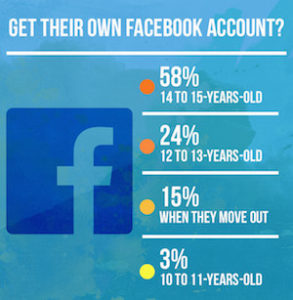

Social Media: While most parents would not allow their children to open social media accounts, one third said that middle school was a good time to allow it. As a clinician who has worked with teen girls I can tell you that the middle school girls I saw not only were unable to self-regulate the amount of time they spent on their device, they also dealt with more issues of cyber-bullying and struggled with the skills on handling online misconduct. Many of them disclosed to me in confidence their online mishaps, conversations, and bullying…all of which parents are completely unaware. Middle schoolers are just beginning to be aware of other people around them and cannot conceive the cruelty that humans are capable of, much less handle it on their own. For some of them, thoughts of ending their life held the answer when they could not figure out another way.
I recommend teens in high school utilizing beginning accounts like Instagram, Facebook, and Twitter, while being consistently monitored (not dissected) by parents. Not for the sake of voyeurism, but to look for talking points on handling online misconduct and affirming self-regulation (the self control needed to movein and out of the digital world into reality). If you allow your middle schooler social media, make sure you are aware of who they are talking to and friending at all times.


 Adult Content: This one really surprised me. On one hand, parents were almost unanimous on the idea of their child/teen getting a permanent tattoo. In fact, the number one answer was “LOL” or Laugh Out Loud. It was a humorous idea to parents that they would consider allowing their teens to make such a life changing decision. Yet, when it came to exposing their children to adult content and violence often found in rated “R” movies, 38% were fine to allow their 15 year old, 16% a 13 year old, and 4% actually would allow a 10 year old. Considering the film industry is allowing more graphic scenes in movies than ever, I’m not sure these parents are tracking the effects of images, violence, and almost pornographic material being introduced so young. I was shocked at the previews before the recent Avengers movie I took my boys to (ages 8 and 11yrs). It was rated PG-13 and I had researched it beforehand only finding a few cuss words to give it such rating. An “R” movie is even worse. It has long been known that these images produce not only a curiosity for more but introduce them to concepts about sex, relationships, and violence before the parent’s (hopefully heathy) teaching has had a chance to take root.
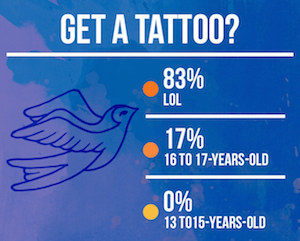 Compare this to the poll that address when to have the “sex talk”. With 58% willing to let children under 15 years watch an R movie, 29% are waiting till the “teen years” (implying 9th grade and up) to talk about sex, and 7 % aren’t even willing to talk about it. So let me get this right, more than half of parents don’t mind letting Hollywood educate their children for them, one third will wait until too late to talk about it, and some consider it not their responsibility at all. Follow this with when they think a child should be able to date- a time when they should definitely know what sex is, what it is for, and how they should be treated in a relationship.
Again, I was pleased with the majority vote of 57% waiting until a teen is 16yrs which I will address in a moment. But again, 33% said 14yrs old and 4% actually said 12yrs. From my time with tween and teen girls. I can say that this almost 40% is in for a painful familial breakdown once they open pandora’s box of dating younger than 16yrs. I heard a speaker once state that a freshman teen girl will date anything that walks. The teens and I laughed when we heard it, but honestly, I saw it to be incredibly true and most of the teens agreed with it in their therapy sessions alone with me. I dealt with more issues of mistreatment, cyber-bullying, sexting, inability to be alone, and negative affects on self-esteem with girls under the age of 16yrs who had been allowed to date. Freshmen in high school or middle school were often targeted by older boys who could not find someone to date their own age, and of course what girl wouldn’t want an older boy wanting to date them? Thus dating anything that walked. They seemed to have an inability to screen for the “good” boys and more quickly attached their self worth to whether they were “datable”.

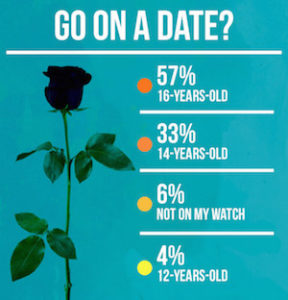 In summary, America- you are doing it wrong. Most of you are headed in a good direction, but the rest of you are playing with fire. Do not overestimate your child’s ability to handle adult situations or know what to do with them when they are exposed to it. Consider waiting until your child proves their ability to balance the digital world with the real world- but that means you must model it first. Liking the opposite sex and wanting to date them will be inevitable, they will even try to sneak it online, but your involvement and teaching will be what they look back on and appreciate. While I am not advocating a suffocating approach that over-restricts the growing independence of a teen, I do recommend a gradual “letting go”, a gentle hand off that guarantees a teens ability to handle the world.
Talk with your children about sex. In a poll I did with teens (which is consistent with other larger polls), children are exposed to their first form of pornography (online or in print) between the ages of 8-11yrs. It is your responsibility to educate your children, not the world. Even worse is expecting them to educate you. If you wait for the culture to do it, you will find yourself and your family out of control before you know it.
-
Finding Home Again
It is our turn to move again. If you haven’t heard me talk about it, #TeamWeathers is on the road again to our next location. This one will only be for a year, our shortest yet, while Matt is in school and takes a much needed break to replenish. We are making our rounds visiting and living with family as we wait for housing on post to open up. I am extremely grateful for their support for us as we have moved in only to leave stuff behind for us to get later. Although it is wonderful to see familiar faces, it doesn’t quite fill the hole of having a home or the anticipation of where we will be. Thankfully, we visited post to see the housing, so I have been envisioning where I will put furniture and settling in my mind. Of course, I have seen this not go well before because the mind has a way of distorting the actual size of what I remember.
 The boys are handling it very well. The newness of an adventure has a way of easing the transition and we have made sure to create opportunities to “circle the wagons” between the four of us by planning fun events, checking in at night with how we are doing, and protecting our time as needed.
As we drove through the suburbs on our way back to our temporary housing last night, I watched so many big houses pass by my window. I wondered what it must be like for a family to choose a house and stay there for 20 years. I wondered what their life is like, the friends they see all the time, and the church they invest in that becomes a second home. Then I wonder if they know I exist. If they ever think about the families that give so much to give them the freedom to make the decisions they do. I don’t want pity at all, some have even said to me how they long for the adventures I get to have- starting over in a new place. The grass is always greener until you have to maintain it, I’m reminded. But what I believe is really going on inside me is a moment of loneliness that exists in the adventure more than I need their attention. It’s a need to feel understood in the midst of the chaos of change.
As we all climbed into bed together last night for an end of day snuggle, Matt prayed over all of us. With the boys in the middle, Matt and I reached our arms across them and held hands, closing them into the circle that was once just the two of us. “This is home”, he prayed- thanking God for giving us each other as a home. Until these little men leave to make their own family, we will always find home base between us. I find so much comfort in that this morning.
I think about the many different groups of spouses I have talked to since winning the MSOY15 award. National Guard Spouses who are tucked into the suburbs trying to fit in who don’t have other military families around them. Special operation spouses who never get to have a “normal” routine with their service member as they are whisked away for missions they can’t talk about. They are all asking the same question I am. I don’t think it comes from a place of entitlement. There are many jobs out there that involve a spouse traveling, being gone, being in harms way, and relocating. Some of them are taken by service members when they retire because it is familiar.
Like others including emergency responders, the nature of what military families do rest on a purpose to serve their country, to make sure we have the freedoms we were given- and spouses and military kids join in to serve the country too- and I believe we love it.
That is why military families huddle up. Our desire is not to push everyone else out or act entitled, we just need to rest in the familiar. We need to mention in passing the stress of the lifestyle and hear someone say, “I know”. It often doesn’t take more than that. That is why I am excited about the upcoming launch of the Lifegiver Podcast. Hearing other people’s stories can be a powerful antidote to our weariness. It can be a reminder that we are not alone and I promise you- hearing a shout out from someone else saying “thank you” can mean the world. I understand that this is one niche of so many. There are plenty of amazing people to thank in this world and I hope we are finding them and thanking them on a daily basis. Gratitude can change everyone involved.
I hope you will join me. I hope, whether you are military or not, that you will consider recording a thank you or an encouraging message to a military spouse. You can quickly record it on your device and email it to corie@corieweathers.com to be included on the Lifegiver Podcast. it can make a huge difference to someone who is feeling alone in their new location, fighting to keep their marriage strong, or trying to find purpose in a new city. I am here to share the megaphone I have been given, and I hope you will join me.
Listen now to the first Episode of Lifegiver Military Spouse Podcast, available on iTunes.
-
Protecting Your Marriage From an Affair
Matt and I see it all the time, a couple comes in for help after an emotional or physical affair and he/she says “I never thought it would go that far.” Protecting your marriage from an affair is crucial to having a long lasting relationship. I pulled from”Twelve Steps Towards having an Affair” by Brady Boyd because it is so well written and to the point. It is an excellent model showing just how slippery a slope it can be.
Protecting your marriage takes intentionality, work, and incredible boundaries. Affairs can happen to anyone, and don’t often start with the affair in mind. They begin with believing small lies about you, your spouse, or your marriage. If you have trouble finding them, they usually revolve around you and a disconnection within your marriage. They may sound like, “Another man will make me happy” or “I deserve to be happy.” In fact, our generation is divorcing more out of the idea that they can “be happier” than ever. Chances are, if you are human, you have been tempted by one of these thoughts. The first three steps leading to an affair are experienced by most people so if you want to affair-proof your marriage, you must be aware from step one.
Here are the steps:
- Something difficult happens that causes tension within you– an argument with your spouse, deployment, loss, or worse.
- You find yourself aware of another person and think he is attractive. This is normal! Yet, you are tempted to wonder what married life would be like with him, tempted to be closer friends, or jealous of his/her marriage.
- Innocent meetings (perhaps unplanned) happen and flirting occurs. Perhaps a joke is told and he laughs when no one has laughed at that joke in years! It feels good, and you notice.
- Meetings become intentional. Perhaps you know he is in Starbucks every morning at 8:30 or he’s in the office at a specific time- so you make effort to be there.
- While in a group setting, the two linger together in conversation. You find yourself wanting to have purposeful conversation with him more than anyone else.
- Conversation begins to shift to feelings. This is where things really start to slip. Discussions begin about how you feel including personal details, struggles you have, stress, etc. Sharing feelings leads to the building of intimacy. Women must be especially careful because sharing feelings comes so naturally.
- Intentional meetings occur under the disguise of a legitimate purpose because you really want to talk about more feelings.
- An isolated meeting happens for pleasure. This is where you can’t account for your time or what you were doing without lying. You are making excuses out of fear that you will be found out for what may be an emotional affair.
- Embraces become affectionate and playful touching begins. You are sold out and it is a matter of days or hours before the physical affair happens. You have turned away from your spouse and now you have in your mind said, “I deserve this, need this, and want this.”
- Embraces become passionate.
- Adultery happens.
- Affair becomes public.
The truth is, an affair will cost more than you think! You will eventually have to face the public and your friends. It will destroy you, your spouse, and your family. Each step, you choose to believe the lie that someone else can make you happier or the truth that you could lose everything. If you find yourself moving towards someone else… walk away. Most who are already at or past step 3 will struggle to find the strength to walk away. Remember, fulfillment and the “lover of your youth” is at home- nowhere else. What captivates you? “Captivate” is an emotional word, a romantic word. Do you notice your spouse when they walk in the room? Allow him to captivate you again.
So how can you affair-proof your home?
- Pray together. Talk openly about your beliefs in life, God, and growing with each other. This is the most intimate thing you can do!
- Date each other. Be date-able and you will be dated!
- Talk openly about sexual temptations. As hard as that sounds, he wants to know about it. There are NO SECRETS in marriage.
- Stay accountable by someone other than your spouse who is the same sex. Give them permission to ask you anything they may need to. It needs to be someone that knows you well enough to know if you are lying.
- Praise and compliment each other. Women and men need to hear it and thrive off it. When you praise your spouse, compliments from others won’t mean as much because they are getting it from you.
Note: If you are already on your way towards an emotional/physical affair, confess to someone more mature than you. This should be someone who loves you enough to say, “If you can’t tell your spouse, I will.” Next, tell your spouse and finally, tell someone who can actually help you. There are plenty of pastors and counselors that have the authority and ability to help you. Building trust back will take time, but if both of you are in to fight for your marriage, with the help of God and others, you can win it back.*
*Portions taken from “How Do Affairs Happen” by Brady Boyd, New Life Church
-
What Military Spouses are Unwilling to Say
There is no doubt that serving as a military spouse is honorable and meaningful. While our soldiers train and perform brilliant and complex missions, the military is clear that it is the families at home that provide the stability for them to do their job. Specifically, it is the spouses that hold down the fort at home that the military works hard to support. Unlike the civilian sector, the military offers spouses programming, childcare services, and benefits galore to improve their quality of life while at home without their soldier. Yet the latest budget cut threats cause extreme anxiety and causes great stress upon the soldiers and their spouses.
More than ever I am seeing acute depression and anxiety in especially our spouses and the straw that caused me to break my own silence was hearing the numbers of military spouse suicides. Perhaps some of these underlying issues that are leaking out have always been inside the military culture, or perhaps the system is beginning to backfire on the very population it was so eager to support.
In the psychotherapy world, we say “Secrets make you sick.” It is the idea that when you hold something in long enough, it will begin to show physical and emotional symptoms. Military families are increasingly struggling with higher divorce rates, separations, rage-filled family episodes, substance abuse and the before-mentioned suicide and it’s not just the soldier anymore. One of the biggest problems is that spouses are not talking about it. They are remaining silent. Being a spouse, myself, I can understand why. Yet, what happens when you shove feelings, hurt, mistreatment, and lack of self-care down for months and years? Like a two year-old shaking a Pepsi, something is going to explode and someone is going to get hurt.
There are many reasons why spouses don’t speak up. The current military cultural climate is like a giant vacuum where they feel both privileged and silenced at our own hands. Any temptation to speak out is followed by a reminding thought of how honorable it is to serve our soldiers and country with gratitude (I have spouses constantly apologizing for what they are saying in a confidential therapy session). We might share with another close military spouse, but we generally fear that if we share with civilians they will give us a look of “didn’t you choose this lifestyle?” So spouses are staying in the inner circle of those who understand. The problem is, there are things they feel they can’t say out loud in the military bubble either and I am watching a generation of spouses struggle more than they should.
“If I say it out loud, it will affect my soldier’s career.”
In the military culture, the spouse can influence a soldier’s career. I read a study once that correlated a soldier’s success to his wife’s involvement in the Family Readiness Groups and mentoring other spouses. While there is no doubt that the family support programs are crucial to the family’s survival by providing a fulfilling opportunity to serve each other, spouses easily get confused about whether or not the military genuinely cares. Why? On the one hand, spouses have been invited into meetings, have playgrounds on every corner, offered resiliency programs, and are even asked “Do you have any questions prior to the deployment.” The culture embraces spouses and tells them they are the backbone by providing amazing benefits that civilians would beg for (and who frequently remind them). This creates a sense of entitlement, and they get caught in the trap of believing that the military owes them something for sending their husband into war when the truth is, the soldier is an employee and the military honestly owes them nothing.
So spouses volunteer to stay connected and serve the others in the belief that a soldier whose family is happy and supportive to the needs of the military will most likely get promoted. And that sounds rewarding…up until the nostalgia wears off, fatigue and marriage problems set in, and suddenly you see the other side of the coin. People often remark that our culture feels like the 1950’s, where women feel that speaking out of their pain can directly effect the soldiers career. If you don’t participate, they know. If you attract negative attention, they ask what’s wrong with your wife and marriage. If you have to miss work to take care of your crumbling family, they may be “supportive” but now there is a negative perception of you and your family. And so you don’t say anything. Command sees the negativity as a problem to be addressed. Acting out, making a mistake, falling apart “too much” when you kiss him goodbye only causes embarrassment on the soldier when asked about it later. On the most basic level we see that the military needs its employee and it doesn’t have to care about the family. The voice spouses thought they had, feels one-sided, and real motivations for the care received for years is beginning to show. Spouses have more-so been “managed” to decrease the consequences of multiple train-ups, deployments and emotional/moral injuries on our families for over a decade, because it affects the “readiness” of their unit.
Spouses feel their only option to break the silence is to remain anonymous, and yet, to them, there is no way to remain anonymous. We have military chaplains and counselors who are confidential, but most fear it can still get back to command. Off-post therapists are an option, but some expressed that no family is stable enough to see real change happen. How can a soldier and his wife work on their marriage with consistent counseling when the soldier is consistently unavailable? I believe this repression leaves a desperate desire for a loud un-confidential voice. But the moment she thinks to let out the internal screams, she quiets herself with “Don’t look a gift horse in the mouth and express your pain because it will eventually come back on your soldier. It’s just plain unpatriotic. After all, my soldier had it far worse than me while deployed so I have no room to complain.” There is no adequate comparison between the military spouse and the soldier. They are both hard lives, for different reasons. The moment we begin comparing is the moment we trample the sacred moments of pain and accomplishment for both individuals. But using the soldier’s deployment to repress personal difficulties only builds up more resentment for later.
“I can’t speak because of the judgment of other spouses”What once was a beautiful culture of women mentoring other women through the pain of separation and war, has recently changed into a generation of isolation and judgment. I believe the Old Military has gone or is going away. Senior spouses are rightfully tired having been through more deployments than any marriage should handle. Mentoring is fizzling as Facebook becomes our new coffee-group and spouses stay inside their homes rather than outside greeting each other. Research shows the higher ranking the soldier, the more isolated and alone the senior spouse, even correlating them to the same isolation felt by a pastor’s wife. The pressure of not being authentic out of fear that it can affect your soldier’s career is compounded by the pressure and perceived judgement from other spouses. Even though we aren’t employed and given a rank, the volunteer system has us working along side the spouses of those ranked above our soldier. There is no way to be authentic when a higher ranking spouse that is supposed to be mentoring you is married to your soldier’s boss. Introductions are often made by asking “Where were you stationed before?” and “How many deployments have you been through”- sorting out those who will mentor and those who will need mentoring. And so they mask feelings, stay strong, and push it all down.
I recently had a new military wife tell me that she screamed and latched on to her husband as his bus was getting ready to pull away. Part of me wanted to tell her “Good for you! I wanted to do the same thing.” Yet, I am now ashamed to say that I would have been lumped into the group of women who pulled her off her soldier and told her it was “Time to pull her big girl panties up. This is not how a military spouse behaves.” Meanwhile, I’m sure the soldiers were ragging her husband on the bus.
Judgement comes from both directions as younger spouses judge tearful, exhausted senior spouses as weak leaders. If other spouses are supposed to be our life-line and we can’t be authentic, then we have a serious problem. There is only so much the human psyche can push down and contain. After years of perfection and forced adaptability to change, spouses will eventually react and be judged for it. I have seen them both implode by losing their identity or explode by divorcing and losing their self-control in reckless abandon- and who wouldn’t?
“I can’t let go of control when control is all I have.”There is a bumper sticker that says “Army Wife: Don’t confuse your RANK with my AUTHORITY” and it gets mixed reviews. When I do play-therapy with children, parents often ask why the child is refusing to eat or obey. My response is typically to ask them if the child feels they have any sense of control at home. When you have no control of the environment around you, you control whatever you can. Military spouses are the most adaptable creatures you will ever meet. We are conditioned to not want anything or need anything. The “needs of the military come first.”, we say with pride. My husband and I have an inside joke saying, “it can all change in a lunch hour” because in the military- it can. I think he is surprised sometimes by my “whatever” mentality to our life, but you have no other choice. One of my own spouse-mentors says sarcastically “Apparently I missed Option Day”, meaning we may have chosen this lifestyle but that often feels like the last time there was a choice.
This can lead an extremely go-with-the-flow persona while controlling everything else possible. After years of vacillating between being a geographical single parent to a unified parenting team trying to share responsibilities, eventually she will become the all encompassing home manager. While the lack of stability can create wonderful opportunities for personal growth (if desired), it can also lead to controlling everything that is non-military. For soldiers, it doesn’t seem to work to share control with your spouse when things are always changing, so many resign to let their spouse maintain control. What will military marriages do when the war draws to a close? We will have marriages in turmoil, and no one in whom the spouses can confide?
“I can’t talk to my soldier…”
Add to that the military contradicting its message of care for the families with the “don’t upset your soldier” message. After a long deployment, spouses are told to push down their needs further by not asking too much from their soldier. “Give him time, let him adjust, don’t rock the boat.” And so spouses push down every desire to flee and care for herself, again, possibly for another three to six months until their soldier comes home to say they are training up for another deployment.
Is there a solution?
Of course, as a clinician, I would say to anyone repressing feelings that the first step is beginning to have safe appropriate conversations with the right people. Only then can you distinguish between internal lies that keep you quiet, and the truth. This however, must involve other people to make that possible.
If you are a civilian, be willing to listen to military spouses. One of the best things you can say is “I may not fully understand, but [that] must be difficult for you.” We need someone to say that the hardship is not worth the benefits. Tell her that she has a voice with you and that it is not unpatriotic to hate the military sometimes.Soldiers, do not give in to the cultural lie that your spouse can break your career. While it is not wise for a spouse to voice her opinions to your command unsolicited, her voice in more appropriate places will bring her life! Listen to her, serve her when you can and encourage her to care for herself. Protect your family by setting boundaries at work when possible and learn to differentiate when you can’t. Remind others and lead those below you that work ethic promotes a career, not family. While it may be the norm to stay after five o’clock to put in extra work, it is not always necessary and by staying you may be adding to the peer pressure. If they come down on you for your spouse being appropriately real with other spouses, stand up for her as a leader and mentor and ask them to leave her out of your job. The military wants to protect you, but often results in enabling some soldiers to remain boys by not letting them handle personal consequences. Take ownership for your own stress level and maturely state if she is handing you too much too fast. It is often when we mess up that we have the opportunity to grow, and reintegration is that for both parties. Removing the employer as the middleman in the marriage can make a lot more room in the marriage bed.
Spouses, what saddens me is that the fear I am seeing mimics what I often see in a controlling relationship. When you are told to push feelings down for the sake of your soldier, to not disclose to those who could make his job more difficult, and stay strong for the other spouses, you will eventually implode/explode. Sacrificing self-care to the god of rank and patriotism only results in brokenness. If being a soldier is a job, then it is not completely true to believe that we as a spouse can destroy our soldier’s career. Our soldiers are responsible for doing their job while we are responsible for being a mature, confident woman who can practice self-care. We are believing a lie if we fear others have that much power over our life. While it is never professional to storm our husband’s boss’s office (or his wife) with our opinions, that doesn’t mean we do not have a voice. Only a victim believes she has no voice, and one thing a military spouses is not- is a victim. She is courageous, flexible, and willing to do what is right for the sake of her family. She believes in etiquette and the love behind a thank you note and she understands that a good neighbor becomes a life long friend. It’s time to be authentic, confident, and led by wisdom. We have to be the change in our own culture and bring back the Old Army that supported one another and mix in the creativity of the upcoming generation of spouses. We have to have the courage to maturely speak vulnerably for the sake of our sanity and the sanity of other spouses. It may start off in the counseling office, but must eventually end with honest talks over real (not digital) coffee. Ask your soldier to set boundaries by taking accumulated leave to spend quality time with the family.
When they ask for questions, ask. If you feel betrayed by our government, tell them you are tired of feeling like you have no voice and remind them that they are hurting those whom they promised to serve and cultivating a climate of fear and silencing with benefits and programming. Utilize the programming that is offered by using the counseling services for issues your neighbor cannot handle and being a real human example in any one of the resiliency classes on-post, maybe even invite a younger spouse.
Few are beginning to speak out by testing the waters, but many are afraid. I am not advocating mass hysteria, I am advocating reducing the stigma of fear and hiding and the re-installment of mentoring by experienced spouses.
Senior wives– be authentic by telling us when you are weary and need to sit back. Choose where you put your energy wisely, but do not disappear from the culture you once inspired.Experienced spouses– be authentic and serve the senior spouses by picking up the mentoring that is so desperately needed and thank them for the wisdom they have committed their life to give. Teach the new spouses who are isolated and hurting how to also be authentic with maturity and without fear.
Perhaps it isn’t the spouse that is screaming in the parking lot that needs to be helped, it’s those of us who are quieting her.
New spouses, come out of your homes and join the groups. Ask real, honest questions of those who have wisdom to give. If you have had a negative experience with the FRG and coffee groups, the only way to make it better is to be part of changing it.
There is sickness in remaining silent. What would happen if we were authentic with each other? What would happen if spouses voiced their concern for each other to a government who feel forced to financially abandon the “backbone” (family) of their army. What would happen if we changed our perception of our benefits and programming to seeing it as a service, but not designed to appease the pain inside? Regardless of rank, we are a group made up mostly by women, human, and needing each other to be real. We are tired and weary. We are scared and lonely. We may be hurting and feel betrayed by those who invited us in. We may feel misunderstood and some even trapped. As the pendulum swings, we must learn how to use our voice responsibly by confidently beginning the change, and sometimes calling the bluff of the apparent consequences to being human. We too can be Army Strong, united in the cause of protecting each other, but it begins with being vulnerable, sincere and transparent. “The strength of our nation is the Army, the strength of our Army is our soldiers, the strength of our soldiers is our families.” (Chief of Staff, Raymond Odierno) Unfortunately our families are not as strong as they appear from the outside, and the cracks are beginning to show. When we stand together, we are not alone and there is nothing to fear.
-
Moms, Meltdowns, & Cupcakes
It was the last week of school, my last week of work, and we were getting ready to move (again) in a month. Everything seemed to be peaking into this nice opportunity for a meltdown. I was late getting teacher’s gifts, and the double birthday party I had been planning for my two boys’ classrooms (out of sheer guilt that our military calling would be pulling them away from their friends again) had been canceled due to the amount of chaos swirling around me. I felt I had already disappointed them once by postponing, and my youngest’s teacher had emailed me (again) about his behavior at school. I was drowning in the quicksand of mommy-shame. But, this particular morning, I had a winning thought, I can get cupcakes for their classrooms! In one act of service on my way to work, I can help my youngest make amends and give them a chance to have a birthday send off all at once! Several boxes checked. I suddenly felt the pride of a Supermom moment. You know, like when you get the kids off to school, have had breakfast, and you still had time to clean up the kitchen? That feeling only lasted a moment until I stood in the bakery section of Walmart, paralyzed, staring at cupcakes.
I have 50 children, should I get the mini-cupcakes or the full-size? I have no idea. 50 is a lot and will be expensive to get the full-sized. I’ll get the mini ones… but what will my children feel when walk in with mini-cupcakes? Have their friends brought in full-sized for their birthdays? Will they feel cheated, less loved? What about the full-sized- that’s a lot of sugar… they have water day today.
I am now envisioning 50 kids throwing up beside the inflatable water slides on water day because Jack’s mom brought full sized cupcakes with massive amounts of frosting. The teachers are looking at me and I now feel responsible to sanitize the giant slides from this disaster.
Do I chance the mini-cupcakes? Will my kids look back and remember the time their mom brought in tiny cupcakes? I’ll call a friend, I can’t make this decision alone… someone understands this situation as the real, serious, life-altering moment that it is. The first friend I think of doesn’t feed her children sugar. Great, I can’t call her! What is that now saying about me that I am loving my child with food, much less an overly sugary treat. I think, Who else has a fifth grader? Ah, yes! Another friend… but she is homeschooling. Great, she hasn’t been buying cupcakes for 50 children lately and now I’m feeling like crap for sending my children to public school and not teaching them myself. Here I am, a competent woman who is frozen in the bakery section with the Walmart staff staring at me. I can’t do this…
I leave for the clothing section since I need to process this situation. As I step outside of myself like an out of body experience, I’m getting pretty mad. I am a mental health clinician that helps women, mothers and their children on a daily basis with their self-esteem and confidence. I have just been named Military Spouse of the Year and somehow represent 1.1 million military spouses in the world and I can’t pick out cupcakes. As I’m pacing down the aisles, I began to wonder how I got here.
At what point did I give my self-esteem to a classroom of fifth graders? When did birthdays become an extravaganza of exhaustion? When did buying cupcakes become an identity crisis? When did Pinterest become the new measuring stick? Why does motherhood have to have so many extremes of perfection? I CAN’T DO THIS ANYMORE.
In that moment, I take a huge step. I am choosing the middle ground. These cupcakes can’t define me, I feel ashamed that for a moment they did.
I march back over to the bakery section on a mission to reclaim my personhood.
If these two awesome boys don’t know that they are loved by this point, something else is wrong. My children are going to have to rough through another military move and are going to be better for it. I am a working mom with my own goals that won’t be prioritized above my family. I will leave the world a better place starting with the fact that I am feeding 50 children cupcakes because they are loved. Some don’t even get cupcakes, right? RIGHT? DON’T THEY KNOW HOW MUCH THEY ARE LOVED!?
(Obviously a breakdown is happening during my attempts to control the situation.) The phone rings. Its Jack’s teacher again describing his meltdown yesterday and we agree I will help Jack apologize to another teacher for saying he hated her during his own emotional flooding and I wonder which parent he got that from. I stood there, staring down those cupcakes as if I was battling a giant- a giant being the “me” I keep thinking I need to be and I bought mini cupcakes.
You know what? My kids never said a thing about those cupcakes after school. By four o’clock they had forgotten about cupcakes.
Why do we do this to ourselves? It is impossible to get it all right every time. What’s more is that it will be forever impossible to crawl into our children’s minds and know their exact need in the perfect moment. By the way, that part of their mind isn’t even for us, it’s for their future spouse. There will only be one person who will be responsible to tend to those needs in their soul and it’s not me. Can we just let go of the perfect-mom measuring stick for once? What we really need is a reminder that the things we think will be most important in our child’s memories will not be what they choose. Do you know what mine is? A plant my Dad got me for my birthday one year. If we parent as if the world revolves around them, they will walk into the world believing it. I hear from so many other women that have put the burden of perfection on themselves only to crumble. I say do you your best, do what’s smart, and embrace the imperfection of it all. I gave 50 children mini-cupcakes, and found myself again in the process.
-
PCS and the 6 Month Mark
6 months.
It is a significant mark in time and am realizing that it means even more to a military spouse. Here are just a few:
During a pregnancy it is the time when the energetic second trimester is over, and a tiring, grump third begins.
During a deployment (a 9 month or one year), it marks an achievement of everything you have gotten through on your own, but now your ready for your family to be back together. It is a heavy feeling that you have so much further to go but you fear your motivation may run out.
During reintegration it is the point where things can both return to normal or issues really come out.But there is a new one that I have learned about personally… it is the 6 month mark after your PCS. Funny, it can look and feel like the other ones. I realize that a lot of you have this moving thing down, and if you do- please comment because you have so much to teach the rest of us. As a natural introvert (one who gains energy from doing activities alone such as reading a book or going for a run), starting over in a new location can be difficult. I love people, don’t get me wrong- I am a counselor and it is my great joy to see people find joy in their life. But building relationships is something different. I’m the type of person that makes friends and then wants to build a neighborhood full of them and stay there for the rest of my life. That’s not exactly a good thing if you are going to thrive as a military spouse. After struggling at the 6 month mark in the last assignment, I told myself this time, that I would “jump into community” at the new location. I committed to finding a church, a small group, that I would build relationships quicker in the neighborhood, etc. And now I find myself at the 6 month mark again.
Part of it is me. I have worked hard to establish myself in my job here, something I wanted to take advantage of while I could, but Matt held me accountable and pointed out that I keep finding things to do to stay busy. I love him. Sometimes I hate hearing what he has to say, but he was right. That’s when I realized that I fill the void of real relationships with projects. I could find one to get lost in every day. I wonder if others of you do that as well. My projects tend to revolve around helping people but rarely involve real, meaningful relationships. The only thing that leaves me at the 6 month mark is alone and burned out. Perhaps there are extroverts that find ways to stay busy with events without building community as well? Do you over-volunteer for the sake of being around people?
I never want to present something difficult without also providing a solution. The truth is, PCSing will always be difficult, filled with ups and downs. There will always be projects, events, and opportunities to volunteer that will be waiting in the wings for us to squeeze it in while sacrificing what was most important to us. A good friend of mine once described building relationships after a PCS like speed-dating. That is so true. I after feel like I am trying to show that I am a real, normal person (I like to think so) and not the annoying, needy, neighbor that is in all actuality very much needing connection. The 6 month mark may always show up, reminding me of what I need most- solid connection with my sweet family and friends to thrive with where we are planted. So today, I’m going to listen to it’s nagging voice that is telling me I’m missing something important and go read my Mission Statement. If you don’t have one, write one today. I desperately need to read mine every morning. It keeps me focused on my priorities and values of what I need most to be happy. I have one major mission statement and then a list of priorities under it that align with it. As I re-read it this morning there are several projects I have said “yes” to that don’t align with what I originally said would bring me joy. So… I’m going to go play Monopoly with my kids, find a place to hang my Mission Statement, say “no” to a few opportunities (and to myself), and then go talk to my neighbor.
-
My Response to Conscious UnCoupling
It’s conscious uncoupling that prevents families from being broken by divorce and creates expanded families that continue to function in a healthy way outside of traditional marriage.
Before we unpack Conscious Uncoupling and how it effects our view of marriage and divorce, we have to look at our perspective. You are likely in one of more of these scenarios, (but not limited to):
1. You are a child of divorce in some stage of healing and processing.
2. You are considering marriage and asking yourself What is marriage?
3. You are married and both of your are working damn hard to keep divorce out of the equation.
4. You are married and considering divorce yourself.
5. You are married and your spouse is considering divorce.
6. You are divorced and your spouse quit on you and know that wounds never heal fully.
7. You are divorced because you quit and you may or may not see it that way.
8. You are in an emotional, physical, and/or sexually abusive relationship and divorce is a necessary topic.Depending on which perspective you have when reading about Conscious Uncoupling, you will have a different response. Let’s be clear from the beginning. If you are are #8, Insightc2 (Matt and I) will always encourage safety for you and any children involved first, and divorce may be part of that process. If you are considering divorce, we also encourage separation before an individual follows through a divorce to gain wise counsel and support before a divorce is finalized. Matt and I together stand for marriage, the covenant, lifelong relationship with one person. It is not easy. In fact, it is the hardest damn thing we will ever do. But it is intended to be the most rewarding, more than any career or amount of success we will ever accumulate.
If you are not #3, it is hard to understand the visceral reaction this group of couples felt when Conscious Uncoupling came out. As a couple who is #3 and mental health professionals that work with all of the above perspectives on a daily basis, it is important for me (Corie) to make a statement about this theory/movement and the harm it can do to every one of those perspectives (1-8).
This is not about the details in a celebrity’s life and why they are choosing to divorce, but it is about the platform they have to influence others.
What is “Conscious Uncoupling”?
Here is a link to read the full article:
http://www.goop.com/journal/be/conscious-uncouplingDr. Habib Sadeghi & Dr. Sherry Sami are the ones who have coined term “Conscious Uncoupling” and are trying to suggest that we need to redefine divorce. They claim that divorce is not the problem, it is more likely the fact that we are living longer lives and being with one person is just not realistic. They are encouraging three things.
1. Lifelong marriage is no longer something that is realistic since we are living longer than our ancestors and we are biologically/psychologically more likely to spend our lives in several long term relationships, therefore the belief structure/expectation/measuring stick of marriage should be lowered to what is easier or what commonly seen in America.
2. In order to make divorce less painful, we must shift our beliefs about divorce as well. Divorce brings with it shame, feelings of failure, and deep hurt, causing us to lashing out in resentment and anger. Feeling like a personal failure can be prevented if we resolve that the pressure of “till death do us part” in our vows was too high of a standard to commit to.
3. By setting boundaries with people and taking ownership for our own internal reactions, we can be vulnerable and yet unaffected by other people’s behavior. By realizing our conflict with the other person is triggering our own issues, we can resist the urge to add fuel to the fire and instead regulate our own behavior.I don’t completely disagree with Sami and Sadeghi. The one thing I appreciate is their attempt to encourage healthy boundaries. Nearly every session I have with clients involve boundaries and toxic people. On some level we must learn to take care of our own internal response to people (i.e. you can’t make me angry, I choose to be angry). I agree that there are times that we must find the strength within ourselves to see our own worth and respond with firm boundaries when someone else is destroying our relationship with selfishness. In fact, if you are #1 and a child of divorce, you likely loved this theory because it tends to your pain of having parents who made a decision that changed your life and you either are thankful that they successfully co-parented, or read this and wish this theory could have helped. You (and I) are hearing it from a child’s perspective in light of our own pain of people that chose to hurt each other without regard to others around them. Yet, redefining marriage doesn’t quite sit right either because you will always, deep down inside as a child, wish that your parent(s) would have chosen selflessness and achieved the “crown” of lifelong partnership that is now the “exception to the rule.”
If you are #8, in an abusive relationship, then this doesn’t work either. Although setting boundaries is necessary (and extremely difficult) and finding the inner strength is necessary to set them, uncoupling is not an option. There are and should be deep consequences to the offending spouse, possibly including having little to no choice on your role in parenting and access to the spouse you hurt. In these scenarios, taking internal ownership of what is happening in conflict is the opposite direction we would want. The other person is selfishly destroying you, and that is not your fault, nor does it have to do entirely with your past. It has everything to do with your spouse selfishly harming those around him/her. Marriage is not the problem, divorce is not the problem- you made a bad choice in who you chose to marry and they are just a bad person. Period.
If you are married (#3, 4, or 5), you know that marriage is the hardest thing ever. There are ups and downs and during your worst moments, it takes maturity and selflessness to not throw the “d” word out. Conscious Uncoupling is offensive because you participated in your vows on your wedding day, and they meant something to you. Even more, you hope they meant something to your spouse. You have likely learned that original vows are a one time commitment in front of others who witness them but they are a daily choice as well. Spouses who are both fighting for their marriage (or those who are trying but their spouses aren’t) see Uncoupling as a cop out for something they fight for daily. The standard of “till death do us part” is sometimes the only thing that gets them through the worst moments where they can say on the other side, I’m so glad I held on to that commitment. Uncoupling only gives a spouse the “permission” to change their mind and give up, saying Oh well, it was never meant to be (especially when your spouse is not doing the work already). It is weak, selfish, and destructive to whose heart you promised to standby “in sickness and in health, for rich or poor”. I say, if you said “I do” you are accountable to that and there are consequences when you don’t. Some of those include the generation beneath you that you committed to providing stability for at conception whether or not you feel like it.
Speaking of the next generation, if you are #2 and considering marriage, this definitely affects you. Hitching to this bandwagon, especially because some celebrity endorsed it, is ignorant, naive, and headed towards a disaster fueled by entitlement. Do your future spouse a favor and change your vows to “I might”, then they have the opportunity to rethink whether you are seriously into this and they can back out before having their heart broken by someone who is only half in, half meaning only considering his/herself.
Marriage is designed to have friction. Under the covenant relationship of “lifelong commitment” there will be intense differences. It is the friction that causes movement towards betterment. Two people should not even enter into it unless they have proven as much as possible their ability to receive accountability and actually make changes, rather then just think on potential. They also need to show they have the guts to hold you accountable when there is something your need to change. In other words, marriage takes confidence, humility, and a willingness to improve- even when you can’t see it as clearly as your spouse can. That’s why having a God in the mix of all of this is crucial. We are all human and flawed and it takes a God who is not, paired with the wisdom of community around you who also believe in this God to help you see when to be confident, when to humble yourself, and when to do the hard work.
Finally, lets talk about #6 and 7. If you are divorced and someone left you (#6), there is no amount of your ex finally deciding to be an adult that will make the pain of that marriage failing go away. Although self regulating and boundaries can lead to healthier communication post divorce, reframing marriage and divorce is not going to take the sting away. It is jsut as difficult to see a family split up because one or both were acting like children only to act like adults once the family is torn. For some people, suddenly choosing to Consciously Uncouple is a slap in the face of those who were hurt. It is saying, I will now get along with you for the sake of others by managing my own feelings, now that less is required of you. I’m not saying you still shouldn’t try, maturity is always best, but you will still not be able to escape accountability.
If you are #7 and you initiated the divorce, you may have ended it because you tried and the other didn’t and you had to set a boundary. In that case, you are really #6 and have every right to still be processing your feelings for having to make that decision. I’m more so talking to the ones who emotionally left their spouse even before the marriage. The ones who just gave up, had affairs and left, and are still experiencing the consequences of their actions. For you, Conscious Uncoupling validates what you’ve been needing to hear the whole time. That marriage is too hard and it is completely acceptable to end things early. That divorce shouldn’t have feelings of guilt attached to it if we just say that this is the norm in America. To you (although you won’t hear it) I will say that you are fooling yourself, and so are Sami and Sadeghi.
There is no escaping guilt, unless you are a sociopath and maybe that is who Conscious Uncoupling is for. Guilt is the productive feeling in our gut that says we are or have done something wrong. It is what moves us to change our selves and be better. Without it, a marriage would never survive. Get rid of that, and there will be no marriage at all. If someone hurt you by leaving when you were still trying, then guilt is not the usual feeling- it is the pain of rejection mixed with relief- neither of which I would minimize by saying marriage was just too hard. For them, it was torture.So I contend, marriage is not the problem, divorce is not the problem, selfishness is always the problem. It is the root of sin and is what makes us human, which is why we need a God.
-
Joy In Between
I have a great friend who every year thinks and prays about a word that she will focus on for the new year. It seems to have brought her great focus on the past years and I have been thinking a lot about doing it myself. For last two weeks I have thought about my last year. We moved to Augusta, Ga in December and I started working in January. I have been thinking about the ups and downs of being am military spouse and how the first year is often a time of excitement, adventure of a new place, and a rush to settle in. Our mission becomes settling the hearts of our children in new schools and friends, supporting our soldier as he finds his own connections at work, and deciding what we will do with ourselves. At home, it involves making it feel as such and finding our own circles. If you work, it is the anxiety of wondering if anyone wants to hire a military spouse, and then investing into your career- once again proving your worth to the local world who knows nothing of your past accomplishments. If you move as frequently as we do, year two is a bit tricky.
Year two is a time where we are settled in, making gains, and are… in between. There is no talk of where we are going, although we know it is inevitable. We have no choice but to continue to invest in the world around us, as if we are going no where. We naturally long to settle and have stability and so we tell ourselves that we are going no where. That’s always an option, right? Other military families get stuck, we could too, right? I don’t know about you, but my heart longs to do that, but my mind seems to anticipate change. So as I have thought about what word God would want me to focus on, He seemed to replay moments of the last year where I have used the word JOY. I have mentioned it in sessions with individuals and families, taught on it in marriage retreats, I even made a canvas to hang in my home during the holidays that shouted “JOY” in big bold sparkly letters. My soapbox on it has been that it means something other than happiness. People come into my office asking to be happy. I think happiness is fleeting. It is like opening presents on Christmas morning and is over in a moment. JOY is the lasting contentedness that follows that I think all of us are wanting. It comes from a place of connection and safety with others and the world around you, a sense of gratefulness for your Maker, and what follows is peace.
As I look into year two for me, I realize I have a lot more to learn about JOY. I desperately need it’s warm blanket to calm anxiety, settle vision, and keep me from over reaching. I have a tendency to do that. I claw at the future to grasp certainty when often times there is nothing there. But my present is, and that is where I need to be.
And so, JOY will be my word. In the midst of busy schedules, Cub Scout meetings, my own career including a teen outpatient program, and investing in my marriage, I will be learning about JOY. Here are a few things that I know bring me JOY:
- Thoughtful prayer with Jesus, not just a passing conversation. There are things I long to pray for that I keep putting aside for that quiet moment that I never find. I am convinced that my lack of focus stems from my inability to make this happen.
- Music- I put my guitar away when my step-father passed away. I believe I am ready to take it out again. I have a piano that was gifted to me, and my husband has begged me to sing around the boys again, so I believe I will. Worship frees my heart and unloads the weight of the world that I experience each day.
- Being content in myself. Actually working on the physical goals I have for myself and enjoying wherever I am in the process.
- Allowing myself to have more moments of happiness. They may be fleeting, but the JOY that comes from it flows into a grateful heart. Whether its playing a game with the family or basketball outside with the kids- it is far better than whatever is on the digital device in front of me. Having fun with my husband as well- we have worked so hard and this definitely doesn’t need to be forgotten.
- Creativity. For me, I have to contain this one. This year, I will be a good steward of what God provided and work on one project that will give me a sense of giving life to something. I am a lifegiver, and I know this is what God has gifted me to do. If I don’t hedge myself in, though, it can tend to get out of hand.
So, in the “in between”, my hope is that I will learn to be content there. “In between” can be a great place to be- not working towards anything, just being a good steward of what I have. Enjoying those I am blessed to be with and smiling more. JOY- in between. What word is on your heart?
-
A Woman’s Mind
When Matt and I talk about some of the differences between men and women, we often refer to the computer screen as a perfect metaphor. Of course, we are not trying to label people or say that everyone is the same, but it does seem pretty consistent that men and women have different ways of thinking.
Matt and I work from two separate computers. I think he is extremely thankful that, other than the satisfaction that I have finally joined the Apple community. When I go to his computer and log in, I see his nicely organized desktop, with perhaps one window open that he failed to closeout before he hurriedly ran out the door. But when he opens mine, I generally hear something like “Have mercy, what in the world could you possibly be working on with all of this happening!” I usually have about four internet windows running, three projects minimized, and several things saved to my desktop waiting in line. It usually looks something like this- this is my current screen shot:

My current window is this article I am writing, while another internet window is searching for business plan templates and Facebook is available for quick reference. Nevermind focusing on one thing, I have my Wunderlist behind my internet window waiting for more tasks to add to my to-do list and another article off to the right. Don’t forget the budget at the bottom of the screen that may need updating at any moment. I can see why this drives Matt literally mad…
Thus, our saying that men and women think like two different computer screens. Women have this amazing ability to multitask. We can be working on one project, only to have it remind us of something else we wanted to do, which reminds us of the room we meant to decorate (open Pinterest) which reminds us of the budget that we open up, reminding us to book the event that is coming up in the Calendar, and then the coupons that need to be saved and printed out. I mean, why close anything when I can load something else while I wait? Matt often jokes with me that I probably contribute to the internet slowing down at night more than the online gamers do. Very funny… all those open windows are serious Mister….
Women can have multiple “windows” going on and still function in the here and now. Of course our super power diminishes the more windows we have open. We become more and more consumed by what is happening in our brain. For example, I can be thinking of the kids playing outside while I am following directions on a recipe for dinner thinking that I will check on them in 2 minutes. In the meantime, I may minimize that “screen” while I remember to water the plants on the patio, then remind myself about the kids in 1.5 minutes, then turn to think about what we will have for dessert while I am writing down what we need from the store, which reminds me to call my mom, leaving me 1 minute to say hello before I go outside to check on the kids, right when it is time for me to add the next ingredient.
Of course, that also leaves plenty of room for us to forget something important, like the kids, an ingredient, or worse- dinner burning. We may think everyone can think that way- but I assure you, men do not. Most men’s minds compartmentalize topics, similar to a command prompt screen or train car. One thought may lead to another and then to another- drawing a final conclusion. It also gives them the ability to “put a thought away” (especially if it is a troubling thought they don’t want to affect them now) and come back to it later… or not. How this plays out in the man’s mind is another topic, but for today we need to focus on what this “multi-tasking superpower” can mean in our relationships. Although it is incredibly useful- it can also damage our relationships if we are not careful to manage it.
One is that we become forgetful and consumed. Men often say they feel like their wife can think of everyone else, but they feel forgotten by the end of the night. Ladies, it is important to have a “window” open for our marriage. We need to be thinking about how they fit into our crazy thought life. What happens when it is not the dinner that is burning, but we have set aside improving our relationship. Marriages often suffer when the tasks of life and children take our energy and we save the marriage for later. The 30’s are a prime time for this (believe me I know!)
Another is the annoying pop up. I hate the ones that you have to chase around to close out. We get those too. You know those feelings that we thought we resolved 5 yrs ago? Our husband may do the smallest thing that causes that feeling to re-surface. Sometimes it is another layer to look at and process, but a lot of times its an annoying feeling that we closed out long ago. Hear me on this one, friends. It is our responsbiity to close out those windows. Just because old feelings that have been resolved “pop up” does not mean we have to “click” on them and open the “window”. Old wounds that have scarred over through forgiveness are often resolved, but we must have the self-control to “close it out” before it becomes destructive- or worse- is used as a weapon when we said we forgave.
Lastly, if you feel overwhelmed by too many responsibilities and “windows”- communicate to your husband about ways he can help close out some of those windows- doing the grocery shopping, the laundry, or the dishes, etc. Let go of the control that only you can do it and let him help you. Let him know that by doing this, you are able to make more room for him in your thought life. *Hint* Tell him it’s a turn on, leaving you more time during your day to think about him coming home. Most men want to be thought of and needed more, they just need to know what they can do to make it possible. Believe me, you both will thank me for it later!
-
When its Time to Leave
I love being a military spouse. It provides an opportunity to travel, be part of something bigger than myself, and serve along side my soldier. Balancing out the bright moments are the darker difficult days of relocating, adjusting, and times of separation. It is a bitter sweet relationship that promises to stretch me out of my comfort zone and make me better, even if I go kicking and fighting. I find that I can count on that now. Like clockwork, although I promised myself that I would not “settle in”, I find that I accidentally did and PCS orders remind me once again that I was never supposed to stay.
I realize I can’t help myself from nesting- buying those curtains that may only work in this home or constructing a garden that clearly cannot be uprooted. It is in my nature as a “lifegiver” to create life wherever I am. I’ve accepted that about myself. I love to plant myself, root where I am, and allow the season to hopefully create a harvest with me or out of me because I need it like a I need air. I need community, others to rely on and them to rely on me. I need my children to experience that home is wherever we are and if that means I buy new curtains that fit in every new home, then so be it. I need an opportunity to grow and be challenged with a project that forces me to “find a solution to the problem/need” like a life sized Calculus problem waiting for the student to raise their hands with a triumphant sigh.
And yet here I am again, realizing that I planted myself in Augusta, Ga- loving my current set of curtains and sitting on my new-er sofa looking at orders to leave. Augusta provided a chance for me to use my counseling license and practice. I welcomed new clients with open arms and shared the vulnerable journey of life along side so many. Augusta needed a Christian Counselor for teen girls, and I became it. Like a flock of birds migrating, they all came to me, brought by frazzled parents who were looking for hope and answers. This became my life-sized Calculus problem- how to help a large group of teen girls feel less alone- and so I sweated through the problem and found the solution by starting an outpatient program. I decided to introduce my teen clients to each other through a therapy group and it became theirs. Theirs to own, create, protect, and use to find acceptance, test new social skills, and say the things to each other that they also needed to hear.
 I have seen girls overcome social anxiety through talking in group, find courage to do the right thing, find normalcy in the pressures of school and culture, and discover that being “good” still means something in this world. Creating a safe and inviting space was no easy task. My soldier championed me by making book shelves, hanging things on the walls, even delivering our own TV from our home to make group happen. It has been a joy to sacrifice for this project. I have learned so much from these girls, girls that still struggle to find how they can make a difference in the world around them.
And as I look at our orders in front of me to leave, I realize that none of this was ever mine to keep. It was never mine to begin with, it was something I was asked to make and take care of for a season. And after I go, it will evolve into whatever it needs to become for those after me. There will me more girls, more issues, and more needs to fill. It will become someone else’s life-size Calculus problem and they will see something that I couldn’t see. I realize now that we aren’t supposed to do any of it on our own or we will find ourselves tempted to be the god of our surroundings.
And so I am grateful. Grateful that I planted here and gave it my all. I know now that I wither without it and I don’t regret any of it. I am grateful that I got to be part of something that made a difference, even if for one family. Grateful that I get to hand all of this off to someone else- whether it means it thrives or finds the end of its life cycle. Grateful that I spent this season embracing the stretch of trying something new and saw it succeed, grateful that I can raise my hands in the air in triumph and sigh- it was worth it. I hate saying goodbye- to my clients who have opened up their hearts and trusted me, to my employers who gave a military spouse a chance knowing she would leave, and to friends that I would have invited into my imaginary neighborhood of collected life-friends we call family. But its time, and we are called to go.
I have grown to appreciate the warm wash of future uncertainty even though it still makes me nervous. This will be my fourth location and although I know how to direct the packers, can expect the dreaded 6 month mark of melancholy that I will feel, and can embrace the opportunity to reinvent myself, the anxiety of change still looms. What will my kitchen look like? Will we find a church home? Will the spouses like me? Will people want to invest in us when we won’t be around for long? What in the world will I find to do there? I don’t think that ever goes away, but at least I know this- I will plant myself. I will enjoy the warmth of the sun shining there and hold its memory for the days when the clouds seem to linger too long. I will take on a new season of growth and let it stretch me in a new way because its harvest reveals character. In the meantime, I will balance this decisive courage with a little bit of retail therapy shopping for curtains and possibly consider dying my hair some shade of purple.
-
Who is the Child, Who is the Parent?
There is nothing like our kids to bring out, well, the kid in us. And I’m not talking about being playful. What I’m referring to is arguing like a child. Children, tweens, and teens will always frustrate us and bring us to our wits end- they are supposed to. They are one more reminder (consistently) that we are out of control of those around us. We can’t force them to listen, obey, love us, or heaven forbid eat. A lot of parents come to me as their tweens turn to teens when they feel the most out of control. “The won’t listen” “I think they are lying” “What’s wrong with them?” “I’ve done everything I can think of and their still not happy!” and “Why are they choosing to be bad?” But what is it about our children that causes us to lose control emotionally and lower to their level. Sooner or later, parents can find themselves arguing like a teenage peer rather than being the adult in the room.
The first thing we need to remember is that these teens may look like adults, bathe and be responsible (maybe) with their homework like adults, but their brains are not. All too often, parents stop parenting when a child seems self-sufficient from the outside. Arguing and fighting, assuming they think like adults is only going to go from bad to worse. Parents need to understand that the part of the brain that is still developing in the teen is the frontal cortex, where impulse control and future thinking is housed. This doesn’t mean they are unable to think into the future, it just mean it takes 10 times the effort it takes an adult (I’m making that number up, but you get the point). If that is true, then when things get heated, the first thing your teen is feeling is all of their emotions in the moment and no way out. They feel overwhelmed, mad, sad, and probably like they want to escape- all at once. They don’t have the wisdom we adults have that if they just push through the conflict and connect, then the relationship goes deeper and becomes more safe. But of course, that’s assuming that we are indeed having a mature, grown up argument and have learned that ourselves.
When you have parents that have also not learned how to engage in healthy conflict and are still emotionally stuck as teens themselves, you end up with a big fat mess. You end up with a teen that is depending on their parents to teach them how to communicate now completely overwhelmed and beyond frustrated. The only answer for them is to somehow be the adult in the relationship, if they can figure that out. Otherwise, you have a teen that either mimics the immaturity in the home or shuts down completely, often going inward and hating or hurting themselves because they assume they are the problem. When they see their parents scream, stomp their feet, slam doors, call names, shut down, interrupt, drink, and go on the defensive- they might as well just go to their room and stop communicating all together. They can get plenty of that drama at school.
Come on parents, why are we expecting more from our kids than we ask of ourselves? Part of teaching your child how to communicate like an adult means that we have two brains full of feelings and thoughts that both matter. We have to be willing to listen to the tough stuff, the behavior they see in us that is hurtful, doesn’t make sense, and that they need to change. Just because we have “rules” in the home, doesn’t mean that the same rules we had for them at 12 will look the same at 17. They are going to have their own thoughts and feelings about those things and we have to be willing to listen. Adult to adult conversations “should” start to sound like this:
“When you ask me a question and don’t let me answer it, I feel like you don’t care”
“I’m so sorry you feel that I don’t care. I’d like to try again and I’d like to listen to what you have to say.”
We would hope our conversations with our spouse looks like that, why is the same conversation with our teen considered disrespectful? Is it because they are calling attention to something in us we don’t want to see or admit to? Isn’t that the way you would want them to communicate in their future relationships? We, and our home, is supposed to model that. If we don’t provide the place, atmosphere, and courage to practice this, we are setting them up to view themselves as unworthy to be heard, an inconvenience, and that they don’t matter. They need someone to teach them that they have the right to ask someone to change their behavior if it feels wrong or disrespectful, but it starts with the safest relationships around them, which includes us as parents.
So, first that begins with us learning how to communicate more like adults ourselves. Whatever you feel like you need to do to learn how to communicate more effectively, more maturely… start today. This is likely not a new issue, it may be already showing up in your marriage or work setting. Buy a book, join a small group, find a therapist, whatever you need to do to learn new strategies for handling your frustration and triggers. Sometimes previous relationships or conversations are triggered in our mind during conflict, but it often has nothing to do with your child- in that specific moment. It is your responsibility to manage yourself and that is what we want to also teach them.
Second, slow down. When things get heated between you and your child, take a deep breath and realize this is an OPPORTUNITY to teach and coach your tween/teen through how to talk like an adult. Your connection is always more important than the problem at hand. Breathe, remind yourself you are talking to the child and that you are the adult. Remind yourself that you need to be the adult that models healthy communication.
Third, model rather than lecture. Listen to what is going on in them. Ask or help them identify their feelings. Don’t talk them out of it, that is aggressive or passive aggressive (sometimes worse). Listen assertively, which means “Your feelings and thoughts matter just as much as mine do.” Listen for how they may have perceived something, even if it doesn’t make sense to you. To them, it is real- children and teens think in concrete ways and they often accidentally make concrete assumptions. You’ve been in their shoes I’m sure in other adult conversations.
Fourth, own your stuff!! If you took something too personally, got triggered by something else, or hurt them in some way- there is nothing more important here than owning it! Forgiveness modeled in the home is absolutely crucial to a teen’s ability to forgive themselves and keep connections with others. Keep your side of the “street” clean and teach them to do the same by taking responsibility for their part. Don’t expect them to do this if you are not modeling it yourself.
Finally, remember that it is often what we have said in anger that our child will remember the most. It’s not what we “meant to say”, it’s what we said, or worse- how we said it. Saying “I’ve had it” really sounds like “I give up on you.” “This is too difficult, I don’t know what else to do” actually sounds like “You are too much for me.”
Being a parent is possibly the most difficult thing in life, second probably to marriage. Do the hard work, be willing to grow yourself. Family is a crucible for chaos that eventually leads to a more healthy, balanced, and mature existence, hopefully for everyone.
-
Desperately Seeking “Her”
I’ve been thinking a lot lately about wishing I could find the woman who can do it all. It seems like it’s a daily fight to balance everything as a mom, wife, and professional. I really want to find the woman who loves her body as it ages, who works out almost daily with muscles to show for it. I want to hear about how she fills her body with nutritious food without obsessing about it or when she will get to the gym that day. Surely there is someone who reads her bible daily, spends time in prayer for her children, husband, family, and friends. Who volunteers in the community and travels abroad on mission trips occassionally without her focus being completely shifted into how to change the world. I want to find a woman who is there for her children before school, after school, and reads with them at bedtime without feeling like she is giving something else up right then to do it. I want to hear how her incrediblely perfect quailty time with her children raised well behaved teenagers who make all the best decisions. Would she have the discrenment to know exactly what’s going on thier soul and speak to that without missing the opportunity? I want to ask her how she gets herself ready for work without forgetting the nutritious lunch and healthy snacks she packed and still had time to load the dishwasher and wipe down the counter tops before she left the house. I want to know how she presents herself at work as refreshed, ready, and in control of her day without needing two or three cups of coffee to keep herself from looking tired. I want to know how she keeps it all in her digital calendar with reminders that work right when she needs them- when she actually has the time to do the task that she is being reminded of. I wonder how she plans all of the family’s meals out in advance and still lines up her grocery list so she doesn’t forget key ingredients that she needs to make it happen. I want to meet this amazing person who invests in her marriage throughout the day, prays for her husband and after the kids go to bed has the amazing energy to invest in their time together as if it were 10am that morning. Her house must be clean and organized, and not with the help of a professional cleaning service. The laundry is done, the dishes are never dirty, and she times them just right so that there is always room in the dishwasher and none leftover in the sink for the next load. Is there anyone out there who has this figured out? Someone who can accomplish all of this without being labeled Obsessive Compulsive Disorder, Anal or “A” type, Controlling, Self-focused, Frigid, or too rigid in her routine or structure? Is there anyone out there that achieves physical, social, psychological, and spiritual balance on a weekly basis? Where are you? I would love to interview you… or would you even come forward because of the kind of confidence it takes to say you have done it without struggle, and yet… would that be your issue? Is it possible to be all of these things wihout having it cause some other breakdown in some part of your life?
On second thought. I don’t want to meet you. I would only feel worse, or would worse than that… strive to be you. Something that I don’t think I want to be now. There is something about the struggle of balancing it all that makes me choose each day what and for whom my day is for and I don’t think I am ready to let that go yet. I hate that I can’t balance it all. I hate that some days I choose to be on my treadmill rather than lift in the gym, or some days I choose to forego it all to do something way more important. Why do I feel like you are out there and that I may have a shot at being you? Maybe I’m okay with the fact that the last few years of life have given me lines on my face and the well earned gray stripe in my hair. My husband actually says he likes it. The reward that comes from the choices I make thoughout the day feel good when I hear “I love you Mommy” and feel the satisfaction of succeeding that day to the best of my ability. Being tired means I did something, invested in something or someone I believed in. Getting up to do it all over again is the opportunity to put forth my best no matter how it compares to someone else. I think you would be an extremely annoying positive person, with a skewed sense of reality and your relationships. There is always something to work on. I need my husband to call me to the carpet and remind me of how I can be better. And I need the reminder that I’m not perfect, from him and my children so I can be an example of humility and showing growth. My children need to see that sometimes taking care of me is more important than obsessing about housework or my career. And that sometimes they are more important than whether I got a run in that day. My husband needs to see that sometimes taking a few hours of silence are what refresh me and then other times ask me to choose time with him when we can be quiet together. The struggle to figure it all out feels a whole lot better when I have others to struggle through it with me. I like our conversations that are filled with moments of failure, weakness, and exhaustion. We laugh and cry and beat the table and then share strategic, creative ideas that worked in that area of our life that maybe encourages one another. Those relationships will be with me on this journey and must include struggle in order to achieve what is most important: Knowing that I was never intended to do it all alone and that there is One God and I am not Him, but need His perfection desperately.
So nevermind, if you are out there. I don’t think I want to meet you. I think I’m okay with me for right now. I like who I am. I work hard, love my family, love my husband, and love God. I’m not perfect, and rarely will I ever have a day when I felt I ‘did it all”, but that’s okay. Maybe on that day, I’ll have an extra piece of chocolate to celebrate considering you won’t be enjoying it.
-
Remarkable
 You know… there are few things that invoke awe in me. I post tons of pictures hoping that it can communicate our life here or stir emotion in someone the way it may for me in real life. Usually, I know that its impossible unless someone is right here experiencing it with me in real time. However, after downloading the pictures this week of the sunrises here, I must say they took my breath away in the same way as the day I captured them. I love that the sky changes daily here, if not hourly. I love that the world seems different, new, and full of art on a consistant basis. I didn’t expect that of the mountains. I didn’t expect to be so close to the clouds that I could live in them.
Take note heart. It is your God that directs the clouds, moves the air, breathes into the wind. It is your King who lights the sky, who fills it with glory and calls you to take notice. It is your Counselor who gives you comfort, who inspires awe, and rests your soul.
Take note weary soul. It is your Creator who commands the sun, who shakes the mountain, and demands praise from the rocks. Take note, for He calls you to notice. He calls you to rise, lift your voice, to lift your eyes, your chin, and your chest to exhale your praise to Him. . . for no other reason than because He is the I AM and has spoken the day into being.
Take note. Remember. Capture His presence. All of this is ours for use in getting who He is, how He moves around us, in us, for us.
I see it.
 Remarkable.
 -
Guilty for Stealing Joy
Through waves and clouds and storms, He gently clears the way
Wait because in His time, so shall this night
Soon end in joy, soon end in joy
Soon end in joy, soon end in joy.
~ Jars of Clay, God Will Lift Up Your HeadStorms don’t have to be external circumstances that make you feel out of control and feel distant from God. In fact, mine tend to all be in my head. My surrounding life and family can be running smoothly, seem just fine, but my mind is full of clouds, storms of fear, anxiety, and noise that drowns out God’s voice. I am self-aware enough to know that at times this calls for a physical relase of energy, one of the reasons I run about twice a week. I usually feel compelled to do it, to clear my mind, soak in Vitamin D from the sun, and fill my ears with the methodical beats of worship aligned with my shoes pounding the trail. Other times, though, running isn’t enough, it is something in my gut that can only be processed through prayer, writing and reflection. It is God’s way of pounding on my heart that He misses our time and I have let life take hold of my heart instead of Him.
This week I have witnessed the effect these storms can have on my attitude, my peace, and serenity. I can’t pinpoint a trigger, everything on the outside seems fine, but inside my heart has been robbed of joy. The storms on the inside are far worse than those on the outside- and I have seen the result of external damage outwardly that began from one degree off in the mind. In fact, Matt and I had a conversation this week about how the enemy doesn’t tempt us (me) with immediate, extreme sinful behavior, he tempts us by distracting us from our source of peace, direction, and joy- often causing me to focus on myself, my feelings, and entitlement. I then allow it to transition to a selfish attitude resulting in grey clouds of unhappiness. Where is my joy? I left it behind.
I see more clearly now the sinful nature that so easily entangles. “For in my inner being I delight in God’s law; but I see another law at work in the members of my body, waging war against the law of my mind” (Rom 7:22). I am left feeling like the dry bones scattered on the floor of the valley needing only the breath of the living YAHWEH to bring flesh and life to what is dry and lifeless. I realize now more than ever that amidst the clouds and storms of my mind, there is only one thing I can be sure of, certain of, and that “Christ [can] make his home in my heart as I trust him. My roots will grow down into God’s love and keep me strong. And may I have the power to understand how wide, how long, how high, and how deep his love is.” That with my effort to seek him, know him, that I will be made complete with all the fullness of life and power that comes from God. Eph 3:18-19
Once you experience the love of God, embrace His son as the source of joy, and listen to the Spirit’s voice, it is evident that there is no other truth. There is no job, no book, no talk, no pill, no running trail, no end to the chaos around you that can bring back your joy but Him who created it. If I never had storms, if I was never tempted away from God, I would never have reason to choose him, I would never run to him, and never have need to thank him from delivering me from myself- for that is who I have to blame in the end. And that is my sin- I allow the storms and confusion room in my heart to rob me of joy. And I am grateful to know that- because I want joy not of my own making- because I can’t make it.
After Ezekiel delivers prophesy as he is told, the bones took back the form of life, but only Yahweh could breath life back into them. This was his message to his people- “I will put my Spirit in you and you will live, and I will settle you in your own land. Then you will know that I the Lord have spoken, and I have done it.”
Yahweh- I beg you to breath you life into me, restore my joy, forgive me for my sinful heart- for I make myself an idol when I shift focus from you to me. Clear the way, and in your time, end this period of night with joy. Settle me in the land you have already given me, and mark my character so that I will remember that it is you who did it all, for there is no greater truth than what you have already spoken in your Word and through the power of your son.
-
Father’s Day
So Happy Father’s Day to all of you who have created little ones, want to, or have chosen to father the fatherless. Much has been written about the importance of fatherhood. As crucial as it is to have a mother, a nurturer, a caregiver, there is something about the follow through of a father that God put great expectation on. It is a fascinating role designed to influence our perspective on the heavenly father. They say that little girls strive to captivate the attention of their fathers. Although I was not one to twirl in my pretty dress in front of my father, I in a tomboy sort of way did everything I could to chase after him. Of course, I really didn’t have to work that hard because I believe he chased me too. What a great picture of who God is- one who pursues us without ceasing. I remember chasing after my Dad while he jogged on my bicycle until I was old enough to run myself. And then I remember him at every track and cross country meet he could get to. Holding a stop watch, helping me with time, encouraging me to attack the hills. He was present and wanted me to work hard to be my best.
I have a great earthly father. He continues to teach me and inspire me and points me to God even when he doesn’t realize it. Above all, he is a good man. He fights for what he believes in, stands up for those who can’t stand themselves, and works hard. He knows what his passions are and enjoys life. Even in my adulthood, he supports me, helps me when we need it by bridging the gaps between what we know and what we have yet to learn and yet with such respect.
I have an amazing husband as well. There is truth in finding a spouse that is like your father. It was not luck or by accident that I chose to say yes to Matthew. The example of integrity my Dad walked with set an example I wasn’t even completely aware of at the time when I came across my husband. God knew exactly what I needed in a man and walked with me through my childhood opening my eyes to the things he wanted me to see and remember. As I am sitting here on vacation at the beach, I have a vivid picture in my mind of my father playing in the sand with me. It is a precious picture in my mind of a present, playful, and creative man. And yet, over the past month- our family has been in transition, moving across the country for our next assignment. Matt has been so amazingly present, playful, and patient with all of us during what could have been a stressful experience. It leaves me so complete to watch him build in the sand with the boys, play with them in the water and work with them to raise them to be solid, good, men. Men with integrity, men who raise up those in need, and patient with each other.
So, Happy father’s day to my Dad- you do such a great job, in a role that is quite difficult at times. Thank you for all you have done and keep doing. Thank you for teaching me so much about life and myself. I take pride in seeing each day that I am more like you than I ever thought. Thank you for pursuing me and being so patient with me.
Happy Father’s Day to my husband. Thank you for being so involved in parenting our boys. You bring thoughtfulness and strategy that when paired with my discernment results in making decisions that I believe are from the Lord. A perfect example of unity and a whole picture of God’s justice, grace, and goodness. I love you both! -
Disappointed
When I first started Seminary, I started out as a Masters of Divinity student. After one semester, and an almost nervous breakdown, I realized I was not supposed to go for that degree. One of the classes that led up to this moment was a study on Jurgen Moltmann, a popular German theologian. An entire semester was devoted to this guy and we were asked to laboriously suffer through reading his German-to-English books on his view of God. His thoughts were thick, philosophical, and so deep my brain couldn’t hold even the cliff notes version. I struggled to understand why it had to be so complicated. I cried in the bathroom while my husband assured me that I would get it. Sure, for him, it was like candy- Matt devoured this kind of mumbo-jumbo jargon. When it came exam time, even the three hour exam-prep class wouldn’t help me. I was lost in the sauce, and all I had was one sentence of what Moltmann was trying to say, and I knew a whole exam of questions and essays could not be answered with that one sentence:We can only hope for that which God has already promised us, and that was Jesus.
That sentence cost me about $1500 to learn. At the time, I thought it was the biggest joke and disappointment I had to that point. I was disappointed in Moltmann, my professor for putting me through that mess, but mostly in myself for “not getting it.” Now, some 11 years later, I find myself still struggling with disappointment. It rocks my world every time. I get disappointed in people, the church, life’s uncontrollable events, and mostly me. I am way low in adaptability in my strengths. I freeze when something surprises me, I have no wit or quick come backs for a joke, and most frustrating is when something unjust happens in front of me and I go blank as I wait to figure out what my response will be. As I am learning to embrace my inner workings, I am still met with why disappointment rocks my soul. And that haunting Moltmann sentence comes back to me: We can only hope for that which God has already promised us, and that was Jesus.
I am disappointed because I hoped in something. I hoped in everything that is flawed, that could and will let me down. Of course, I know I am not center of the universe, but somehow I seem to easily put myself there. I hoped that a friend wouldn’t hurt me or let me down, I hoped that I could find consistency this week as I tried to feed my body the nutrition it so deserves, I hoped and trusted that the church people would act like lovers of Jesus, I hoped for stability in the midst of a calling in the military, and even what I thought was most important- that God had my back. We will be disappointed every time. We will be discouraged every time. As much as it pains me to say it, Moltmann was right. The only thing we can put our hope in is what God has already done. There are no new promises from God because His Word introduced his desire for us, revealed a promise of reconciling all things to him, and delivered. And the delivery of His son Jesus answered every disappointment, every fear, every bit of suffering we would ever feel in that Jesus brings us back to God. He has made it so that I cannot even trust my own ability to be consistent, because only He is. He is stable, loving, all knowing, and full of grace for when we slip away to think of ourselves more than Him. Romans 5:2, “And we rejoice in the hope of the glory of God. … And hope does not disappoint us, because God has poured out his love in to our hearts by the Holy Spirit, whom he has given us.”
I love that the Holy Spirit is mentioned here. The disappointment that I struggle with is when things don’t go the way I wanted them to go and I fail to give timely grace. Life, though, is full of all kinds of hurt and disappointments. The Holy Spirit is God’s gift of counsel and wisdom. Without a humble, dependent reliance on God, we will not hear the Spirit clearly. It is the Spirit that convicts my pride for thinking that I could do it on my own strength, that reminds me in the middle of my prayerful complaining that my disappointment was because I trusted too much in the imperfection of the world. Yet, it is also the Spirit who counsels in wisdom that humility does not equal living with a victim mentality. On the contrary, it means trusting in the fulfilled promise of Jesus that we are free from strongholds that keep us from intimacy with our Creator. We are freed to mov actively in obedience as we love others, stand up for truth, and sometimes have to walk away from people or things that seek to teach otherwise.
“Forgive me Jesus, for trusting in my own strength instead of relying on yours. Forgive me for pridefully thinking that life was about how happy I am, or what I get to do. Forgive me for being self centered as I beat myself up for thinking I disappoint you instead of fully embracing your grace and mercy and rejoicing in your love and acceptance pouring over my soul, stilling my heart. Forgive me for not accepting how you created me and living it out fully for your glory. Forgive my unforgiving heart as I have held on to past disappointments from others when I should have seen it was my own sin of putting hope and trust into people instead of you and your plan. Thank you for using my disappointments to develop character in me that learns to look to you and develop patience in life. Thank you for “having my back”, but not in the way it will serve me- but glorify you. With authority, given to me by you, Jesus, I rebuke any stronghold that distracts my view of you. I will uphold your truth, seek to humbly rest in your gift of closeness and refuge, and ask for your strength and consistency, so that I can speak of your unfailing love and forgiveness in the midst of my imperfection and sin. Help me to actively walk in your love, and hope in Jesus.” -
“How am I supposed to know what God wants me to do when I have so many ideas in my head?”
Finding and Keeping our Calling…
I had someone ask me the other day, “How am I supposed to know what God wants me to do when I have so many ideas in my head?” Wow, have I ever been there! I remember a number of times that I thought I heard the Lord speak to me directly and tell me a direction to go, a boy to date, or a career path to begin. Had it not been for the beginning wisdom of a dear professor that taught me how to discern the will of God, there is no telling where I would be today. But if you will allow me, today I am going to zoom in on one aspect that seems to particularly trip us up.
Martin Luther’s Reformation unchained the Word of God from the pulpit and reminded believers that they had a relationship with God personally. Although we Protestants (hopefully) still value confession, Luther showed us that we could go to the Father directly to confess and have conversation with Him. Hearing Him, however, has many believers jumping at the first “whisper” and leaving many confused when something doesn’t feel right, or go right. How are we to tell the difference between our own thoughts, the Holy Spirit, and the enemy?
Let’s start with this. Nothing that God says to us will ever go against scripture. Scripture is the living, breathing, Word of God that is alive- meaning that we are moved and changed by it daily and it’s words give us direction today even though it was written forever ago. Along with that, it is clear that God created a special need for community that we will never be able to escape.
We are flawed. Each one of us. Me, you, your parents, your children … and our spouse (just in case you were expecting them to be more than what you are capable of being). We were designed to be flawed- if we weren’t, we would be God- and there is only one God that can be all things, to all people, watching our beautiful planet at the same time as He is whispering your name. The sooner we understand this, the sooner we will learn to forgive those who accidentally (or purposefully) harm us and learn to accept the love that they try to give that may be different from ours. Being flawed means that we desperately need a God in our life that is trustworthy, there, perfect, all knowing, and peace-giving. And having God in our life keeps us humble by not carrying the burden of imperfection and brokenness and instead leaning on Him to sustain us to do what He gives us the desire to do. Yet He knew, that if we only heard it straight from scripture, or His Spirit in prayer, that we would close ourselves off and dangerously mix our flawed thinking with His truth- thus cults and cult leaders. Being flawed means that we can conjure up the wrong things, believe lies, and then think it’s God’s voice. So, he brilliantly designed the body of believers, the Church (not to be confused with the institution or building), to be an extension of Him. A bunch of other flawed individuals that are also trying to study and hear Him. These believers, those who have confessed and chosen to follow Him (including you), are called to prayer and service to each other. Why? Because we are a physical extension of this God that we cannot see with our eyes, but feel within our spirit.
“But God has combined the members of the body and has given greater honor to the parts that lack it, so that there should be no division in the body, but that its parts should have equal concern for each other.” 1 Corinthians 12:24-25
We desperately need each other. He created it that way. And so anything that we “hear” from Him, must be taken to the body- to at least one believer who is actively following Him (spouse, small group, accountability partner) for confirmation. It is when we receive confirmation from the body (within whom He is also actively involved and moving) that we move forward on that internal whisper. Brilliant, isn’t it? Thank God- for He is good. This is what keeps us from going “crazy”, and leading other people into “crazy”. This is why when I had a boyfriend that told me that we were hearing different things about God on what was clearly unhealthy behavior- that I knew something was wrong- especially when I had friends who loved me confirming it.
When we serve one another, we are “doing” for another what Jesus would still do today if he were physically still on Earth- how else are people today going to experience Him? When we say we are going to pray for someone, people are actually asking us to pray (not just think about) so that we may be the person from the body that gets clarification and confirmation for what they are struggling with. So, when you hear that whisper in your mind, it is not time to move- it is often time to dive into scripture, pray, and share it with someone you trust who is actively in scripture, and wait for God to confirm it within the body. This is also true vice versa- if someone in the body tells you a “word from the Lord”, align it with scripture, pray about it, and seek confirmation from someone else in the body. If you are married to a believer, this is most often your spouse, but for marriage decisions- someone who mentors you.
If all gifts are given to edify, or encourage, the body of believers- then all that we experience with God is ultimately, in a timely manner, meant to be shared and used to encourage each other- thus the power of testimony. We tend to find ourselves “in the weeds”, struggling over whether it is God’s will for us to take the tiniest step- and while God is present in the decision making of your tiniest step- He is simultaneously zoomed out to His timeline of eternity. God cares about that tiny step that is causing you stress. He may even choose to whisper truth and direction to you about whether or not you should take that tiny step- but make no mistake that He has authority over everything that happens in your life. Nothing passes by Him without Him answering on whether He will allow it to happen. No evil, suffering, or obstacle is a surprise to Him (read Job). And while we often confuse this with thinking He “inflicts us” with our circumstances, He knows that life and sin “happen” and are followed by consequences that will hopefully give us the opportunity to glorify Him. The ultimate purpose in everything He allows, is that we glorify Him- that we give credit to Him for the gifting, the blessing, the sustaining, the direction, the rescuing, or the comfort through the worst of it.
“teach me your way, O Lord, and I will walk in your truth; give me an undivided heart, that I may fear your name. I will praise you, O Lord my God, with all my heart; I will glorify your name forever.” Psalm 86:11-13
Finally, the enemy is talented at knowing exactly what to whisper to you. Our childhood Sunday school classes taught us that he is evil, dark, and scary and while that is true- he is also deceptively attractive. That is what deception is, trickery at it’s best that lures someone away form the truth. Lures and baits only work if they mimic something true. And so the enemy often will whisper and tempt us with something that sounds like what God has called us to, but is only slightly off to a degree. If we follow that lie, it will send us in a direction that is completely off track from God’s desire for us. Yet, if we believe that all authority is given to God, and nothing slips by Him- then we must also believe that He allows this temptation to happen in the hopes that we will change course after searching the Word, prayer, and confirmation within the body. It is something to confess, as we chose something other than Him, but He allowed it so that we would be changed by it, remember it the next time that lure shows up and know how to respond. Then, we will sing His praises, glorify Him in His wisdom and grace in our life and testify it to all who have ears to hear.
So, “May the God who gives endurance and encouragement give you a spirit of unity among yourselves as you follow Christ Jesus, so that with one heart and mouth you may glorify the God and Father of our Lord Jesus Christ.” Romans 15:5-6
-
How to Discern God’s Will
A simple approach to discerning God’s will for your life. Inspired from the work of Alice Cullinan, PhD.
“Then you will be able to test and approve what God’s will is- his good, pleasing, and perfect will.”
Romans 12:2 In the military, discerning the will of God can feel a bit backwards. For instance, where we move is often completely out of our control, yet whether we should volunteer (and where) can completely rob us of peace. No matter the size of your decision, you can discern God’s will by lining up your outer circumstances, inward impressions, and comparing it to the truth of God’s Word. To break it down further, ask yourself four questions. Think of it as a chair with four legs requiring all four, grounded, and firm before acting on it.
1. What does Scripture say about it? If Scripture is a lamp to my feet, lighting my path (Ps. 119:105)- should it not illuminate at least the next step? Scripture is full of wisdom, direction, and examples of how to walk closely with God. Knowing how to “correctly handle the truth” (2 Tim 2:15) by reading it in the context in which it was written helps us apply it to “train and equip us toward righteousness” (2 Tim 3:16). For example, randomly opening the scripture and doing whatever the verse our finger lands on is not the wisest way to use scripture to discern God’s will for our situation.
2. What does godly counsel say? Scripture is clear that we are not alone, but have the body of Christ, working in unity for the encouragement of each other. Seek godly counsel, mentoring, and close relationships (preferably not extended family members) like your spouse and accountability partners for wisdom. Some of my best moments of conviction, change, and revelation from God involved key people that spoke truth into my situation. Something I could not have done on my own.
3. What about common sense? Does what I want to do make sense? Some decisions are easily right or wrong on our moral compass- others are more difficult to discern. I remember being in an unhealthy relationship in college and asked for my grandfather’s wisdom, he simply said, “God gave you a brain and he expects you to use it. He won’t always hand you the answer on a silver platter if you have the ability to make sense of it.” Still, our Creator may choose to speak into our inward thoughts when we need help. Although it may not be loud, we can hear a voice behind us saying “This is the way, walk in it” (Isaiah 30:21).
If you can’t answer that it is clearly right or wrong, then ask is if it is wise or foolish. For example, setting boundaries in a difficult relationship can be both wise and right in that God desires you to feel safe, valued, and loved. However, whether or not you work in the home may be wise or foolish based on your circumstances, but not wrong. Remember, trust that every decision is from the Lord, even though we may cast the lot (Prov. 16:33). Do your best to make the right decision, He is there.
4. Are the doors around you open or closed? Paul refers to looking for open opportunities several times throughout 1st and 2nd Corinthians. We may not know until we are about to walk through the door if it will shut, and sometimes we walk through only to find ourselves thrown out. Paul described in Acts 16 that the spirit of Jesus would not allow him and his companions to enter into a region to preach. God has an amazing way of refining and focusing our passion towards where it can best be used and received. Our obedience requires effort, self discipline, humility, and obedience to Him, but it should never feel forced or worse- leaving casualties or destruction behind us.
Now of course, a few comments must be made about the foundation on which we process all of this beginning with sound theological and doctrinal beliefs. Truths related to the Trinity and its relationship with humanity, salvation, and sin, for example, set the foundation. Our time with the Lord in worship and in prayer is not replaceable when it comes to hearing from God. God desires an amazing relationship with us that can only happen when we draw near to Him. There, we discover our strengths, shortcomings, confession, forgiveness, and restoration that lead to our obedience to Him.
Finally, remember that God never tempts us to sin but will lovingly test us. A time of testing, may feel like chaos, God may seem silent, and the enemy may attempt to confuse us. His wisdom, though, is that when that season passes, you will discover confidence in Him, yourself, and new purpose. Therefore, “commit to the Lord whatever you do, and your plans will succeed” (Prov 16:3).
To see this article as seen in Wives in Bloom On-line Magazine, click here