

Brief 03 · August 2026
Brief 03: How the USS Lincoln Was Heard.
The method used by sailors and families to force an answer.
This summer, a method was used to change the direction of the USS Abraham Lincoln, setting a precedent that leaders need to be aware of. Service members and families found a way to go outside official channels to redirect their own deployment, pressuring a response from the highest levels of leadership. This brief is about that method rather than the ship. It takes no position on conditions aboard the Lincoln or on the conflict that kept her at sea.
About this brief. The Culture Shift is a brief series written by Corie Weathers, LPC, that curates complex policy and cultural information into language leaders and families can act on. Each brief follows a single cultural signal from institutional language into lived experience. Sources include contemporaneous reporting, congressional correspondence, published historical accounts, and field observations from ongoing training and consulting work with senior military leaders and military families. Where a claim is made in this brief, a source is listed at the back.
01
What Went Wrong?
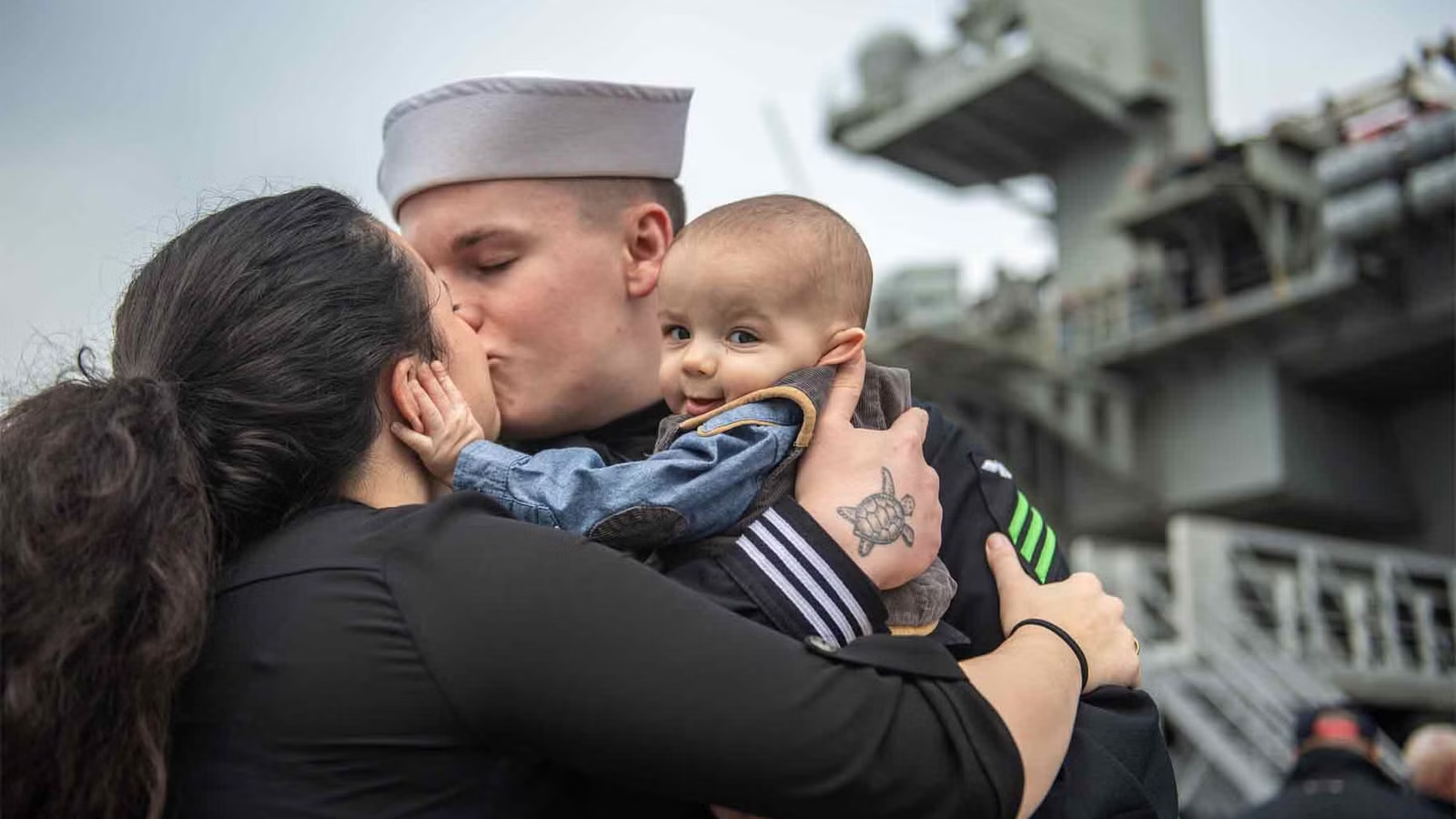
In January 2020 the USS Abraham Lincoln came home to San Diego from a 295-day deployment that had been extended three months over tensions with Iran. One of the stories, carried nationally, was about sailors meeting their babies for the first time on the pier.1 In August 2026 the same ship is coming home from a deployment of comparable length, extended over the same adversary, yet the story of its return includes a letter to the Secretary of the Navy with fifty-two congressional signatures and ten questions.2 The conditions and morale onboard the ship were not the same between the two deployments. What changed was who was telling the story.
The USS Abraham Lincoln departed the Middle East on 22 August 2026, 274 days after leaving San Diego, and will be relieved by the USS George Washington.3 4 5 The transit home may take a month or more, which would put the total deployment past 300 days and make it among the longest since the end of the Vietnam War.6 Admiral Brad Cooper described the deployment as “one of the most operationally intense and consequential of the modern era.”7 Roughly 5,000 sailors and Marines are aboard.
While many are understandably reporting on the length of the deployment, nine months is not an extraordinary deployment length. The USS Gerald R. Ford ran 326 total days in this same period, and the Lincoln herself ran 295 days in 2019 and 2020, also extended over tensions with Iran.8 What is without modern precedent is the absence of relief inside those months. The Ford’s deployment included nine port calls, roughly one every thirty-six days. The previous benchmark for consecutive days at sea was the USS Dwight D. Eisenhower at 206 days in 2020, and that record was set under pandemic port restrictions.9
So, the crew is right to say that something new is being asked of them. The families who began talking to each other were not manufacturing a grievance out of an ordinary deployment. One behavioral scientist who has studied this kind of confinement is Jack Stuster, a behavioral scientist who has studied isolated and confined populations for NASA and among Arctic researchers. He told NPR that ideal deployments run three to six months, but nine becomes untenable when one specific injury occurs. He said, “one of the worst things that you could do to the person is to tell them they’re gonna come home at a certain time, and then you say, ‘No. It’s gonna be delayed.’”10 The Lincoln was extended more than once, and families were told at the August town halls that no return date could be discussed.
The logical next question is to ask what kind of support is available to sailors and marines during a deployment that feels it has no end. The Lincoln deployed with five chaplains, a clinical psychologist, a clinical social worker, three behavioral health technicians, an embedded prevention coordinator, and a facility dog.11 Whatever failed on that ship, it did not fail for want of a behavioral health footprint.
02
How the Story Traveled
Perhaps you saw the story online, in the news, or across your social media account. Yet, it did not begin as a viral post. It began the way these things almost always begin, with family members comparing notes in the spouse-run groups that have carried military family information largely since around 2009.
In April, the Secretary of Defense characterized early complaints about conditions as “fake news.”12 That dismissal is the hinge of everything that followed. Rather than ending the story, it handed every concern after that a narrative to repeat, that the department had said this was not happening and here was evidence that it was.
Over the four months that followed, sailors sent photographs and video off the ship, and a former Navy helicopter pilot with a public platform relayed what she was seeing to a national broadcaster, including images of the mess decks and video of trash accumulating on deck because the incinerator had failed.13 A correspondent for MS NOW interviewed a dozen family members and obtained recordings of their meetings with Navy leadership.14
On 11 August the Navy held town halls in San Diego, in person and online, with the acting Secretary of the Navy and two vice admirals present and roughly 200 family members in attendance.15 One spouse told the room her husband had said he hopes he does not wake up tomorrow. A parent wrote that his son and his shipmates constantly think about jumping off the ship just for relief. Another family member told the officers trust was broken between them and leadership.
Historically, institutions have controlled the narrative, keeping a record of their own listening sessions. This was aided by the fact that previous generations naturally extended trust and loyalty to the institution, believing any actions afterwards were based on good intentions to do the right thing. Today’s culture is different. Trust in institutions are at historic lows, and the youngest generation bases its loyalty on relational currency. The Department of War did not anticipate families in the room influencing a movement behind their narrative, including their own recording of the townhall. Those recordings left the building.
The same week, trade press reported that sailors had attempted to go overboard, which converted a quality-of-life complaint into a safety story.16 A member of Congress then posted to his own account in the first person, describing moldy showers, broken toilets, laundry down for weeks, long stretches without hot water, and a meal that came down to half a cup of rice and two tortillas.17 A senator’s letter to the Secretary of Defense followed on 12 August, and a second senator called for a bipartisan congressional delegation to go and look.18 Fifty-two members of the House signed a letter to the acting Navy Secretary on 14 August posing ten specific questions, and it cited the San Diego town hall, the trade press reporting on the overboard attempts, and the MS NOW account of moldy showers and no soap as its evidence.19 On 14 August the President was asked whether the deployment had run too long and answered, “No, no, no. Not nearly long enough.”20 The following day the acting Secretary of the Navy posted to his own account that the coverage was dishonest and had harmed service members.21
From the trade press report of 11 August to the question put to the President on the 14th was three days. From the department’s first dismissal in April to its acknowledgment in August was four months.
Institutions have always controlled the record of their own listening sessions. What changed is that the families in the room made their own recording, and the recording is what left the building.
Two features of the institution’s response deserve attention from anyone who may find themselves in a leadership role. The first is that the Navy’s denial was falsified inside a day. The service stated it had not identified an increase in reported suicidal ideation or suicide attempts aboard the ship, and CNN reported within twenty-four hours that a sailor had gone overboard the previous month and been recovered.22 The acting Secretary later acknowledged that a small number of mental health cases had been treated. The second is that the institution depended on the same platforms it initially relied on for its counter-message, which means the institution did not lose access to the tools. It lost the first four months of the argument.
There is a clinical assessment of what denial costs. Dr. Phillip Hunt, a former Navy physician who deployed on submarines, told NPR that leadership denial of crew struggles “is highly detrimental to the crew’s morale,” producing “anger, anxiety, or eventually mental exhaustion and depression.”23 The denial is not only a communications problem. It is an additional injury to the people being dismissed.
03
The Method Has Worked Before: Manila, Christmas 1945
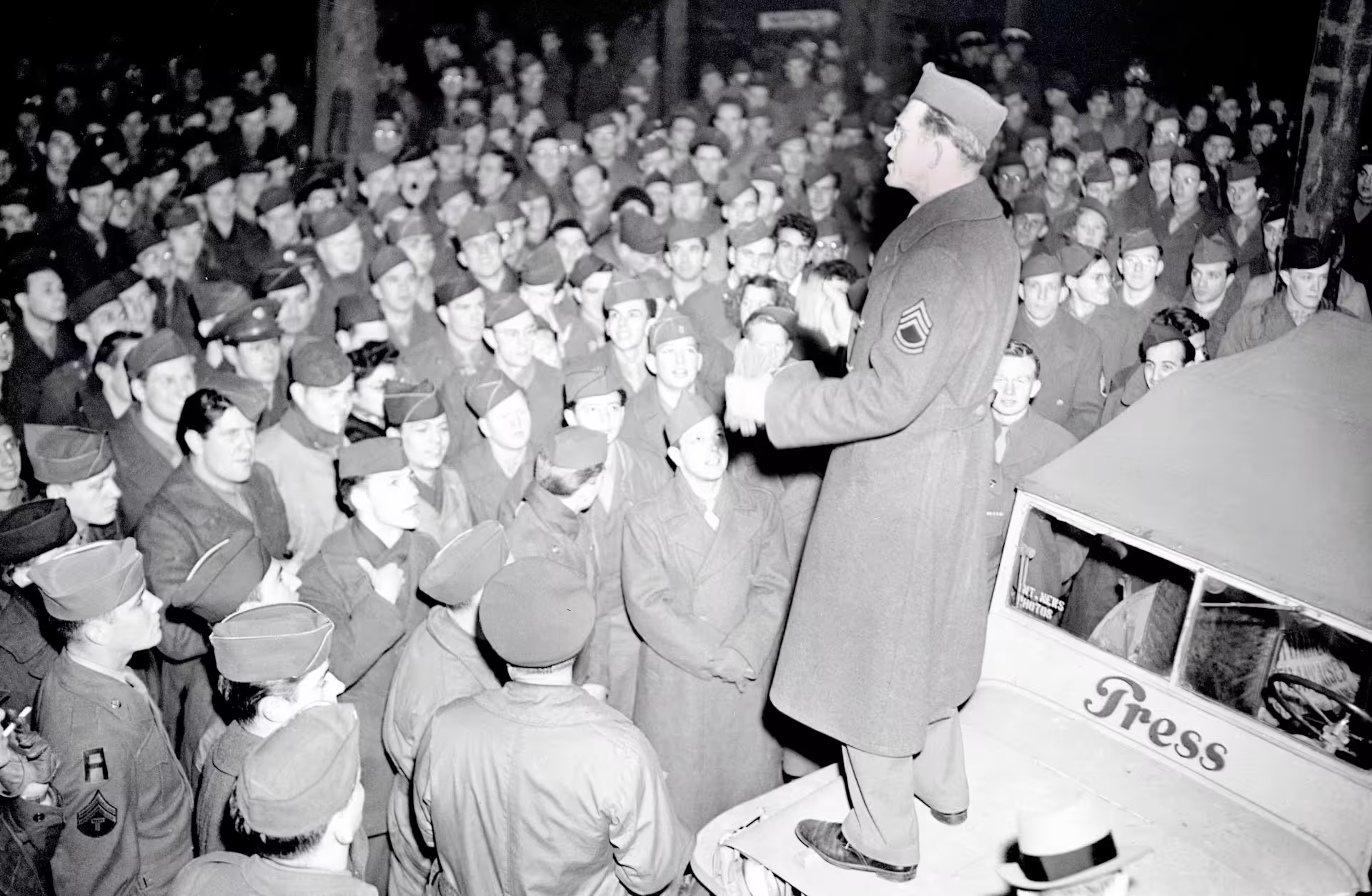
In the months after V-J Day, roughly 2.5 million American troops remained overseas and demobilization slowed. In response, four thousand soldiers marched on military headquarters in Manila on Christmas Day, 1945. Within weeks the demonstrations had spread, with more than twenty thousand in Manila, twenty thousand in Honolulu, five thousand in Kolkata, three thousand in Korea, and thirty-five hundred Air Force troops staging a hunger strike on Guam.24 Five hundred American troops in London marched to Claridge’s Hotel looking for Eleanor Roosevelt. Soldiers rubber-stamped “No Boats, No Votes” on their outgoing mail, which was an electoral threat delivered from inside the uniform. Eighteen thousand of them pooled their own money to pay for a cable to journalists, which is a crowdfunded press release in 1946. Two hundred and fifty soldiers of the 823rd Engineer Aviation Battalion, an all-Black unit serving in Burma, wrote directly to President Truman.25
At home, more than two hundred “Bring Daddy Home” clubs formed among servicemen’s wives and ran a coordinated write-in campaign to Congress. They mailed photographs of their children, and then they mailed hundreds of baby shoes tagged “Please bring back my daddy.”26
Truman privately called it plain mutiny. Eisenhower declined to discipline anyone, observing that there had been no acts of violence or disorder. Demobilization proceeded, and within eighteen months the overseas force had fallen from 2.5 million to under a million.27
Most of what we are watching in 2026 has a counterpart in 1946. There is testimony from inside the force, a parallel campaign by wives aimed past the chain and at Congress, an emotional artifact designed to travel, an intermediary sought out for her standing, and an explicit threat to the political interests of the people who could fix it. The tactic is eighty years old.
The same pattern continued through every decade that followed, in whatever form the era made available. During Vietnam, service members produced more than three hundred underground newspapers, circulated on bases worldwide and published largely without signatures.28 In 2006, roughly two thousand service members used the lawful channel available to them under Title 10 and petitioned Congress directly through the Appeal for Redress.29 In 2007, soldiers and families sourced a newspaper investigation into conditions at Walter Reed that ended with the Secretary of the Army resigning and the hospital commander relieved.30 In 2018 and 2019, spouse groups documenting mold, lead, and vermin in privatized housing supplied the reporting that produced Senate hearings and a tenant bill of rights.31 In 2020, a family-led campaign after the killing of Vanessa Guillén ended with fourteen Fort Hood leaders fired or suspended and a federal law carrying her name.32 In 2021, spouses at Pearl Harbor organizing through their own groups forced acknowledgment that jet fuel had reached the drinking water.33
04
The Shift to Track Is Not About Technology
Something has shifted across those eighty years, though it is easy to misidentify what. The workaround itself is constant, and the technology matters less than you think. What has shifted is who absorbs the risk.
In 1946 tens of thousands of men absorbed the risk, which made it arithmetically uncrushable. Eisenhower declined to punish anyone, citing the absence of violence or disorder, and whatever his reasoning there is no practical way to court-martial twenty thousand soldiers in Manila. During Vietnam, anonymity diffused the risk, since an unsigned newspaper protects the person who wrote it. At Walter Reed, the risk was transferred to the press, where reporters absorbed the institutional exposure and protected their sources.
After that the pattern narrows to a single person. In April 2020 the commanding officer of the USS Theodore Roosevelt wrote a letter about a COVID outbreak aboard his ship, the letter reached a newspaper, and his crew filmed themselves cheering him down the brow as he left.34 He was fired. The acting Secretary of the Navy who fired him flew out, called him stupid over the ship’s announcing system, and resigned when that leaked as well.35 The mechanism functioned completely, and the one man who used it was removed from command. That case is an important part of this conversation in that it is not a success story. Any account of going around the chain that omits it is teaching families something false about their odds.
What is significant in 2026 is that the risk has settled on spouses. Spouses became the instrument because they are the last people in the household not ordinarily subject to the Uniform Code of Military Justice. When a grievance can no longer be carried safely by the service member, by the commander, or by an anonymous newspaper, it moves to the person with no formal exposure. No one chose this migration as a strategy but it is what remains after the other carriers have been foreclosed one by one.
05
A New Perspective of Reach
Here is what should hold a commander’s attention. Twelve families and one recording did in three weeks what took twenty thousand men in Manila. But those twelve are individually identifiable, and the twenty thousand were not.
It is important to note that two things move when a grievance goes public. The first is reach, meaning how far the account travels and how fast. The second is cover, meaning what protects the person whose name is on it. In 1946, reach and cover moved together and the protection came from the number of people that were involved. Twenty thousand men marched in Manila. No commander can discipline twenty thousand men, so each of them was protected by the other nineteen thousand nine hundred and ninety-nine. Mass carried the message and mass absorbed the risk. It did both jobs at once.
The two have since come apart. A recording from a town hall reaches a national audience in a day, and it does that whether twelve people stand behind it or one. Distribution has replaced mass. Distribution carries the message and absorbs nothing. A spouse who speaks on the record is reaching an audience the Manila marchers could not have imagined, and she is standing there by herself while she does it.
Think about it. Sailors sent photographs without their names attached, because anonymity is protection. A former Navy pilot relayed what she was seeing, because she has already left and there is nothing further to take from her. Members of Congress asked the questions in public, because their standing does not depend on the Navy. None of those are stylistic choices. They are the places where the protection still is.
Reach went up. Cover went down. The institution did not account for that.
06
The Two for One Model, Tested and Shifting
Nancy Shea's The Army Wife was printed six times between 1941 and 1966 and distributed to officer, NCO, and enlisted wives alike. By 1966 it had been revised by one- and two-star generals and carried the full cooperation of Pentagon authorities on the inside page. It told a wife that her conduct would have a direct effect on her husband's efficiency and chances of promotion. That is the two for one model stated in print, by the institution, as guidance. Recruit one person, expect the labor and the loyalty of two, and enforce the arrangement through the career of the one you pay.
Spouses have contested this before. By the early 1980s they were telling the Army directly that the Shea model was outdated and unsustainable, and they won real changes, including striking the word dependent from policy papers, publications, and orders.
Despite the institution’s admittance that there are no expectations on the spouse to volunteer, the culture still carried the fear that one’s actions could jeopardize the service member’s career. The vocabulary has been retired for forty years but is still in the room, which is why most spouses in 2026 weigh potential remarks carefully before they give a reporter their name. The institution has benefited from the leverage that fear offers.
While a majority of Gen X spouses still lived under this fear throughout the Global War on Terrorism (GWOT), the younger generation is pushing new limits. If they hold jobs, or want to, they are less willing to sacrifice it, building careers alongside the service member's rather than behind it. The institution has been counting the cost of this in its own documents for years, in a spouse unemployment rate above twenty percent and a wage gap of roughly a quarter against civilian peers. Those numbers describe a population that has already reorganized its life around something other than the arrangement. A spouse who is not trading her career for the institution's goodwill has less of the institution's goodwill to lose.
The infrastructure followed. Secure Families Initiative, as one example, launched in November 2019 for the express purpose of uniting, training, and mobilizing spouses to speak publicly, on the argument that Americans hold goodwill toward military families without much understanding of their lives, and that the resulting policy misses. Individual spouses have since built followings across social media and write under their own names about military family policy. This is a capability that did not exist in 2010.
The two for one model bundled two obligations that have nothing to do with each other. The first is operational security (OPSEC), which is lawful, specific, and not in dispute. The second is reputational silence, which was never law and never policy. Spouses are still wanting to prioritize OPSEC, but less willing to feel obligated to stay silent. The content coming off the Lincoln concerned mold, food, laundry, and mental health. None of it was operational. The leverage the institution still exercises depends on those two obligations remaining fused in people's minds, and they are coming apart. That is happening even under another fear the institution often leverages, that speaking gives an adversary an advantage.
Spouses are testing whether reputational silence is enforceable, and the early evidence is that it is not. A norm without a regulation behind it holds only as long as people observe it. On career consequence, they know the cost is real. Many have shared that they have their service member’s blessing to speak up. Laura O'Dea has over 20k followers on Instagram and said her “husband signed an oath, but she made a vow to defend him.” (Instagram, @_lauraodea.ma).
View this post on Instagram
What they have decided is that it is worth paying. A spouse goes on the record at the point where she judges the harm already exceeds what the career is worth, and more spouses are reaching that point because the career was already worth less to them than the institution assumed.
07
Could the USS Lincoln Shape What Is Next for Bahrain Evacuees
In late February 2026, drone and missile attacks on Naval Support Activity Bahrain forced the evacuation of more than eight thousand service members, contractors, spouses, civilians, and school staff.36 Nearly six months later many of those families remain in temporary duty status, scattered across Germany and the United States, ineligible for base housing or rental assistance because of that status, with out-of-pocket costs running from roughly two thousand to more than fourteen thousand dollars and reimbursement slow or incomplete.37 Educators have described continuing nightmares. Children have been enrolled and re-enrolled across several states. A vice admiral has indicated that reopening Bahrain to families is not a near-term option.
By any humane accounting this is a larger harm than the one aboard the Lincoln, affecting more people over a longer period and including children.I have found no senator’s letter on it, no question put to the President about it, and no change of policy.
The reporting on all of this exists and has run nationally, so what is missing is not coverage but something else. No gag order appears anywhere in the record. What appears instead is that a newspaper granted anonymity to four evacuees because they feared repercussions for speaking publicly, and a broadcaster withheld a name to protect a spouse’s career.38
I have heard two separate accounts from spouses personally affected by the evacuation. Both shared extensive trauma because of the event. One tearfully told how her husband’s command had offered no guidance, answers, or help, adding pressure to not say anything or face “legal consequences”. Her husband has, as a result, decided to end his career as soon as possible and giving his blessing to her sharing what happened “somehow”. Here she was sharing her story somewhat anonymously in hopes someone else could begin a movement.
The complexity in this method working for the Bahrain evacuees is that the Lincoln is one hull with one accountable chain, and there is somebody to demand answers from. The Bahrain families are dispersed across services, statuses, and continents, and there is no single node responsible. The Lincoln families remained a community with a physical anchor in San Diego and relationships that had compounded over years. The evacuation dissolved the Bahrain community, and a community that has already come apart cannot easily come together again to protest what came apart.
Another variable to watch is this: the Lincoln account attached itself to an active political fight. The House letter of 14 August carries fifty-two signatures and not one of them belongs to a member of the majority party, and every Senate letter and public call for a probe that I located came from the same side.39 That does not make a single family’s testimony less true, and the questions those letters ask are the right questions. It does mean the grievance traveled in part because it was useful to someone with a platform, and a grievance that serves no one’s interest may not travel at all. Any family that expects this method to work for them should understand that it worked here with that advantage.
08
What This is Actually About
There is one more piece of this that came to us as a field observation rather than as reporting, and it should be handled carefully.
It was relayed third hand, that a sailor who went over the side of the Lincoln did so in plain view of the captain and was recovered. In the telling, a friend of his said he understood the act might kill him and did it anyway, because he had concluded there was no other way to get attention on that ship. That a sailor went overboard and was rescued is independently reported.
I am not going to assert that man’s motive, and I would ask that no one else assert it either. What I can report is the interpretation, because the interpretation is itself the data. Shipmates and spouses are telling each other that a man went into the water because he had run out of ways to be heard, and that explanation is spreading because it is plausible to the people who live there. Whether or not it is accurate about him, it is accurate about them. A community that finds this explanation credible has already concluded that its ordinary channels do not work, and that belief will shape behavior regardless of what happened that day.
Which brings me to the only thing this brief will offer the community. Some lessons learned that may help in your level of personal or professional leadership:
- Going around the chain of command is expensive. It has cost people their commands and their careers, and in at least one account circulating aboard the Lincoln it very nearly cost more than that. Nobody pays that price when the route through the chain is open and working. A leader who cannot yet verify what his people are saying can still verify that they chose the expensive route and can leverage curiosity towards the people and the system that is showing cracks.
- Silence is not the same as satisfaction. The Bahrain families carry a larger harm than the Lincoln families by any humane measure, and they have produced no letters, no questions, and no change in policy. What they have instead is anonymity granted by reporters to protect careers. A leader who reads a quiet formation as a healthy one is reading the wrong instrument. The absence of complaint measures the cost of complaining.
- A behavioral health footprint is not a grievance channel. The Lincoln sailed with five chaplains, a psychologist, a social worker, three behavioral health technicians, a prevention coordinator, and a facility dog. The resourcing was there and the account still left the ship by other means. Counting helpers tells a leader what has been provided. It does not tell him whether anyone believes that using them will change anything.
- A denial you have not personally verified is a wager. The service said it had identified no increase in reported suicidal ideation or attempts, and the contradiction was public within a day. On a ship of five thousand people carrying cameras, a categorical statement about conditions bets that no evidence exists to the contrary. Hunt’s finding is what the losing side of that bet costs. The crew hears a denial as a statement about whether their experience is real.
- Observe that in the four months between April and August, the department had dismissed the account and had not yet offered one of its own. The institution lost authorship of a story about itself. By the time it wanted to speak, the record had already been written by other people, and the only move still available was to argue with it.
- Separate the two obligations before someone else does. Operational security is lawful, specific, and enforceable. Reputational silence is custom. A command that treats them as one thing spends real authority to enforce a norm it does not own, and risks compliance with the part that actually matters. Families who watch the two get conflated learn to discount the whole instruction.
The Lincoln is coming home. The method that helped bring her home is eighty years old, and it worked, which means other families will study it. The next leader to meet it will not have the advantage of surprise that this one had.
What that leader inherits is not a communications problem. It is a group of people who judged that the ordinary route would not work and went looking for an expensive one. The cost was not evenly distributed. A commanding officer lost his ship. A spouse in Bahrain gave a reporter her story without her name on it and hoped it would be enough for someone else to pick up. On the Lincoln, a sailor went into the water, and his shipmates have their own explanation for why.
For the families in this brief, going public was not a first choice. It was what remained. The answer did not arrive until the story did, and that sequence is the thing worth carrying into the next deployment, the next evacuation, and the next town hall where someone in the room decides to hit record.
Tell us what you decided. Responses become field notes for the next brief. I anonymize what gets cited and always ask permission before naming anyone. You can reach me directly at corie@corieweathers.com, or through the contact form at corieweathers.com/contact. A brief is a starting point, not a conclusion. What you see shapes what I write next.

Sources
- Fox News, “USS Lincoln sailors meet babies for first time after 295-day deployment,” January 2020. ↩
- Letter to Acting Secretary of the Navy Hung Cao, 14 August 2026, released by the office of Rep. Joe Courtney. ↩
- USNI News, “USS Abraham Lincoln Leaves the Middle East After Almost 7 Months,” 22 August 2026. ↩
- Newsweek, “USS Abraham Lincoln Heads Home After 272 Days,” 20 August 2026; letter from 52 members of the House to Acting Secretary of the Navy Hung Cao, 14 August 2026. Sources differ by a few days on the San Diego departure and the Guam port call. ↩
- USNI News, “USS Abraham Lincoln Leaves the Middle East After Almost 7 Months,” 22 August 2026. ↩
- Ibid. ↩
- NPR, “USS Washington to relieve USS Lincoln after concerns about the crew’s mental health,” 17 August 2026. ↩
- The War Zone, “Supercarrier USS Abraham Lincoln Passes 200 Consecutive Days At Sea Mark,” 9 July 2026; Fox News, January 2020, op. cit. ↩
- The War Zone, op. cit.; USNI News, 22 August 2026, op. cit. ↩
- NPR, “As USS Lincoln heads home, mental health experts tally the stressors of life at sea,” 21 August 2026. ↩
- Task & Purpose, “Navy sending more mental health help to the USS Abraham Lincoln crew,” August 2026. ↩
- Newsweek, “Navy Responds to Reports USS Lincoln Sailors Are Trying to Jump Overboard,” 13 August 2026. ↩
- NPR, “No privacy, little downtime: Life aboard the USS Abraham Lincoln,” 14 August 2026. ↩
- MS NOW reporting by Priya Sridhar, August 2026. ↩
- Stars and Stripes, “USS Abraham Lincoln families press Navy leaders over sailors’ mental health,” 11 August 2026. ↩
- Military Times, “Senator presses Navy for answers on USS Abraham Lincoln deployment,” 13 August 2026. ↩
- Rep. Mike Levin, posts to X, August 2026. ↩
- ABC News, “Democrats demand answers about conditions aboard USS Lincoln,” August 2026. ↩
- Letter to Acting Secretary of the Navy Hung Cao, 14 August 2026, released by the office of Rep. Joe Courtney. ↩
- Newsweek, 20 August 2026, op. cit.; Axios, “Trump shrugs off concerns about dismal conditions on USS Abraham Lincoln,” 14 August 2026. ↩
- Stars and Stripes, “Navy secretary calls reports of Lincoln crew struggles ‘dishonest,’” 15 August 2026. ↩
- CNN, “Sailor went overboard from the USS Abraham Lincoln this month as conditions on the ship prompt lawmakers’ demand for answers,” 13 August 2026. ↩
- NPR, 21 August 2026, op. cit. ↩
- Inquirer, “Starting in postwar Manila, homesick G.I.s mutinied in 1946 and won.” ↩
- Ibid. ↩
- HISTORY, “Why World War II Soldiers Mutinied After V-J Day.” ↩
- Inquirer, op. cit.; HISTORY, op. cit. ↩
- Painter and Ferrucci, “‘Ask what you can do to the Army’: A textual analysis of the underground GI press during the Vietnam War,” Journalism, 2019. ↩
- Appeal for Redress, 2006, submitted under 10 U.S.C. § 1034. ↩
- Washington Post investigation into Walter Reed Army Medical Center, February 2007. ↩
- Reuters investigation into privatized military housing, 2018; Senate Armed Services Committee hearings, February 2019. ↩
- BBC, “Fort Hood: Soldiers fired and suspended after Vanessa Guillen probe,” December 2020. ↩
- Honolulu Civil Beat, “Report: Navy Mismanagement Led To Red Hill Water Contamination Disaster,” November 2024. ↩
- Navy Times, “Navy fires Theodore Roosevelt skipper following leaked letter pleading for COVID-19 assistance,” 2 April 2020. ↩
- Ibid. ↩
- Stars and Stripes, “Months later, Bahrain evacuees still don’t know what’s next,” 29 May 2026. ↩
- Ibid.; NPR, “Months after being evacuated from Bahrain, military families await their next move,” 12 August 2026. ↩
- Stars and Stripes, 29 May 2026, op. cit.; NPR, 12 August 2026, op. cit. ↩
- Letter to Acting SecNav Cao, 14 August 2026, op. cit.; ABC News, August 2026, op. cit. ↩
The Culture Shift. · Corie Weathers, LPC · corieweathers.com/brief

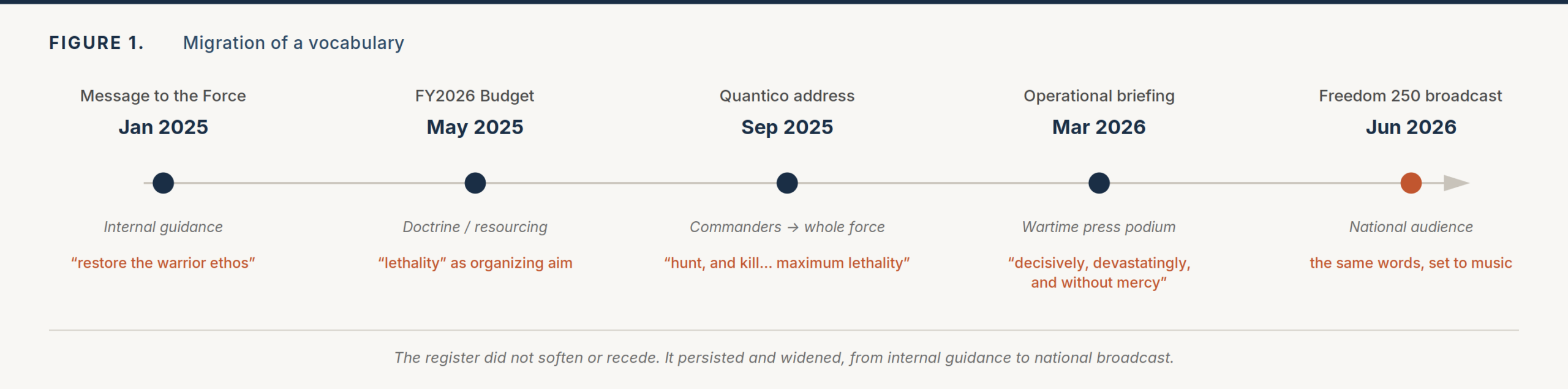
Brief 02: The Rhetoric of Lethality
The vocabulary of and toward the military has narrowed to a single attribute — and the person who carries it has been edited out.
Maximum lethality. Hunt, and kill. Without mercy. None of it is wrong — they are warfighters. But this brief traces where that register has worked, where it has failed, and what it asks of the people who must live inside it.
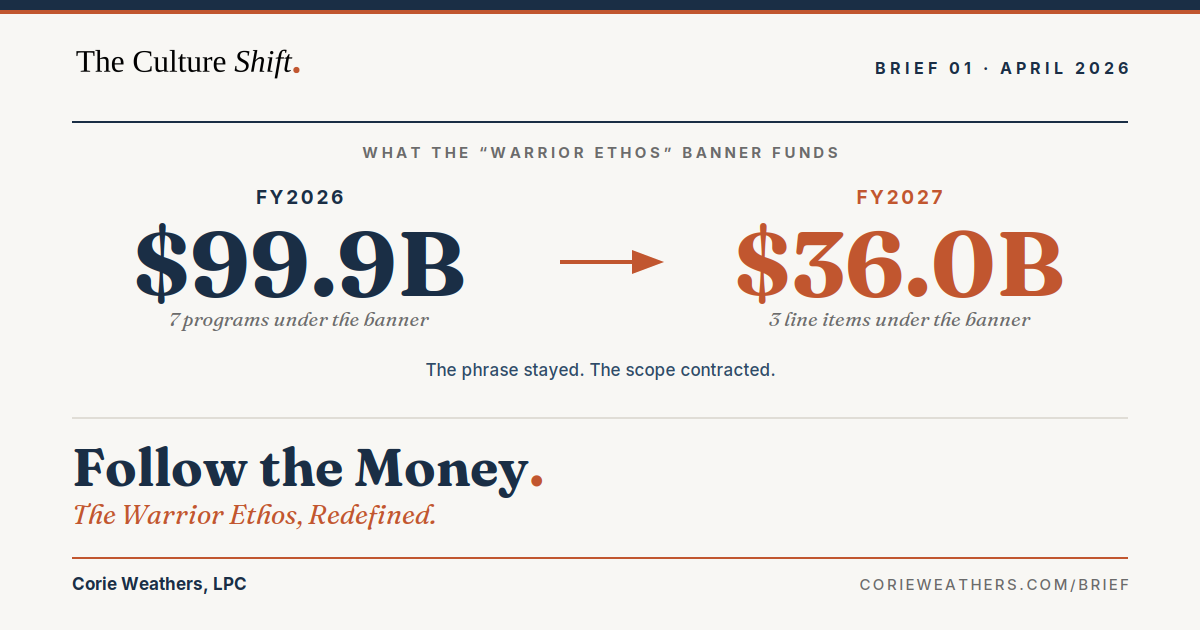
Brief 01: Follow the Money: The Warrior Ethos, Redefined
The FY2027 $350 billion mandatory defense request, and what the Warrior Ethos banner funds now.
The language calls it the Warrior Ethos. The scope has changed. This brief walks through three connected shifts in 2026 — in words, money, and how the institution treats the people who sustain the force — and what they mean for military families.