

Brief 01 · April 2026
Follow the Money.
The Warrior Ethos, Redefined.
Corie Weathers, LPC, BCC · Clinical Advisor on Military Morale and Leadership
Published by Corie Weathers, LLC · April 2026
The Department of War is requesting $350 billion in new defense funding outside the normal appropriations process. The language calls it the Warrior Ethos. The scope has changed. This brief walks through three connected shifts in 2026, in words, money, and people, and what they mean for the families who sustain the force.
About this brief. This is the first brief in The Culture Shift, a quarterly series written by Corie Weathers, LPC, that curates complex policy and cultural information into language leaders and families can act on. Each brief follows a single cultural signal from institutional language through budget data into lived experience. For readers of Military Culture Shift (Elva Resa, 2025), a brief is the bite-sized companion to the book: one theme, one document, readable in a sitting. Sources include presidential budget requests and supporting documentation, congressional testimony, Government Accountability Office and Congressional Research Service reports, and field observations from ongoing training and consulting work with senior military leaders and military families. Where a claim is made in this brief, a source is listed at the back.
The Shift in One Page
Follow the Money. The Warrior Ethos, Redefined.
The relationship between the military institution and the families who sustain it is shifting simultaneously in three places. Reading them together makes the pattern visible.
In Words
How the institution talks about military families
1980s Recruiting Assets
↓
2000s Backbone of Strength
↓
2010s Readiness Inputs
↓
2025– Informed, Not Assessed
2026 NDS:
“Warrior ethos” × 3
“Family” × 0
In Money
What the Warrior Ethos banner actually funds
FY2026
$99.9B
under the banner, 7 programs
↓
FY2027
$36.0B
under the banner, 3 line items
Not in this lane:
Defense Health · Child care
MWR · Spouse employment
BNA · TRICARE · PCS reform
(remain in normal appropriations)
In People
How the institution treats the people it depends on
One pattern, at three levels:
Same signal.
Three levels.
“The strength of our nation is our Army; the strength of our Army is our soldiers; the strength of our soldiers is our families.”
Gen. Raymond Odierno, Chief of Staff of the U.S. Army, 2014
The framework Odierno named is not the framework shaping today’s decisions.
Families are reading the words, the money, and the pattern.
All three tell the same story.
01
Why This, Why Now
On April 3, 2026, the White House released the FY2027 President’s Budget Request. The headline number is $1.5 trillion in total defense funding. The less-discussed number is $350 billion: the size of a separate mandatory request that moves through budget reconciliation rather than the annual appropriations process.
The day before, on April 2, the Secretary of War fired the Army Chief of Staff, the Chief of Chaplains, and the commander of Transformation and Training Command in a single afternoon. These firings occurred during an active war. No reasons were given publicly beyond “retirement effective immediately.” They were among more than a dozen senior uniformed firings since January 2025.
These two events, the budget request and the firings, are not connected in any conspiracy-theory sense. They are connected as expressions of the same pattern. The institution’s relationship with military families is shifting simultaneously in three places: in the words it uses about them, in the money it allocates for them, and in how it treats the people it depends on, from the senior officers who sit in family-adjacent seats down to the civilian workforce that runs family programs.
This is a different kind of ask. The $350 billion request is not a supplemental in the sense of the Overseas Contingency Operations account that funded Afghanistan and Iraq. It is not a discretionary increase that Congress negotiates in the normal way. It is the second use of a mechanism, first deployed in the One Big Beautiful Bill Act of 2025, that lets an administration move large blocks of defense funding outside the annual budget cycle with only a simple majority vote in the Senate.
Most families will not read the 28-page FY2027 Mandatory Budget Overview. Most leaders will not either. But the document carries the Warrior Ethos banner that the administration has used since January 2025, and it defines what that banner now funds. That definition matters. It shapes what every command beneath the Pentagon hears the institution prioritize, and it shapes what families see when they look at the budget and try to find themselves in it.
The question driving this brief. When the same language a generation of family programs was built around is preserved, but the scope it now funds is contracted to facilities and vouchers, and the institution is treating people, at every level, differently than it did a year ago, what does that mean for the families who sustain the force?
02
The Signal, in Three Registers
The relationship between the military institution and its families has always been defined by what the institution says, what it funds, and who it empowers to carry the case inside the building. In 2026, all three are shifting at once, and in the same direction. Reading them together makes the pattern visible in a way that no single register makes it.
In Words
For forty years, the institution’s language about families has moved through four distinct eras. In the 1980s, as the all-volunteer force stabilized, families were framed as recruiting assets: General Wickham’s 1983 Army Family white paper made the institutional case that family benefits were force multipliers. In the 2000s, during the GWOT deployment cycles, leaders like General Odierno named families the backbone of force strength, an effort to sustain morale under sustained operational demand. By the 2010s, after sequestration, the language had narrowed again. Families were readiness inputs: measurable contributors to service member performance, discussed in readiness briefings as a factor affecting deployability. In 2025, the vocabulary narrowed a fourth time. Families are now informed, not assessed. Recent institutional briefing products have narrowed the commander’s responsibility toward families to a single function: inform. Not support. Not resource. Not assess. Inform.
1980s
Families as Recruiting Assets
2000s
Families as Backbone of Strength
2010s
Families as Readiness Inputs
2025–
Families as Informed, Not Assessed
In the 2026 National Defense Strategy published in January 2026, the phrase “warrior ethos” appears three times. The words family, spouse, and quality of life appear zero times. The language of the institution’s highest strategy document and the language of the most recent budget are tracking closely together.
The strength of our nation is our Army; the strength of our Army is our soldiers; the strength of our soldiers is our families. That is what makes us Army strong.
Gen. Raymond Odierno, Chief of Staff of the U.S. Army, 2014 · Cited in Military Culture Shift, Ch. 1 (Weathers, 2025)
In Money
“Warrior Ethos” is a phrase with institutional history. It carried forward from the infantry ethos of the pre-GWOT era and, in the FY2026 Defense Budget Overview Book, became the banner for an entire chapter that funded the Defense Health Program, family housing, family support programs including child care, MWR, and commissary, DoDEA schools and base operations support, military construction and facilities sustainment, and junior enlisted pay raises.
The phrase was attributed to Secretary of War Pete Hegseth in his January 2025 Message to the Force: “The President gave us a clear mission: achieve Peace through Strength. We will do this in three ways, by restoring the warrior ethos, rebuilding our military, and reestablishing deterrence.” The institutional machinery of the Comptroller, P&R, and the Services filled that phrase with content drawn from forty years of family-inclusive budgeting tradition.
In the FY2027 Mandatory Budget Overview, released 15 months later, the Warrior Ethos section funds three things: Mitigating Poor and Failing Facilities ($29.9 billion), Barracks Funding Reform ($5.2 billion), and DoDEA School Choice Vouchers ($870 million). That is $36 billion total. Every family-facing people program listed above is absent from the new money. The phrase stayed. The institutional memory that filled it with family-inclusive content is thinner. The scope contracted accordingly.
What “Warrior Ethos” Funds, and What It No Longer Does
FY2026 Discretionary Request
What the Warrior Ethos chapter funded last year
| • Defense Health Program | $42B |
| • Unaccompanied Housing (Barracks) | $7.2B |
| • Family Support Programs | $10B |
| • Family Housing | $1.9B |
| • Military Construction | $11B |
| • Facilities Sustainment (FSRM) | $27B |
| Total under the Warrior Ethos banner | $99.9B |
FY2027 Mandatory Request (new, $350B)
What the Warrior Ethos section funds now
| • Facilities Sustainment & Repair | $30B |
| • Barracks Funding Reform | $5.2B |
| • DoDEA School Choice Vouchers | $0.9B |
| • Defense Health Program | not included |
| • Family Support Programs | not included |
| • Child Care & Youth Programs | not included |
| • MWR / Warfighter & Family Services | not included |
| • Commissary | not included |
| • Military Pay | not included |
| Total under the Warrior Ethos banner | $36.0B |
Both documents use the language of Warrior Ethos. They do not fund the same scope.
In People
On April 2, 2026, the Secretary of War fired three senior Army officers in a single afternoon: the Chief of Staff of the Army, the Chief of Chaplains, and the commander of Transformation and Training Command. The firings occurred during an active war in the Middle East, with no public explanation beyond “retirement effective immediately.” They were among more than a dozen senior uniformed firings since January 2025, following the earlier removals of the Chairman of the Joint Chiefs and several service chiefs.
Authority vs. cause. The President and the Secretary of War have the authority to remove any general officer. That authority is constitutional and well-established. What is unusual is the absence of stated cause in a cluster of firings that included the Army’s top officer, the Army’s top chaplain, and the officer leading the service’s transformation effort, all removed in a single day, during wartime, with no public explanation. Leaders and families read the signal even when the reason is not named.
The effect worth noting is not at the four-star level. It is at every echelon beneath it. Leaders throughout the force now operate with a heightened awareness of political risk attached to offering frank advice, raising concerns, or advocating for programs that might read as out of step with the current institutional direction. That awareness is not paranoia. It is a realistic reading of the environment. The timing of the April 2 firings, the day before the FY2027 budget release, is noted without claiming to know the reason for it.
What this produces at ground level is a force where commanders calibrate what they say in staff meetings, what they include on the unit’s priority list, and what they advocate for through their chain. Family programs, morale concerns, and quality-of-life observations compete for scarce advocacy capital in a moment when leaders perceive real risk to sounding off-message. Families feel the downstream effect even when they do not see the cause. Programs feel thinner. Requests feel slower. The commander’s attention is pulled toward the mission and away from the family side of the job, not because leaders care less, but because the institutional environment rewards calibration.
Read in one register, each of these signals is debatable. Language shifts across administrations. Budgets reflect priorities. Generals serve at the pleasure of the President. Read together, they describe a single pattern that reaches every level of the institution. At the top, senior leaders are removed without stated cause, and the seats most closely tied to soldier and family wellbeing, including the Chief of Chaplains, sit vacant while replacements are sought. In the middle, the DoD civilian workforce that runs family-facing programs has been reduced by DOGE actions. At the bottom, family programs have been left out of the largest new defense pot in a generation. The cultural shift is not about any single firing or any single line item. It is about how the institution now treats the people it depends on, at every level, and what families feel cumulatively as a result.
03
What the Data Shows
How the FY2027 Request Is Structured
The administration is requesting $1.5 trillion in total defense budgetary resources for FY2027. This comprises:
- $1.154 trillion in base discretionary budget authority, moving through the normal annual appropriations process
- $350 billion in additional mandatory resources through budget reconciliation, bypassing the filibuster and most of the oversight that applies to discretionary spending
The mandatory request is the second of its kind. The first was the $155 billion in defense funding provided by the One Big Beautiful Bill Act of 2025, also enacted through reconciliation. OMB Director Russ Vought described the approach at a defense conference in December 2025 as a “paradigm shift for beating Democratic opposition in the Senate, where the filibuster remains intact.”
The $350 billion, combined with the discretionary request, would represent a 28 to 42 percent increase over FY2026 defense funding, depending on how one counts the OBBBA baseline. Even the size of the increase is contested.
Where the $350B Is Allocated
The Warrior Ethos line is the fourth-largest category in the request, at roughly 10 cents of every dollar of new mandatory funding.
The administration has described the theme of this request as “shifting from a sustainment-based force to a force investing in productive expansion of the industrial base.” Reading the section allocations, that description is consistent with the numbers: roughly three quarters of the request is for weapons, technology, and the industrial capacity to produce both.
What the $36 Billion Warrior Ethos Section Actually Funds
| Line Item | Amount |
|---|---|
| Mitigating Poor & Failing FacilitiesFacilities sustainment across DoW. Roughly $8.6B of this reaches barracks and family housing directly. The remainder is general installation facility repair. | $29.9B |
| Barracks Funding ReformNew authorities for rapid barracks capacity expansion. | $5.2B |
| DoDEA School Choice VouchersNew $15,500-per-student tuition benchmark under EO 14191. Projected to cover about 11,000 dependents. | $0.87B |
| Total Warrior Ethos | $36.0B |
Not funded in this lane. Defense Health Program. Military pay. Child Development and Youth Programs. Morale, Welfare and Recreation. Warfighter and Family Services. Commissary. DoDEA base operations. Spouse employment. Basic Needs Allowance implementation. TRICARE access. PCS reform. These programs are not zeroed out, but they are not in the $350 billion mandatory request. They remain in the normal appropriations process, where they compete with everything else for a constrained share of discretionary resources.
04
The Question This Raises
What happens if this pattern continues without conversation or education of families? Families will continue to think the DoD has their back when, in words, funds, and responsibility, the institution is pulling away. Is this what needs to happen to keep the DoD from being stretched too thin? That is the question this brief puts on the table. There is no institutional body currently positioned to answer it. There is no advocacy venue where the three registers, words, money, and people, are being considered together. Whatever answer gets settled on will be settled in rooms where most families and most leaders are not present, unless the conversation starts somewhere else first.
05
To the Leader Reading This
The leaders reading this brief did not create the shift it describes. You are navigating a strategic environment that demands more than any predecessor cohort in a generation. The industrial base cannot currently produce munitions at the rate peer competition requires. Critical minerals are controlled by an adversary. Shipyards cannot produce submarines at the Navy’s demand. These are real problems, and the people working on them are not indifferent to military families. They are trying to solve the problem in front of them with the tools they have.
The families you serve, the units you lead, the staff you supervise, and the peers you advise are watching you navigate this. What they will remember is not whether you fixed the systemic problems named in this brief. Those are above your pay grade and above ours. What they will remember is whether you kept asking how families are doing when the institutional vocabulary stopped rewarding the question, whether you named the Warrior Ethos in your shop in terms that included the people who sustain the mission, and whether you used your position, whatever its scope, to keep the conversation alive where you stand.
Two things you can do inside your authority, regardless of what the budget does:
Publish the training and operations calendar ninety days out. When it changes, communicate directly to families. One email signals that someone thought about them. Predictability is the thing families most often tell me they wish leaders would protect, and it is entirely within your control.
Stop counting FRG attendance. Ask a different question: how many families in your unit could name three people they would call in a crisis? That is the readiness metric. Formal programs matter less than whether families have informal networks to lean on, and the research confirms it.
Source: Knobloch, McMaster, Tannenbaum & Ray (2025), Military Psychology, Millennium Cohort Family Study, N=1,325. Informal networks produce better outcomes than formal programs.
The institution’s formal machinery for family readiness may be thinner this year than last. The informal machinery, the leader who asks the right question at the right time, the spouse who brings the observation forward, the commander who writes the memo nobody asked for, has never depended on a budget line to function. It depends on you. This brief exists to give you better data to work with, not to tell you what to do with it. You know your people. Trust that.
06
A Question for You
The data in this brief tells one part of the story. The other part lives at ground level, in the conversations happening in neighborhoods, FRGs, commanders’ calls, and staff meetings that no policy document reaches. That is the part I cannot write without you.
If you are a senior spouse, a commander, a civilian policy advisor, a junior officer, a retired leader, or a military family member with something to say about what you are seeing, I want to hear it. What is the conversation sounding like in your shop, your unit, your neighborhood? What are families bringing to you that is not making it into the hearing room? Where is the gap between what the institution is saying and what you see on the ground?
Write to me. Responses become field notes for the next brief. I anonymize what gets cited and always ask permission before naming anyone. You can reach me directly at corie@corieweathers.com, or through the contact form. A brief is a starting point, not a conclusion. What you see shapes what I write next.
About This Brief
The Culture Shift is a quarterly brief series written by Corie Weathers, LPC, connecting policy data, budget analysis, and ground-level observation into a picture no single source provides. Each brief follows one cultural signal from institutional language to lived experience.
About the Author
Corie Weathers, LPC, BCC, is a Clinical Advisor on Military Morale and Leadership and the author of Military Culture Shift (Elva Resa, 2025). A licensed professional counselor and military culture consultant, she works with senior military leaders, spouses, and policy stakeholders to bridge the gap between institutional policy and family experience. She is a military spouse of more than twenty years.
Related Reading
- Military Culture Shift, Corie Weathers (Elva Resa, 2025). The full historical treatment of how policy, culture, and generational change have shaped the force. Chapters 1, 4, 6, and 9 are most directly relevant to the arguments in this brief.
- Follow the Money (2025). One-sheet showing how defense budget growth has outpaced investment in military families since 2001.
Sources
- Department of War, FY2027 Mandatory Budget Overview, April 2026.
- Department of Defense, FY2026 President’s Budget Request Overview, March 2025.
- Office of Management and Budget, FY2027 Topline Fact Sheet, April 3, 2026.
- 2026 National Defense Strategy, Department of War, January 2026.
- Committee for a Responsible Federal Budget, “An Overview of the President’s FY 2027 Budget,” April 2026.
- Akin Gump, “White House Releases FY2027 Presidential Budget Request,” April 2026.
- EPIC for America, “President Trump’s FY 2027 Discretionary Funding Request,” April 2026.
- Inside Defense, “White House’s historic FY-27 defense budget fueled by reconciliation,” April 2026.
- Eric Bazail-Eimil, “Mullin: No more money to pay DHS employees as of May,” Politico Pro, April 21, 2026.
- Weathers, Corie. Military Culture Shift. Elva Resa Publishing, 2025. Chapters 4 (Follow the Money), 6 (The Great Culture Shift), 9 (Spouse Culture).
- Secretary of Defense Pete Hegseth, “Message to the Force,” January 2025.
- Written Testimony, SASC Subcommittee on Personnel, Oversight Hearing on Quality of Life in the Military, February 11, 2026.
- American College of National Security Leaders, Strategic Advisory Brief, February 2026.
- Axios, “Hegseth’s wartime firing of top generals stuns officials,” April 3, 2026.
- Time, “The Army Chief Hegseth Ousted, and the General Who’s Taking Over,” April 3, 2026.
- CNN, “Hegseth ousts US Army chief of staff and two other generals amid Iran war,” April 2, 2026.
- Washington Post, “Hegseth forces out Army’s top general, two other senior officers,” April 2, 2026.
The Culture Shift. · Corie Weathers, LPC · corieweathers.com/brief
share this brief:

Corie Weathers, LPC, BCC, NCC
Catch up on Past Briefs:
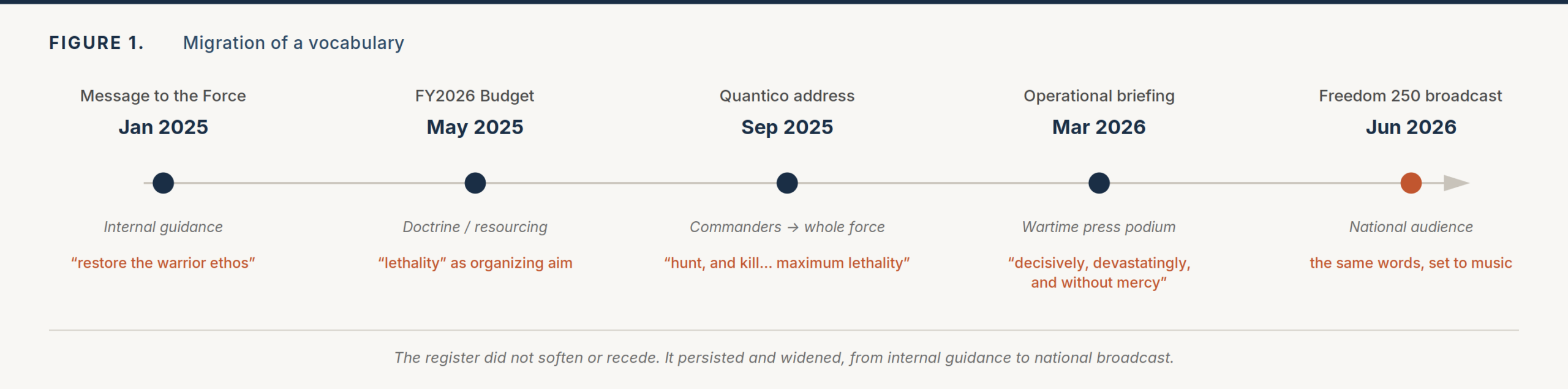
Brief 02: The Rhetoric of Lethality
The vocabulary of and toward the military has narrowed to a single attribute — and the person who carries it has been edited out.
Maximum lethality. Hunt, and kill. Without mercy. None of it is wrong — they are warfighters. But this brief traces where that register has worked, where it has failed, and what it asks of the people who must live inside it.