

Brief 02 · August 2026 · Quality-of-Life Brief
The Rhetoric of Lethality
What it signals, its use in history, and what it asks of the force if it continues
Over the past eighteen months, the vocabulary of and toward the American military leadership has shifted. This brief examines that shift. It does not assign motive, and it does not contest the right of civilian leadership to set the tone it deems necessary to meet the objectives it prioritizes. This brief asks a narrower and, for a force, more useful question: when has this kind of language appeared before, what does it produce, and what does it ask of the people who must live inside it.
The language around “lethality” and the current administration’s consistent use of “warfighter” is not incorrect or incongruent with what the force asks of its personnel. They are indeed warfighters, trained and capable of disciplined violence. However, this document warns that this message is incomplete and amplifies a single attribute as if it stands for the whole. The cost is that everything else the warrior is, the protector, the professional, the neighbor, the parent, the person who volunteered to serve and would enter violence only in the right context and for the right reasons, is edited out of the picture the institution presents, to the force and to the nation.
1 · The Signal
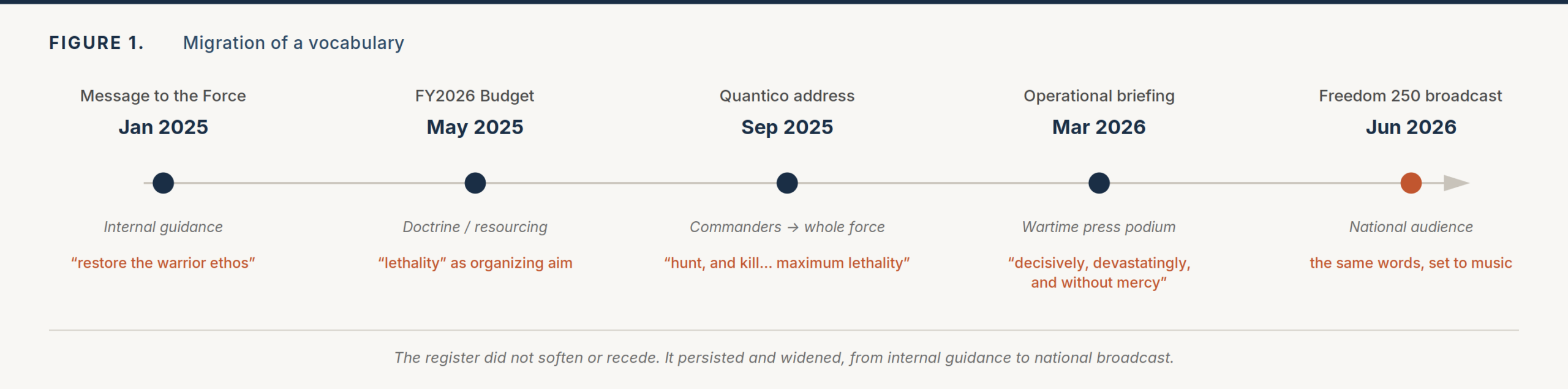
The language has compounded over the last eighteen months across the institution’s most formal channels. The 2025 Message to the Force in January 2025 introduced the language of restoring the “warrior ethos.” The Fiscal Year 2026 budget then built an entire chapter around the phrase and tied it explicitly to lethality as the organizing aim of personnel and readiness spending.1 The 2026 National Defense Strategy further framed the prior era as one that had “undermined our warfighters’ warrior ethos.”2
The fullest articulation came at Quantico on September 30, 2025, before nearly every general and flag officer in the force. The Secretary of War described the department’s purpose in plain terms: “We unleash overwhelming and punishing violence on the enemy.” He continued, “We also don’t fight with stupid rules of engagement. We untie the hands of our warfighters to intimidate, demoralize, hunt, and kill the enemies of our country,” and summarized the standard as “maximum lethality.”3 The address was then directed as required viewing or reading for every member of the force.
Read in full, the Quantico speech is more complex than its most-quoted lines. It invokes the constitutional oath repeatedly, calls for leaders who are “apolitical, faithful to their oath and to the Constitution,” quotes a combat memoirist on war as “brutish, inglorious, and a terrible waste,” and closes with a prayer for soldiers’ safety. The speech contains both registers, the protective and the predatory. What follows is the observation that matters: in the months after, it was the predatory register that was amplified, repeated, and eventually broadcast, while the protective frame stayed behind in the text.
2 · Where This Register Has Worked
Hard, martial language is not new, and it is not automatically a failure. It has built and steadied forces before. George S. Patton’s profane addresses to the Third Army are remembered because they worked, welding frightened men into a force that would move. The deliberate ferocity of Marine Corps recruit training forges cohesion under stress. The warrior framing of the 1980s helped rebuild a hollow, post-Vietnam Army into the force that executed the Gulf War. In each case the language did real work.
The common thread, when it worked, is that the language was aimed inward. It was directed at the people who would carry the cost, to steel them, to bind them to one another, to make them believe they could do a hard thing together. And it operated inside the professional constraints, the law of armed conflict, civilian control, the discipline that distinguishes a soldier from a brawler, rather than against them. Ferocity in the service of cohesion, bounded by restraint, is the warrior tradition functioning as designed.
3 · Where It Has Not
The same register has also produced strategic and moral failure, and the mechanism of failure is well documented. When martial language turns outward, into a theory of the enemy, and slips its constraints, discipline erodes. My Lai and the dehumanizing climate that enabled it, and Abu Ghraib and the documented line from a “gloves come off” command atmosphere to detainee abuse, are taught at the war colleges precisely because they show what happens when restraint is treated as weakness.4 The abuse at Abu Ghraib did not make the force more lethal. It became one of the most effective recruiting tools the insurgency had.
The combat psychiatrist Jonathan Shay, who spent decades treating veterans, stated the principle bluntly: “any ideology that debases the enemy endangers the lives of soldiers while they fight.”5 Dehumanizing language is not only a moral problem. Shay’s clinical finding is that it is a tactical liability to one’s own people, because a force that has loosened its internal restraints is a less disciplined force, and an undisciplined force loses the population, the legitimacy, and in the end the war.
This is also where one phrase deserves precision. “No quarter” and the refusal of mercy describe, in the law of armed conflict, conduct that is prohibited. When that language enters the register, it places the junior leader, the captain and the noncommissioned officer, between the words coming from above and the legal obligation they are sworn to uphold. The gap does not land on the podium. It lands on them.
4 · The Measure: Leading From the Rubble
There is a standard against which command language can be judged, and it comes from the American tradition itself. On September 14, 2001, standing in the wreckage of the World Trade Center with a bullhorn, President George W. Bush did three things in order. He stood with the people. He named their grief and their exhaustion and acknowledged the cost they were already carrying. And only then did he point them at the mission.6 The resolve he summoned was real because he honored the human being first. He led from the rubble, from the ground, alongside the people who would do the work, before he turned them toward the enemy.
There is no mission without the trust and loyalty of people. Lose that and the mission will fail. The mission begins with people.
Military Culture Shift
Measured against that standard, the current warrior-ethos language inverts the order. It leads with the mission and violence as identity, assuming this is the highest motivation of those being recruited and the human who bears the cost. The spouse is absent. The family is absent. The service member as a person, rather than as a weapon, is absent. “Untie the hands to intimidate, demoralize, hunt, and kill” names the act and erases the actor. This is the observation at the center of this brief: the language is not failing because it is too hard. It is failing because it omits the human step that, historically, made hard language work.
5 · The Whole Person and the Part
Every effective warfighter carries the capacity for controlled violence. They have to; a force cannot ask someone to close with an enemy who cannot reach that part of themselves. But in a healthy professional that capacity is situated. It switches on in the right context, for the right reason, under lawful constraint, and then it switches off, and the person returns to the protector, the leader, the parent. That oscillation is not a weakness in the warrior. It is the thing that makes the warrior trustworthy with violence in the first place. The discipline to come back is the whole point.
Shay’s clinical work names what happens when a person cannot come back. The fully activated combat self, what he calls the berserk state, “cuts the warrior off from all human community,” and when it is survived it can leave lasting damage to the capacity for ordinary life and ordinary virtue.7 The veterans who reintegrate well are generally those who could hold the combat self as a role they entered and then left, not as the whole of who they are. Fusion with the violent self predicts worse outcomes, not better ones. This is not soft observation. It is the consistent finding of the people who treat the wounds.
Place that finding next to the language. The Quantico address tells the force that warriors “don’t necessarily belong, always, in polite society,” and draws a line between the warrior and the civilian world to which he supposedly does not return. Language that asks the entire force, in peacetime, to make the predatory self the real self, and treats everything else as a softness to be shed, is asking people to live inside the one state the clinical literature says they most need to be able to leave. The service member who is told the hunter is who he or she truly is, and the rest is pretense, is being handed a smaller and lonelier identity than the one they volunteered for. He or she signed up to serve. The violence was always in service of the protecting. Invert that order and something is taken, even as they are told something is being restored.
Language that asks the entire force, in peacetime, to make the predatory self the real self is asking people to live inside the one state the clinical literature says they most need to be able to leave.
6 · Why the Language Goes Unchallenged
It would be easy to assume that experienced leaders hear this rhetoric and are motivated. The more likely response, among those who have actually been in combat, is caution. They know what the language points at. They know the activated state is a last resort entered under specific conditions, not a way to live. Their hesitation is not weakness or disloyalty. It is the judgment that experience produces.
The difficulty is that the language leaves no room for that response. The Quantico address offers the force a binary: “if the words I’m speaking today are making your hearts sink, then you should do the honorable thing and resign,” set against those whose “hearts are full.” Full or sinking. Warrior or quitter. The seasoned professional who is fully a warfighter and uneasy about saturating that identity in peacetime is not on the menu. The most grounded reaction available to a combat leader, situational caution, is defined out of existence by the choice on offer. The result is a force that finds it difficult to examine, in professional terms, the very language it is being asked to live inside.
Naming the binary is what dissolves it. The unease an experienced leader feels is not a sign that he is insufficiently a warrior. It is the professional judgment of someone who knows the difference between the instrument and the identity. The fact that the language implies only the uncommitted would feel that unease is itself the thing worth noticing.
7 · From the Command Tent to the South Lawn
In a March 2026 Pentagon briefing on an active operation, the Secretary of War opened by declaring that America was winning “decisively, devastatingly, and without mercy.”8 That exact construction now anchors a Department of War commercial released ahead of the UFC Freedom 250 event on the White House South Lawn, staged as part of the nation’s 250th-anniversary celebrations before an audience that is substantially military. The commercial narrates:
America’s military is unmatched… We will measure our success not only by the battles we win, but also by the wars we end, and perhaps most importantly, the wars we never get into. It’s called peace through strength… If you attack the United States of America, we will hunt you down and we will find you. Decisively, devastatingly, and without mercy.9
Two things are worth witnessing here, and they should be held together. First, the script contains its own restraint. “The wars we end… the wars we never get into… peace through strength” is the older tradition, the one that measures success by violence avoided. It sits in the same sixty seconds as “without mercy.” The commercial is not a single note. It is the whole tension of this moment compressed into one broadcast.
Second, and more important: the phrase “decisively, devastatingly, and without mercy” originated at a wartime operational podium, describing strikes on a real adversary. It has now been decoupled from that context and set to music for a mixed-martial-arts spectacle. The same words that a combat leader would use with care, about a specific enemy, in a specific operation, become the applause line of a national party. That decoupling is the phenomenon. The vocabulary persisted and widened, from internal guidance, to doctrine, to commanders, to a wartime briefing, to a broadcast stage, and then became, simply, the way the nation narrates itself to itself.
This is the inversion of the 9/11 bullhorn moment. The nation is being shown its service members as warfighters, and only as warfighters. The servant, the protector, the volunteer who would enter violence reluctantly and leave it cleanly, is not in the commercial, because the language being amplified has no place to put him.
8 · What It Asks, and What It Costs
The recruiting base. A register organized around the “highest male standard” and the warning that “weak men won’t qualify” narrows the aperture of who is invited to see themselves in service, at the precise moment the force faces a recruiting and retention challenge it can least afford. A force that needs more people is speaking in a way that addresses fewer of them.
The family signal. Brief 01 tracked the disappearance of the family from the institution’s vocabulary, from “asset” in the 1980s to near-absence today. The warrior-ethos register completes that erasure rhetorically. Notably, the institution’s own doctrine resists it: the FY2026 budget’s warrior-ethos chapter still, barely, includes “the well-being… of the families who support” the force.10 The language continues to shift as it consistently strips the family out. The gap between the two is itself a finding: the erasure is happening in the rhetoric, not yet in the policy.
The person. The deepest cost is borne by the warfighter. A vocabulary that celebrates the activated self as the true self, in peacetime, runs directly against what keeps people whole, the ability to enter that state and then leave it. The institution is setting, as an ideal, the precise identity configuration its own clinicians spend careers helping veterans loosen. That is not a partisan observation. It is a clinical one.
Closing
The institution has produced effective hard language before, and it knows how. The question for leaders is not whether to be lethal. Lethality, situated and disciplined, is the profession. The question is whether the language considers the people who must be capable of that level of lethality, and whether they are well served by a constant reminder of that single standard. Equally concerning, a nation that consistently receives briefings and campaigns showing only the warrior’s lethal side may eventually lose the ability to differentiate the warrior from the human it must reintegrate into society.
This brief does not prescribe a remedy, and it does not tell any leader what to feel. It offers only this: the unease that an experienced professional feels at hearing his calling reduced to its sharpest edge is not a failure of warrior spirit. It is the judgment of someone who knows that the edge was always meant to be drawn in service of something larger, and sheathed when the work is done. A force allowed to be only the edge has been told a smaller story about itself than the truth. Naming that may give people the words for why the language, for all its force, does not quite land.
Notes
- Office of the Under Secretary of Defense (Comptroller), Fiscal Year 2026 Budget Request Overview, Chapter 4, “Restore the Warrior Ethos,” 2025. ↩
- Department of War, 2026 National Defense Strategy, transmittal memorandum, January 23, 2026. ↩
- Secretary of War Pete Hegseth, remarks to general and flag officers, Marine Corps Base Quantico, Virginia, September 30, 2025. Full transcript. The address was subsequently directed as required viewing or reading for the entire force. ↩
- On dehumanization as an operational and moral liability, see Shay (1994); and the documented command-climate findings in the Department of the Army inquiries following Abu Ghraib (2004). ↩
- Jonathan Shay, Achilles in Vietnam: Combat Trauma and the Undoing of Character (New York: Scribner, 1994); and Odysseus in America: Combat Trauma and the Trials of Homecoming (2002). ↩
- President George W. Bush, remarks at the World Trade Center site, New York City, September 14, 2001. ↩
- Shay, Achilles in Vietnam (1994); Odysseus in America (2002). On reintegration and the holding of the combat self as a bounded role, see also the broader moral-injury literature building on Shay’s work. ↩
- Secretary of War Pete Hegseth and Chairman of the Joint Chiefs of Staff Gen. Dan Caine, Pentagon press briefing on Operation Epic Fury, March 4, 2026. ↩
- Department of War commercial released for UFC Freedom 250, White House South Lawn, June 14, 2026. Quoted from the released narration as transcribed by the author. ↩
- Office of the Under Secretary of Defense (Comptroller), Fiscal Year 2026 Budget Request Overview, Chapter 4, “Restore the Warrior Ethos,” 2025. ↩
The Culture Shift. · Corie Weathers, LPC · corieweathers.com/brief

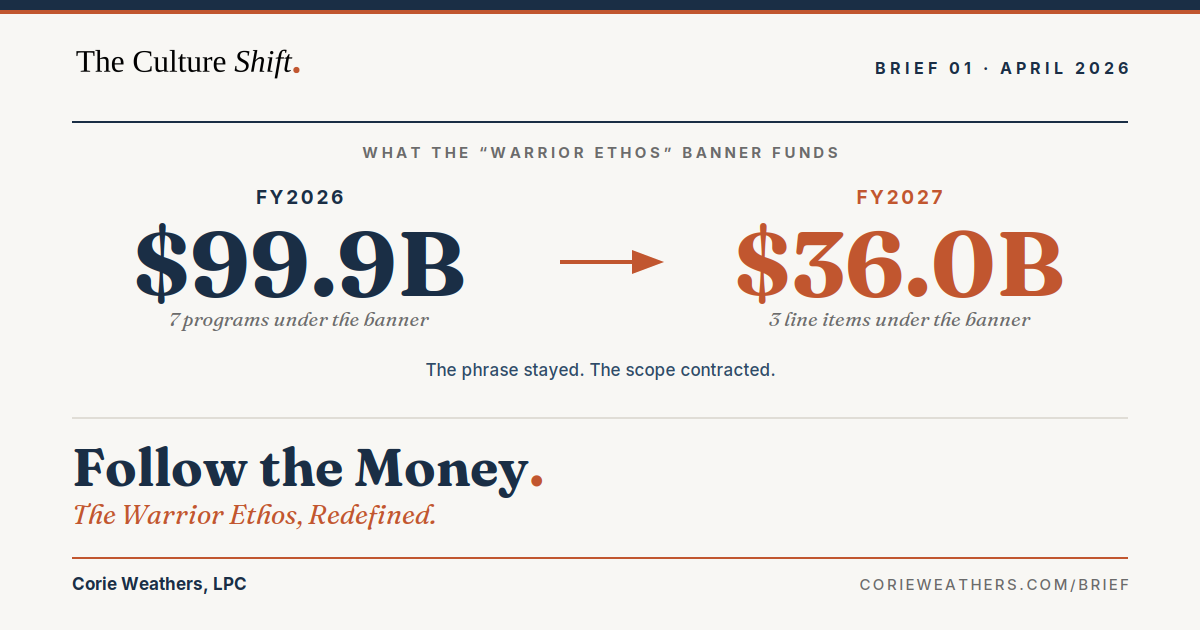
Brief 01: Follow the Money: The Warrior Ethos, Redefined
The FY2027 $350 billion mandatory defense request, and what the Warrior Ethos banner funds now.
The language calls it the Warrior Ethos. The scope has changed. This brief walks through three connected shifts in 2026 — in words, money, and how the institution treats the people who sustain the force — and what they mean for military families.